Digital Freight Forwarding for SME Importers
Small importers drive growth in digital freight forwarding platforms.
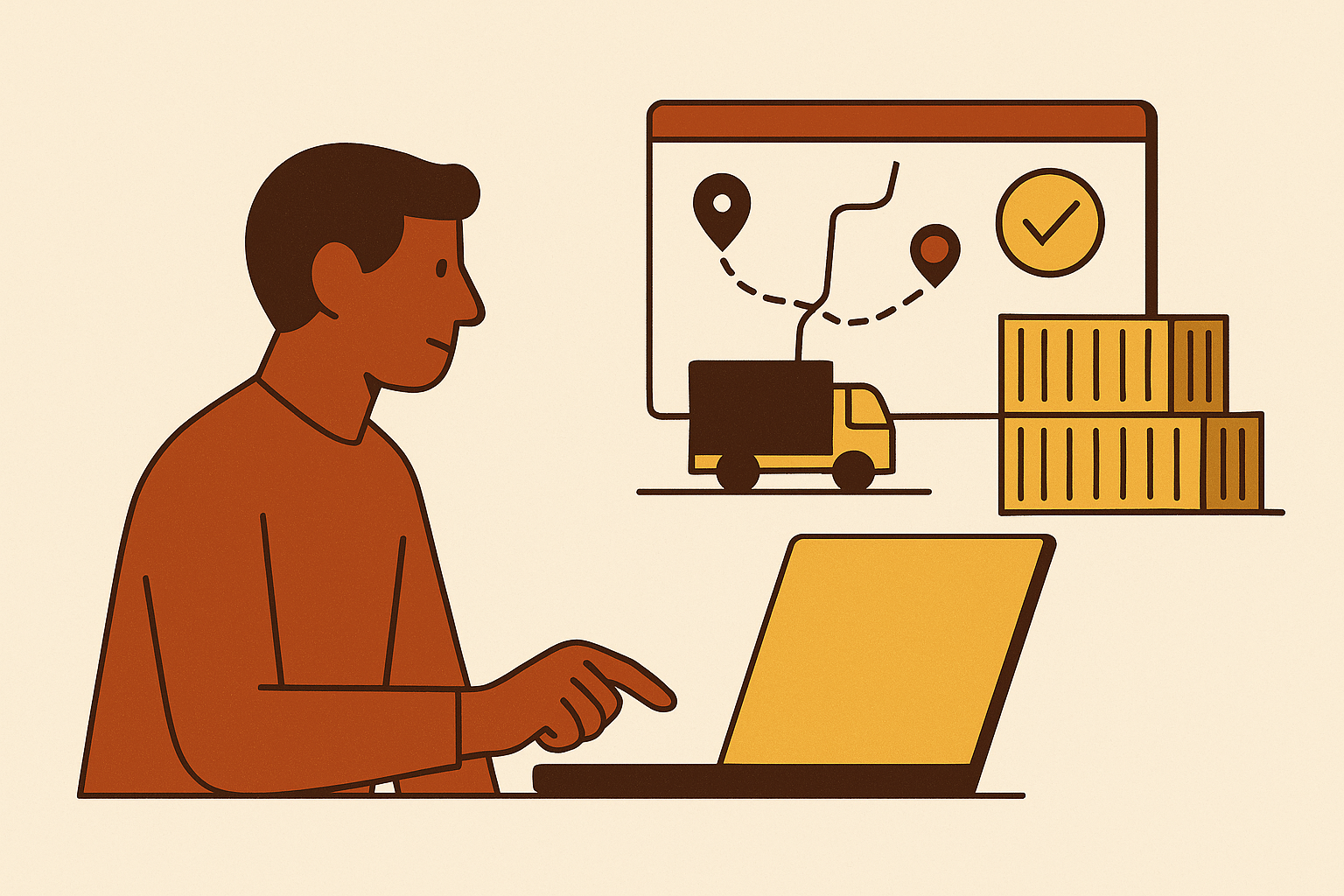
SME importers are now the majority of the digital freight forwarding market, holding 60.27% of it in 2025 and growing at 17.45% a year through 2031, according to Mordor Intelligence's 2026 numbers. The broader digital forwarding market, worth $33.6 billion in 2024 and headed toward $94.8 billion by 2030 per ResearchAndMarkets, is growing three to four times faster than traditional freight forwarding as a whole. What follows is a walk through what these tools actually do, where they quietly stop doing it, and how to figure out whether one fits your specific lanes and cargo before you commit a year of shipments to it.
What SME importers actually struggle with under traditional freight forwarding
Nearly all of them, 94% according to a Shipa Freight "Ship for Success" study, say they've run into real problems: documentation errors, customs delays, lost cargo, or just bad service from the people supposedly managing their freight. That's a big number for something that's supposedly a solved industry.
Four things show up over and over. First, information opacity: 79% of SMEs say getting timely, relevant shipment information is one of the main things they look for in a logistics vendor, and phone-and-email coordination fails that test constantly. You call, you leave a message, you wait, and meanwhile your container is sitting somewhere you can't see. Second, customs friction has gotten sharply worse: 72% of UK importers told the British Chambers of Commerce in 2024 research that navigating customs and volatile shipping costs is now a bigger headache than winning new customers, and paperwork is beating out sales as the thing keeping importers up at night.
Third, rate discovery. Without volume, SMEs don't get the same attention from carriers that big shippers do, and manually shopping rates across multiple carriers eats hours or days that a small business often doesn't have to spare. Fourth, there's a talent gap: FCL and LCL freight expertise isn't something you pick up over a weekend, and most SMEs can't justify hiring a specialist for it. They either train a generalist on the fly or go without, and digital platforms exist partly to fill that exact hole.
Traditional forwarders still handle the majority of freight by revenue, and for a lot of shippers they're still the right call. The point here is fit: these pain points hit small importers disproportionately hard, because a single customs delay or a lost shipment doesn't just cost money, it can wreck a quarter when your capital buffer is thin to begin with.
What digital freight forwarding platforms actually do — and what they don't
A digital forwarder is a company that uses cloud software, APIs, and some layer of AI to automate rate quoting, booking, paperwork, and tracking, while still moving your cargo through the same ports, ships, and trucks as everyone else. The physical supply chain hasn't changed; what's changed is the interface sitting on top of it.
On the platform side, you get instant rate comparison across carriers and modes, automated booking confirmations that don't require a human to relay information back and forth, and document generation for bills of lading, air waybills, and commercial invoices, where AI extraction cuts down a lot of the manual data entry that used to eat an afternoon. You also get real-time tracking, exception alerts when something's off schedule, and customs checks including HS code classification and duty estimates. Cloud deployment now runs 70.43% of the global market as of 2025, per Mordor Intelligence, and that's the architecture making the real-time visibility and API connections possible in the first place.
Here's what it still doesn't touch. Physical handling, warehousing, and last-mile delivery still need people and trucks and forklifts; software doesn't unload a container. Complex compliance calls, like sanctions screening or dual-use goods classification, still need a human with judgment and legal exposure on the line. When something actually goes wrong at a port, the kind of problem that needs a phone call to someone who knows the terminal manager, that's still a relationship business. And specialized cargo, hazmat, temperature-controlled, oversized freight, gets treated very differently platform to platform; some accept it online, most punt it to a human agent.
This is the part of the conversation that separates people who end up happy with a digital forwarder from people who end up annoyed. If you assume the platform replaces judgment and relationships entirely, you'll be disappointed the first time something breaks.
The specific advantages that matter most to SME importers
Cost is the obvious one, but the numbers are worth sitting with. Instant rate comparison tools can save 15% to 30% on freight costs, per FreightAmigo's 2026 figures, and that's most visible when fuel prices are jumping around. Cutting manual internal processes, the back-and-forth of chasing quotes and re-entering the same shipment data three times, saves a similar 15% to 30% in operational overhead for shippers who move freight regularly, according to ExFreight's 2026 numbers. An enterprise shipper with a procurement department barely notices savings like that, but an SME running on a thin margin notices immediately.
Customs automation is the other big one. AI-powered platforms are cutting manual customs work by up to 80%, which matters enormously for a business that has no in-house customs broker on staff. And it's not just the platforms getting smarter: U.S. Customs and Border Protection now uses AI itself to analyze trade flows and cross-check declarations, which means an automated filing on your end is increasingly being reviewed by an automated system on the other end. The 2025 Descartes Forwarder & Broker Benchmark Study, which surveyed 434 logistics professionals across North America, EMEA, Asia-Pacific, and Latin America, found 55% of forwarders are prioritizing AI investment over the next two years. That's money being spent right now, not a future promise.
Visibility changes the day-to-day experience more than people expect. Real-time tracking means you're no longer the person calling a shipping line asking "where is my container" and getting put on hold. Flexport's 2024 system updates, which added automatic notifications and predictive delay analysis, reportedly made clients 30% more operationally efficient, according to SkyQuest's reporting. And underneath all of it sits the real SME-specific argument: you get access to competitive rates and a working logistics operation without hiring a shipping department to run it. That's the trade: you're renting infrastructure instead of building it.
Where digital platforms still fall short for SME importers
So where does this actually break down? Start with lanes. Big platforms optimize for the busy corridors, Asia to North America, Asia to Europe, because that's where the volume and the carrier relationships are thickest. If you're importing from Southeast Asia's smaller ports, Latin America, or sub-Saharan Africa, you'll often find fewer carrier options, weaker rates, and tracking that's more of a suggestion than a fact. Ask for a live quote on your actual lane before you assume anything, and don't take the homepage's word for it.
Specialized cargo is the next wall. Hazardous materials, refrigerated goods, oversized freight, live animals, these mostly fall outside the standard automated workflow and get routed to a human, if the platform accepts them at all. Coverage here varies enormously and it's worth asking directly rather than guessing.
Compliance automation has limits too. HS code classification and duty estimates work fine for standard, boring goods, but they get shakier fast on anything with dual-use classifications, country-specific quotas, or tariff schedules that keep moving. In the Descartes 2025 study, a quarter of logistics professionals, 25%, named manual workflows as their biggest obstacle to growth, which tells you plainly that the "fully automated" pitch has real limits, even at the professional level.
Support quality is uneven, and this is where SMEs get burned the most. Some platforms are built as pure self-serve portals, and when something goes sideways, the escalation path can be slow or genuinely unclear. Low shipment volume often means you don't get a dedicated account manager either; that attention goes to the accounts moving the most containers, which, fair enough, is how business works, but worth knowing going in. Then there's integration friction: connecting a platform's API into your existing ERP, inventory system, or Shopify store takes real technical work, and SMEs consistently underestimate that at onboarding, the software equivalent of buying furniture that says "easy assembly" on the box.
How to evaluate a digital forwarder for your specific trade lanes and cargo
Start with lanes and modes, not features. Get live quotes on your actual origin-destination pairs before you look at anything else the platform offers; a beautiful dashboard means nothing if the platform barely serves your route. Check FCL and LCL coverage separately if your volumes swing month to month, since platforms are often stronger on one than the other, and if your cargo needs air freight, confirm that coverage explicitly, because air tends to vary more sharply between platforms than ocean does.
Test rate transparency the hard way. Ask for the full landed-cost breakdown: origin charges, ocean or air freight, destination charges, customs fees, and final delivery, not just the headline number that looks good in an email. Then run the same shipment past a traditional forwarder for comparison. That's the only way to know if the "savings" are real or just a favorable quote on paper.
On compliance, ask the uncomfortable question directly. For standard goods on major lanes, automated HS classification is table stakes at this point and not much of a differentiator. For anything complicated, ask whether a licensed customs broker actually reviews the filing or whether it's submitted fully on autopilot, because that answer determines who's liable when it's wrong. If you're bringing goods into the U.S., ask specifically about tariff change monitoring, Section 301 exposure, and whether there's a duty drawback tool built in.
Look closely at what "visibility" actually means on a given platform. Is it milestone tracking, departed, arrived, cleared customs, or genuine live GPS and vessel tracking? Those are very different products wearing the same word. And ask what happens when a shipment gets held at customs: who do you call, and what's the actual response time promised in writing? For a business that ships once a month, not knowing the answer to that question is a real risk, not a minor inconvenience.
The main platforms SME importers are using and how they differ
Flexport is the biggest name in the space, with estimated 2024 revenue around $2.1 billion according to Sacra and Contrary Research. It's strongest on Asia to North America ocean and air lanes and carries the broadest carrier network among the digital-native players. In February 2025 it rolled out more than 20 AI tools, including Flexport Intelligence for natural-language queries on shipment data and a Control Tower feature that gives visibility even into freight it isn't managing directly. Its fall 2025 release added an AI compliance agent that reviews past customs filings for errors and recovers refunds, with duty drawback recoveries reportedly running at roughly double what other brokerages deliver. Worth knowing: Flexport's valuation peaked at $8 billion post-money during its $935 million Series E in February 2022, and secondary market pricing had dropped meaningfully by mid-2025. That's context if you're thinking about a multi-year dependency on any single vendor. Flexport tends to fit SMEs with growing, meaningful volume better than occasional shippers, given its pricing tiers.
Freightos, through its WebCargo platform, runs more like a marketplace than a managed forwarder: it aggregates rates from hundreds of carriers and forwarders so you can compare instantly. It's genuinely good for rate shopping and fast booking, less so for hands-on managed customs work. If your main need is transparency on price rather than someone managing the whole shipment for you, this is worth a look.
Tools like project44 sit in a different category entirely: they're visibility and analytics layers that plug in alongside an existing forwarder relationship rather than replacing it. Useful if you already like your forwarder but want better tracking and alerts on top.
Regional and specialist digital forwarders, names like Shipa Freight, Twill, or iContainers, tend to be stronger on specific corridors and often provide more accessible support for lower-volume shippers who'd get lost in an enterprise account structure elsewhere. Lane coverage, cargo type, and how badly you need a human on the phone should drive the decision, not brand recognition.
The decision most SME importers actually face: digital-only, hybrid, or augmented traditional
Digital-only makes sense if you're shipping often on established lanes with standard cargo, and if someone on your team is comfortable navigating a self-serve platform without hand-holding. It's also the right call if what you need most is rate transparency and predictable cash flow, since that's exactly what these platforms are built to deliver.
A hybrid approach, using a digital platform for the routine stuff and keeping a traditional broker on call for the complicated moves, fits SMEs whose shipments aren't uniform: mostly standard freight with the occasional hazmat shipment, perishable goods, or a supplier in a market the big platforms barely touch. It also makes sense if your compliance exposure runs high, say you're importing categories facing heavy tariff scrutiny, where the cost of a mistake outweighs the convenience of full automation.
There's a third option too, doubling down on a traditional forwarder but pushing them to adopt more of the tech: better tracking dashboards, digital document handling, faster quote turnaround. Some traditional forwarders have gotten genuinely good at this, and for an SME with a long-standing relationship and a broker who already knows their business, that might beat switching to something new entirely.
None of these three is objectively better, and the honest answer depends on your lanes, your cargo, your compliance exposure, and how much risk you can absorb if something goes wrong at 2 a.m. on the other side of the world. What the growth numbers at the start of this piece suggest is that the evaluation itself has become unavoidable. Ten years ago an SME importer could reasonably ignore digital forwarding as an enterprise toy; that window has closed.