Instant Ocean Freight Quoting Platforms Explained
Software replaced the email-and-coffee dance of ocean freight quoting with seconds.

A container ship doesn't care how fast your quote came together, but your CFO does. That's the entire premise behind instant ocean freight quoting: rate lookups that return in seconds instead of days, replacing a request-wait-negotiate cycle that used to eat a week. The pitch is simple. What's underneath it, where the rate data comes from, who built the pipe, and why the number on your screen is sometimes wrong anyway, is where this piece actually lives.
Here's how the old way worked, and I mean this literally, because I watched forwarders do it by hand for years. A shipper calls a forwarder, the forwarder emails five or six carriers, and then somebody waits by the inbox and follows up when nothing happens. Rates trickle back at different times, in different formats, with surcharges disclosed whenever the carrier felt like mentioning them, and the forwarder stitches all of it into something presentable while days tick by. The rate data itself lived nowhere in particular: PDFs, an Excel sheet somebody updated by hand every so often, a carrier portal that only one guy on the team knew the login for. No single source of truth meant every quote request turned into its own little research project.
Then there's the surcharge problem. Bunker Adjustment Factor, Currency Adjustment Factor, Terminal Handling Charges, peak season add-ons, congestion fees, each one often quoted separately, sometimes disclosed late enough that the number a shipper thought they'd agreed to had already moved by the time the invoice showed up. Industry data has pointed to hidden or unexpected charges appearing in roughly 60% of shipments. That's closer to a coin flip you didn't know you were making.
Even a genuinely skilled forwarder hits a ceiling here; a person can only manually process so many quote requests a day before pricing errors creep in and margin management turns into guesswork. Shippers lost more than time. They lost the ability to compare carriers or routes with any real confidence, because nobody was putting a clean, apples-to-apples picture in front of them. This was baked into an industry valued at roughly USD 225.4 billion globally in 2025. Multiply a small daily inefficiency by an industry that size and you get a genuinely absurd amount of wasted time and margin.
What instant ocean freight quoting platforms actually do
Strip away the sales deck and the function is narrow: pull carrier rate data from multiple sources, normalize it into one structure, hand back a complete, sellable quote in minutes instead of days.
Platforms pull rate data straight from carrier APIs, from uploaded rate sheets in PDF or Excel form, and from email feeds that get parsed automatically. Surcharges get normalized so a BAF quoted by one carrier actually lines up against a BAF quoted by another. Validity dates and General Rate Increases get tracked so nobody's working off a rate that expired last Tuesday. The quote itself gets assembled by software instead of a person copying numbers between spreadsheet tabs at 6pm on a Friday.
A full instant quote, done properly, covers the base freight rate port-to-port, plus BAF, plus CAF, plus THC, plus whatever hazmat, peak season, or congestion surcharges apply to that particular lane. FCL and LCL get handled differently under the hood, too: FCL prices a full 20 or 40 foot container, while LCL prices shared container space by unit of cargo, so the rate logic for LCL has to account for consolidation in a way FCL never touches.
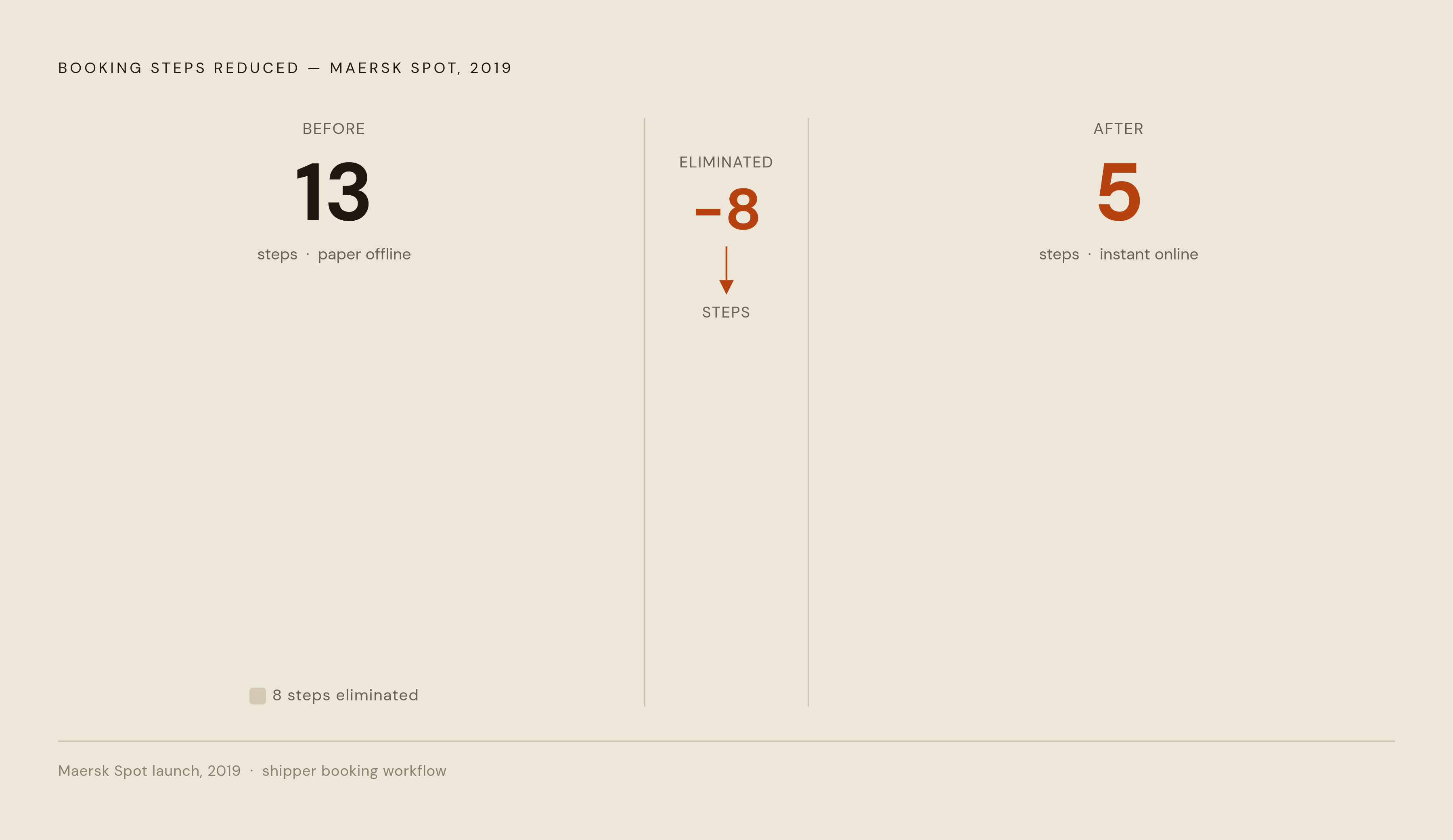
Maersk gave the industry a useful before-and-after when it launched Maersk Spot in 2019. What had been a 13-step offline process, involving actual paper, got compressed into five steps online. That's eight structural steps gone from a workflow, and it's the kind of change that shows up directly in how fast a shipper gets a bookable number.
One thing to flag before going further: these platforms don't all serve the same person. Some are built for shippers, some for forwarders, some for procurement teams staring down a contract renewal. Treating them as one category is where most of the confusion starts.
The three distinct platform types and which problem each one solves
Three categories, three different users, three different jobs. Mixing them up is the fastest way to buy the wrong tool and then blame the tool.
Benchmarking platforms answer one question: are the rates I'm being offered actually competitive? Xeneta is the clearest example, aggregating real contracted and spot rate data across a large base of shipments to produce market intelligence rather than a customer-facing quote. The user here is procurement or logistics leadership sitting across the table from a carrier during negotiation, not an ops person trying to book next week's container. Xeneta tells you whether the number in front of you is good or bad.
Operational quoting platforms sit on the forwarder side and answer a different question: how do I quote my customer faster and more accurately than the guy down the street? Freightify pulls ocean and air carrier rates onto one screen for forwarders, with a white-label portal they can hand off to their own customers; it fits mid-sized forwarders that are growing and need to price faster without hiring six more people. Okargo goes narrower on purpose. Pure ocean, connects directly into major carrier portals, delivers quotes in under 30 seconds. It processes more than 4,000 rate sheets a month for over 150 independent forwarders, and it deliberately stays out of booking and air freight. Cargofive does ocean rate management plus AI-driven contract processing across multiple shipping lines, and got folded into cargo.one in February 2026, becoming part of a broader multimodal stack rather than a standalone tool. The limitation running through this whole category: the forwarder gets faster, but the shipper is still going through a middleman to get a number.
Shipper-facing marketplaces cut that middleman out entirely and answer: where do I find and book a rate right now, without a logistics degree? Freightos serves more than 10,000 importers and exporters with instant quotes and online booking. SeaRates, owned by DP World, calls itself the largest tariff search engine in international shipping and returns carrier rates in seconds. iContainers gives instant FCL and LCL quotes across carriers, pulling from a pool of 250,000 ocean freight rates. All three share the same design principle: built to work without a freight professional standing between you and the price.
The real question before picking any of these isn't which platform is "best." It's which of the three jobs, intelligence, quoting speed, or direct booking, your team actually needs done this week.
How carriers themselves have built instant quoting into their own portals
Worth pausing here, because this is where rate data actually originates. Everything the aggregators and marketplaces show you traces back eventually to a carrier deciding what to charge, and increasingly, carriers are cutting out the middleman on their own platforms too.
Hapag-Lloyd's Quick Quotes tool takes a route, container type, and commodity, and returns a freight quote in about 30 seconds, inland legs included. OOCL's FreightSmart offers instant, fixed-rate quotes and bookings across the carrier's more than 180 weekly services worldwide, and it hit its fifth year in 2025. That's a real, sustained bet with a track record.
CMA CGM's SpotOn is the most aggressive of the three. It turns spot pricing into a fully digital, dynamic process: the price is guaranteed for 24 hours, extendable via a Lock My Price add-on, priority booking confirmation lands within a few hours, and you get priority space and equipment release. More than 60% of CMA CGM's spot volume now runs through SpotOn, which makes it the dominant channel for that carrier's spot business.
That number matters for how you should think about aggregator platforms generally. If more than 60% of one major carrier's spot volume flows through its own portal, any third-party tool not connected to that specific API is showing you an incomplete picture, full stop. Carrier-native tools are fast for a single carrier, but they can't help you compare five carriers at once, and shippers rarely want to log into five separate portals just to sanity-check a rate. That's the actual case for aggregation, and it's held up.
How AI is changing the rate data pipeline behind the quote
Before any of this got automated, rate data showed up the way it always had: PDFs, Excel attachments, email bodies, all of it needing a human to read it and retype it somewhere useful before normalization could even begin. That manual extraction step was the real bottleneck.
What AI-assisted ingestion changes is that machines now read those unstructured documents directly, a PDF rate sheet, a spreadsheet buried three attachments deep in an email, and pull the numbers out without a person copying anything by hand. Validity dates and GRI schedules get flagged automatically, which keeps a rate database current without someone running a manual check every Monday morning. Starting around 2025, providers began moving these tools into the actual user interface instead of keeping them purely back-end, so the person using the platform can see and correct what the AI pulled out rather than trusting a black box.
Dynamic pricing is the other half of it. iContainers describes its system as continuously analyzing real-time shipping data, so the quote reflects current market conditions instead of a static rate loaded three days ago. Some platforms are pushing further into predictive pricing, using machine learning to forecast which direction rates are heading. Genuinely useful for timing a procurement decision, and genuinely hard to verify independently for accuracy. Nobody's published the kind of track record yet that lets you take those forecasts at face value.
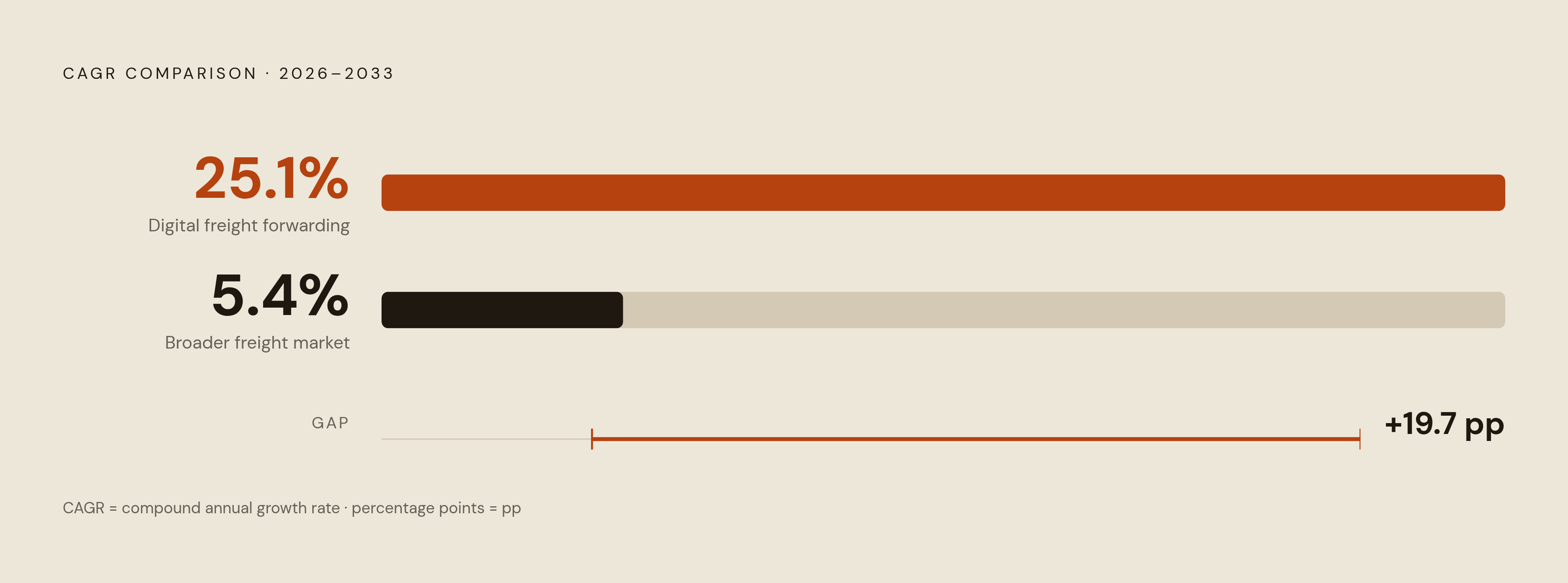
The digital freight forwarding segment where all this AI investment is concentrated is growing a lot faster than freight forwarding overall: a projected compound annual growth rate of 25.1% between 2026 and 2033, against 5.4% for the broader forwarding market. That gap is basically a map of where the money and the engineers are headed.
A sudden port closure, a geopolitical shock, a capacity crunch nobody saw coming, none of this reliably gets solved by AI, since there's no historical pattern to learn from. AI reads yesterday's PDF just fine. Tomorrow's Suez Canal is a different matter.
Where instant quotes are still unreliable and why
The marketing rarely mentions any of this, so somebody should.
A quoted rate assumes a container is actually sitting at origin ready to go. Real equipment availability varies by lane and by week, and an instant quote has no way of knowing the container you need is three ports away. Carrier capacity works the same way: an instant quote tells you a price, not that space is guaranteed. Some platforms address this head-on, SpotOn's priority loading commitment being the clearest case, but most instant quoting tools won't guarantee you a slot on the vessel just because they handed you a number.
Seasonality adds another layer of noise. Rates spike predictably from August through October as retailers stock up for the holidays, and again before Chinese New Year in January and February as factories rush to ship before shutting down for weeks. The pattern is well documented; the size of the spike isn't. It varies year to year, which makes quoting weeks in advance a bit like predicting exactly how bad Thanksgiving traffic will be: you know it's going to be bad, you just don't know if it costs you one hour or three.
Local charges are the sneaky one. Origin and destination fees often get quoted separately, or left off the headline number entirely, which quietly brings back the hidden-cost problem instant quoting was supposed to kill in the first place. A platform is also only as current as its last update. If a carrier files a GRI and the platform hasn't ingested it yet, you're looking at a quote that's already wrong the moment it lands on your screen.
Coverage gaps round this out. No platform covers every carrier on every lane, and niche or regional routes tend to have thin coverage, meaning fewer options and wider price swings than you'd see on a major trade lane like Shanghai to Los Angeles. An instant quote also can't tell you whether the number is good, only what it is. That's exactly the gap benchmarking platforms like Xeneta exist to fill, which is why a lot of procurement teams run both types side by side instead of picking one. Xeneta's own tender data has shown rates landing 23% below the long-term market benchmark after structured negotiation, a pretty strong signal that speed alone doesn't capture the savings. Instant quoting gets you a number fast; negotiating a better one is still separate work.
How logistics and procurement teams should fit these platforms into their workflows
Whether you're shipping spot or under contract changes which platform actually matters to you, and that's probably the first fork in the road.
For spot freight, shipper-facing marketplaces or carrier-native portals get you to a bookable rate fastest, full stop. For contract freight, the sequence flips: benchmarking platforms inform what you negotiate for, and operational quoting platforms help your forwarder respond to RFQs without drowning in spreadsheets.
If you're a mid-sized forwarder, a tool like Freightify or Okargo lets you answer customer inquiries at a speed that used to require a pricing team twice your headcount. That's a real competitive shift. Smaller forwarders can now quote at roughly the pace of the big players, which wasn't true five years ago and would have sounded like a joke ten years ago.
If you're a shipper without in-house logistics expertise, a marketplace like Freightos hands you a real comparison in seconds, not days. One Freightos user described getting 20 quotes back roughly 15 seconds after clicking submit, which is about as concrete a picture of "instant" as you're going to get.
For procurement teams, pairing a benchmarking tool with an operational quoting platform covers both halves of the job, intelligence and execution, and neither one alone gets you there. Retail and e-commerce teams have the most riding on getting this combination right: that sector made up 36.48% of the U.S. digital freight forwarding market in 2025, which tracks with how dependent high-volume importers are on rate speed and tight cost control.
Before signing up for anything, ask a handful of pointed questions. Which carriers and lanes does the platform actually cover, and where does that coverage thin out? How often does rate data refresh, and what happens the day a GRI drops? Does the quoted price include local charges, or does the real all-in cost get assembled somewhere else, later, once you've got less room to negotiate? Does booking through the platform actually guarantee space, or is that a separate confirmation you're still waiting on? Is market intelligence built into the tool, or is that a whole separate subscription you'll need to bolt on?
One last structural point worth keeping in your back pocket: Asia-Pacific leads global adoption of digital freight forwarding, holding a 40.24% share of that market in 2025. If you're managing trans-Pacific or intra-Asia lanes, you're operating in the region where this technology is already most mature and where prices move fastest. Real-time rate tools are closer to table stakes there than optional extras.