Supplier Discovery with Generative AI Models
AI replaces keyword search with semantic discovery, fundamentally changing how suppliers are found.
Generative AI is not augmenting supplier discovery. It is replacing the underlying logic of how it works. Procurement teams that understand the mechanics of that replacement, not just the marketing claims around it, are the ones capturing genuine efficiency and resilience gains. The rest are buying software and wondering why the needle failed to move.
The pressure to change is real and accelerating. Tariff volatility, export controls, onshoring mandates, and local content requirements have made supplier network diversification an urgent operational problem, not a strategic aspiration. Everstream Analytics places geopolitical fragmentation and the strategic weaponization of trade regulations at a 97% threat level for 2026, with semiconductors, critical minerals, and pharmaceuticals among the most exposed categories. Industry surveys show 78% of supply chain leaders anticipate disruptions worsening over the next two years, yet only 25% feel prepared for them; however, the source of these figures should be explicitly cited before relying on them. That gap between exposure and readiness is the problem generative AI is being asked to solve — and in the hands of teams who understand what it actually does, it solves a meaningful portion of it.
Where Generative AI Fits Inside the Broader Procurement AI Market
The AI procurement market is large and expanding fast: valued at $3.32 billion in 2025 and projected to reach $39.20 billion by 2035, compounding at 28% annually, per Precedence Research. Inside that market, supplier management and identification is the dominant segment, accounting for roughly 25% of the total in 2025, per Precedence Research. Supplier discovery is not a niche application. It is the single largest AI use case in procurement today.
Adoption signals are strong but uneven in ways that matter. According to AI at Wharton, 94% of procurement executives are using generative AI at least weekly, a 44-percentage-point jump from 2023 to 2024. EY's 2025 Global CPO Survey found 80% of global CPOs planning to deploy generative AI within three years. Yet that same survey puts meaningful implementations at only 36% of procurement organizations. Deloitte's 2024 Global CPO Survey reported 92% of CPOs planning or assessing generative AI capabilities, while only 37% had actually piloted or deployed anything at the time of the survey.
Investment is accelerating to close that gap. Deloitte found that 22% of CPOs planned to spend $1 million or more on generative AI capabilities in 2025, more than double the 11% who crossed that threshold in 2024. The money is moving. The capability is lagging. That gap between intent and execution is the defining characteristic of this moment in procurement AI, and it exists for reasons that are organizational rather than technological.
How Generative AI Actually Searches for Suppliers: What Happens Under the Hood
Traditional procurement search is fundamentally keyword-dependent. It finds what you already know to ask for, and it misses suppliers who describe themselves in adjacent language, operate across category boundaries, or simply haven't optimized their database listings for your search terms. This is a structural limitation, not a resourcing problem. More analysts running the same keyword searches fails to fix it.
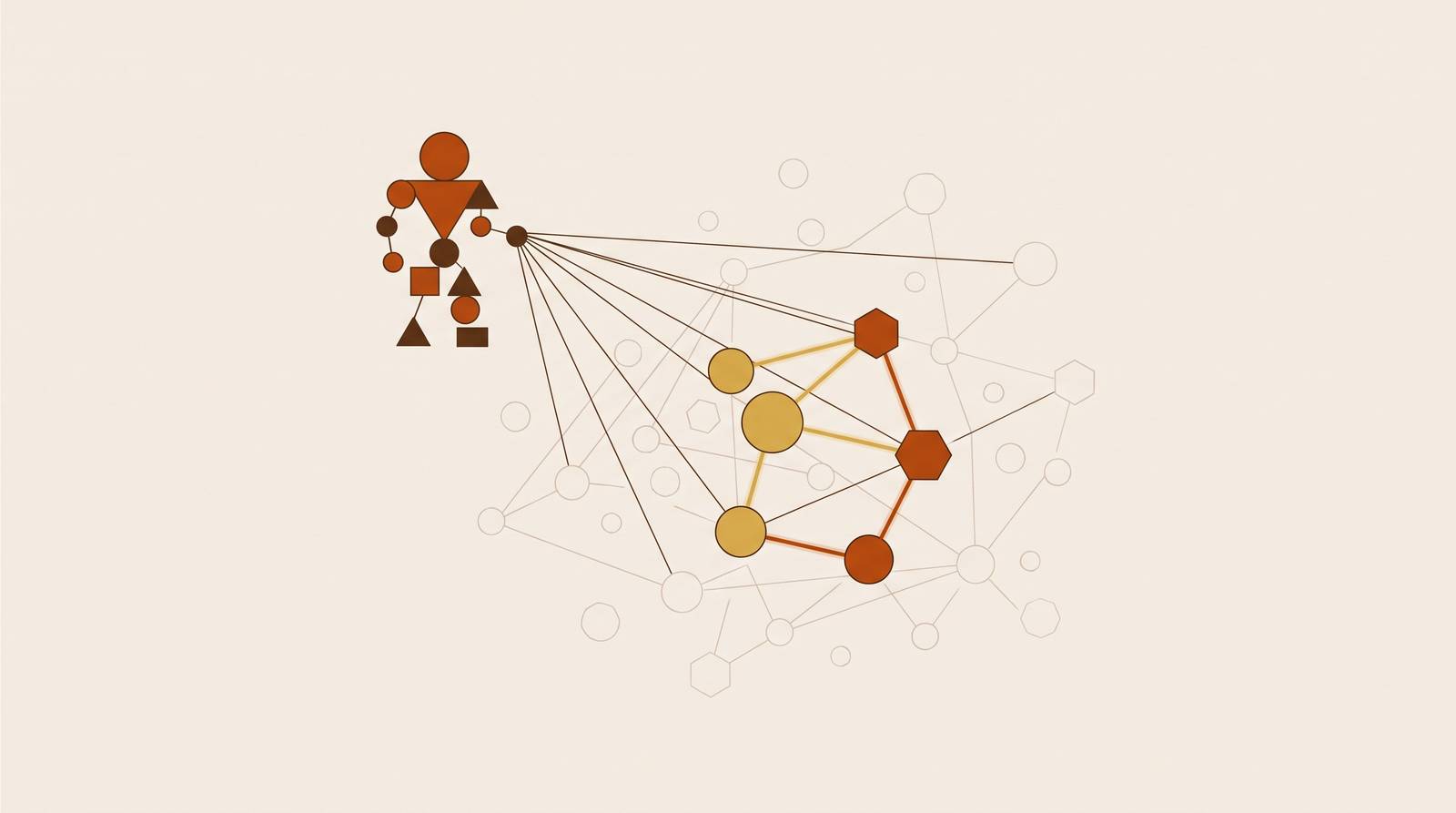
Generative AI replaces keyword dependency with capability-based, semantic search. A procurement professional describes a product, service, or requirement in plain language. The model interprets capability adjacencies: a supplier described as specializing in precision CNC machining of metal alloys gets surfaced as relevant for stainless steel component manufacturing without requiring that exact phrase. Large language models can also ingest publicly available data and cross-reference it against what are sometimes called "seed companies," incumbent suppliers with known capabilities that anchor and calibrate the search.
The scanning scope is qualitatively different from anything a manual process can achieve. Enterprise platforms pull from proprietary, public, and commercial databases covering millions of suppliers, refreshed on a continuous basis. Conversational search adds another dimension entirely: a buyer can ask a natural language question, receive ranked results with reasoning attached, and refine the query in real time rather than rebuilding a structured search from scratch.
Oracle Fusion Cloud's "Discover New Suppliers" feature illustrates what enterprise-grade implementation looks like. The system surfaces suppliers who are not registered in the buyer's own system but possess relevant capabilities. A buyer can register and invite them to a negotiation event directly from the interface, collapsing the distance between discovery and action.
McKinsey reported a case involving a fitness equipment manufacturer adding audio and video capabilities to its product line. The company deployed AI-driven discovery and identified nearly 90 potential suppliers in three days, many of them from industries the procurement team had not previously considered. That is not a faster version of the old process. That is a structurally different process.
How AI Evaluates and Shortlists Suppliers Once It Has Found Them
Volume without evaluation is noise. Surfacing 90 potential suppliers is only valuable if the next step is rigorous, fast, and accurate. This is where the evaluation layer earns its place.
AI risk scoring synthesizes signals that would take a human analyst days to compile: financial and credit records, litigation and sanctions data, certification status, ownership structure, historical performance. All of it collapses into a composite score that updates continuously as new information arrives. The advantage isn't just speed. It's that the score doesn't degrade between review cycles the way a quarterly audit does.
Diversity tracking deserves specific attention as an evaluation capability. AI can link a supplier's certification to a persistent business identifier, detecting ownership changes, certification lapses, or post-merger restructuring in ways that manual compliance checks reliably miss. For organizations with diverse spend reporting obligations, this is not a convenience feature. It is a data integrity requirement.
Scenario modeling extends evaluation into the future. Before a commitment is made, AI can simulate potential outcomes of engaging a specific supplier, factoring in market trends, geopolitical risk exposure, and supply chain dependencies. This moves evaluation from a backward-looking audit function to a forward-looking decision support tool.
Autonomous tender and prequalification workflows represent where evaluation is heading. McKinsey documented a pilot at a chemicals company where AI agents automated tender preparation, supplier prequalification, and bid analysis, with a separate agent routing and synthesizing supplier queries during the sourcing exercise. Human judgment was applied at decision points, not administrative steps.
The fitness equipment case completes the arc. Nearly 90 suppliers identified in three days, reviewed down to a shortlist of roughly a dozen through systematic AI-assisted evaluation. The discovery layer generated the candidate pool. The evaluation layer made it actionable.
What the Performance Data Actually Shows About Speed and Cost Gains
McKinsey's top-performer analysis is the right place to start. Organizations that keep their supply bases continuously calibrated through AI-driven discovery achieve cost positions 5 to 10% lower than peers and carry 20 to 50% less exposure to key supply risks, including single-supplier dependency, per McKinsey. These are not one-off project savings. They compound through a better-constructed, more resilient supply base.
BCG puts the cost reduction range wider for specific categories: 15% to 45%, alongside elimination of up to 30% of manual work for procurement employees, per BCG. At the operational level, McKinsey reports a 10% reduction in operational costs and a 30% acceleration in supplier selection speed among teams using AI-driven decision-making.
Some early implementations have reported exceeding 5x ROI, per ZBrain. These figures come from self-selected early adopters in favorable categories — organizations with clean data, clear criteria, and integrated systems. The full population of implementations will see a wider range, and these figures should not be treated as representative averages.
KPMG's analysis that 50 to 80% of current procurement work can be automated, eliminated, or transitioned to self-service models frames the longer-term potential. The gap between today's 36% meaningful deployment and that ceiling is what organizations are actively navigating. The potential is real. The distance to it is also real.
The Vendor Landscape and What Different Platforms Are Actually Built to Do
The market has differentiated by use case rather than converging on a single platform, which is important when choosing where to invest.
Scoutbee, acquired by Coupa in October 2025, offers natural language search against a database of more than 6 million suppliers. Its integration into Coupa's network of more than 10 million buyers and suppliers makes the combined platform a large discovery-and-transaction infrastructure. The acquisition signals where the market is heading: consolidation around ecosystems that connect discovery, onboarding, and transaction without handoff friction.
Globality is purpose-built for services procurement, where interpreting requirements rather than matching product specifications is the genuinely hard problem. Describing what you need from a consulting engagement or a managed service is categorically different from specifying a component, and most discovery tools aren't designed for that ambiguity.
TealBook focuses on supplier data enrichment and diversity tracking, functioning primarily as an evaluation and compliance layer rather than a discovery engine. Fairmarkit integrates tail spend discovery with autonomous sourcing events, scanning hundreds of thousands of suppliers globally and matching them through AI-powered scoring.
Accio, launched by Alibaba in late 2024, reported more than 10 million monthly active users by March 2026. It is strongest in SME and e-commerce sourcing contexts and is expanding into RFQ and negotiation workflows through its Accio Work offering.
Enterprise suites, including SAP Ariba, Oracle Procurement Cloud, Jaggaer, and GEP Smart, are embedding discovery AI into broader procurement workflows rather than positioning it as a standalone capability. For organizations already running on these platforms, the discovery investment arrives as part of an infrastructure they've already committed to.
The practical guidance here is simple: choose based on your bottleneck. Organizations whose core problem is finding qualified suppliers they don't know exist need a different tool than those whose core problem is managing risk data on suppliers they already have.
Where Agentic AI Is Taking Supplier Discovery Next
The current generation of AI tools requires a human to initiate the search, review the outputs, and make the decisions. Agentic AI changes the initiating step, and that changes almost everything about how supplier discovery functions operationally.
Agentic systems link multiple AI agents in sequence: one identifies a supply base gap or a savings opportunity, another scans for qualifying suppliers, a third runs prequalification against defined criteria, a fourth routes supplier queries during the sourcing process. The workflow runs largely without manual handoffs between stages. Human judgment is applied at decision gates, not at every administrative step in between.
McKinsey documented a tech company case where linked agents identified savings of 12 to 20% in contact center operations and 20 to 29% in BPO and financial services spend, categories where supplier discovery is a direct input into the outcome.
For procurement teams, the practical implication is a fundamental shift in how discovery is framed. It stops being a project — something initiated when a sourcing need arises — and becomes a continuous process, with agents monitoring the supply base for gaps, surfacing emerging suppliers, and flagging risk changes in the background. The procurement team's attention is directed toward decisions that have already been prequalified, not toward the work of finding and screening candidates.
Enthusiasm is high: 64% of procurement leaders expect fundamental change within five years, per Hackett Group. But procurement currently accounts for only 6% of AI use cases across enterprise functions, per ISG's 2025 study. Most of the agentic buildout is still ahead of us.
What Procurement Teams Need in Place Before AI-Driven Discovery Delivers at Scale
The productivity gap is instructive. Hackett Group found that 49% of procurement teams piloted generative AI in 2024, with meaningful productivity and effectiveness improvements among those who did. Yet only 36% have meaningful implementations overall. The difference is organizational, not technological.
Data quality is the foundational requirement, and it is non-negotiable. AI discovery tools are only as good as the supplier data they ingest and the criteria they're given to evaluate against. Deploying a semantically sophisticated discovery engine on top of incomplete, inconsistent, or stale supplier data produces confident-sounding results that are directionally wrong.
Three organizational conditions determine whether AI discovery translates into real supply base improvements.
First, clear capability definitions. Procurement teams need to articulate what they're sourcing in terms of capabilities and outcomes, not just product codes or category labels. This is what enables semantic search to outperform keyword search. If the input is still "castings, ferrous, 6000 series," the model's sophistication is irrelevant.
Second, risk criteria that are explicit and ranked. AI can score suppliers against many signals simultaneously, but only if the organization has decided which signals matter most for a given category. Financial stability means something different in a single-source critical component than it does in a commodity tail spend category. That judgment cannot be delegated to the algorithm.
Third, integration between discovery and onboarding. A shortlist that lives in a separate tool from the supplier registration system creates friction that erases speed gains. The 30% acceleration in supplier selection speed McKinsey cites assumes the workflow is connected. Disconnected tools produce disconnected results.
Genpact and HFS Research found that 53% of supply chain and procurement executives were already shifting funds from other resources to fund generative AI initiatives in 2024. The investment is happening. The question is whether the organizational foundations — the data quality, the defined criteria, the integrated systems — are being built alongside it.
The organizations capturing the advantages described throughout this piece — the 5 to 10% cost advantage per McKinsey, the 20 to 50% lower risk exposure per McKinsey — are treating AI-driven discovery as a capability to build and maintain. Not a tool to buy and deploy once. That distinction is where most of the gap between intent and outcome currently lives.