Autonomous Supplier Negotiation Tools in B2B Procurement
Four categories of AI tools hide behind one label, leading buyers to wrong decisions.

The label "AI negotiation tool" gets applied to products that do fundamentally different things. Conflating them leads to wrong expectations and, worse, wrong buying decisions.
Four distinct categories exist in the market right now. The human prep copilot helps buyers prepare: suggesting anchors, identifying leverage points, surfacing market data. No autonomous action; the human makes every move. The autonomous supplier negotiation agent, which is the subject of this piece, actually conducts the back-and-forth with suppliers without a human approving each step. Sourcing automation platforms manage RFQ and RFP events and supplier selection, sometimes with negotiation features embedded. AI contract redlining tools focus on clause-level language review after terms are already agreed.
The maturity spectrum inside the autonomous agent category matters too. At the assisted end, AI functions as a copilot. At the semi-autonomous level, the system accepts pre-approved clauses or adjusts price within defined limits, escalating edge cases. At the fully autonomous end, it handles the negotiation end to end within buyer-defined guardrails. Most enterprise deployments today sit somewhere in the semi-autonomous to fully autonomous range for tail spend. Strategic contracts still have a human at the table. That is not a temporary limitation. It reflects a deliberate and sensible division of labor, and the best organizations know it.
The technology stack underneath an autonomous negotiation agent
Three core layers work together, and understanding each one changes how you evaluate vendor claims.
Machine learning handles pattern recognition across historical transactions, supplier behavior, and market pricing. It is the dominant AI modality in procurement technology by market share, and it is what allows the agent to arrive at an opening position informed by real data rather than someone's gut feeling. Natural language processing handles the actual conversation: reading proposals, interpreting counter-offers, extracting clause-level terms from documents, generating responsive language. It is the fastest-growing segment in the category, which reflects how central the conversational layer has become to making these tools practical rather than merely theoretical.
Game theory and behavioral analysis determine negotiation strategy: when to anchor, when to concede, how to sequence trade-offs across price, payment terms, delivery schedules, and volume commitments simultaneously. Earlier rules-based tools executed scripts. Current agents assess conditions in real time and adjust strategy based on what the supplier actually does. That is the meaningful architectural difference, and it is worth pressing vendors on which one they actually built.
The agentic layer sits on top of all of this. Generative AI adds the conversational and document layer: drafting proposal language, generating counter-offer rationales, producing summaries that procurement teams can review and archive.
Enterprise integration is not a secondary concern. These agents are embedded directly in existing ERP and procure-to-pay platforms so they operate within established workflows rather than as a parallel system requiring constant manual handoffs. The autonomy runs inside policy guardrails set by the procurement team: price floors, acceptable clause variants, categories in scope, escalation triggers. Bounded autonomy, not unconstrained autonomy — think of it as a skilled negotiator working within a well-marked playing field, not a free agent loose on the field. Anyone evaluating supplier or internal risk should understand that distinction clearly before signing anything.
How a negotiation actually runs from first outreach to signed agreement
The process begins before the agent ever contacts a supplier. The procurement team defines the parameters: which suppliers, which categories, acceptable ranges, non-negotiables, escalation conditions. This setup phase is a human strategy task. What the agent does later is only as good as what gets defined here. I have seen organizations skip this rigorously and then blame the tool when the results disappoint.
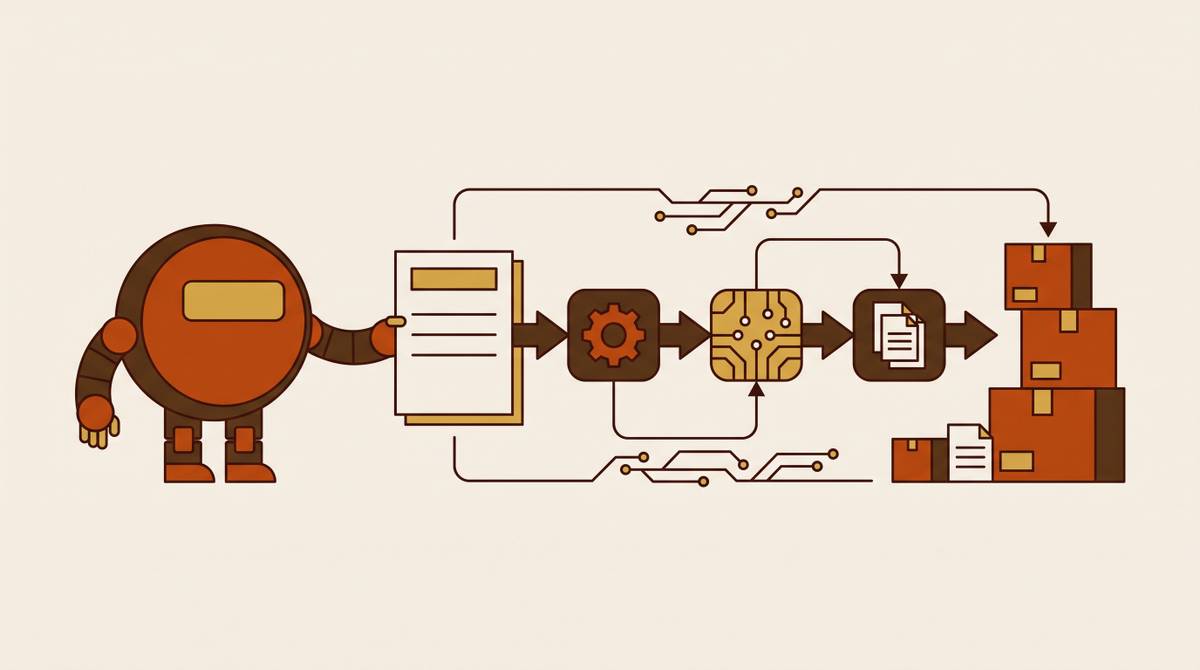
Once configured, the agent initiates outreach at scale, typically via email or supplier portal, presenting the opening position. The supplier responds. The agent reads that response, interprets the counter-offer, and generates the next move. This loop runs without a human approving each step. When a supplier proposes something outside the defined guardrails, the agent flags it for human review rather than proceeding autonomously. When terms are agreed, the agent generates the contract record and pushes it into the enterprise system.
Two things change materially in this model. Speed: negotiations that historically consumed weeks of back-and-forth conducted in business-hours batches can conclude faster, because the agent runs exchanges continuously. Scale: a single agent can run thousands of simultaneous negotiations. A human team cannot run ten simultaneously without something falling through the cracks. Both are real, and neither requires you to take the vendor's word for it. Run the math against your own contract volume.
The multi-variable dimension deserves specific attention. Human negotiators anchor on price because tracking trade-offs across five variables simultaneously in real time is cognitively demanding. The agent does not have that constraint. It can optimize across price, payment terms, delivery schedules, and volume commitments at once, which is part of why savings figures from these deployments can exceed what manual processes produce even when a human does occasionally engage.
Where these tools are being deployed and what results look like
Tail spend and indirect categories are the primary deployment zone, for the same reason they are the most neglected in manual processes: high transaction volume, lower strategic complexity, the greatest coverage gap.
Pactum is the most-cited reference case. Deployed at Walmart, Maersk, Unilever, and Mondelez, the platform has conducted millions of supplier negotiations. Per Pactum's published case studies, supplier acceptance rates exceed 60% and 3 to 7% additional value is captured beyond what manual renewal processes achieve. Keelvar's autonomous sourcing bots, used at Coca-Cola, Mars, and Siemens, report 2 to 8% additional savings versus manual sourcing and 50 to 70% reduction in event cycle times, per Keelvar's published case studies. Fairmarkit, deployed at Boeing and BP among others, reports reducing manual sourcing time per event to three minutes and achieving over 90% of bids below benchmark pricing, per Fairmarkit's published case studies.
A reasonable synthesized midpoint across vendor claims and analyst analysis puts AI-powered negotiation for tail spend in the range of 5 to 8% more savings than manual processes. McKinsey & Company has reported that companies using AI for procurement automation can reduce sourcing cycle times by up to 40%.
Here is the honest caveat, though: the most striking performance numbers are predominantly vendor-reported or drawn from early-adopter case studies. Independent audit data is sparse. These figures are directionally credible; they are not robustly verified at population scale. Any vendor evaluation should include a request for third-party-validated performance data where it exists. If the vendor cannot produce it, that tells you something.
One finding that surprises most people: supplier satisfaction frequently improves in these deployments. The agent is available, consistent, and faster to respond than a human buyer. For a supplier managing dozens of renewal cycles with different customers, that reliability has real operational value. Routine renewals handled by an agent free the human relationship for conversations that genuinely require one.
The vendor landscape and what each approach is actually optimized for
The market segments cleanly by the primary problem each vendor is solving. Buying the wrong category of tool is an expensive mistake, and it happens often because the demos all look similar.
Pactum, Zycus Merlin ANA, and Keelvar are built for volume coverage of routine renewals and indirect spend. If the core problem is coverage at scale, this is the relevant category. Arkestro and LightSource take a different approach: Arkestro's model predicts what price a category will reach in a competitive sourcing event before it runs, giving buyers a stronger anchor going in. The value is in the intelligence layer, not autonomous execution. LevaData serves direct materials and manufacturing procurement, providing AI-driven market intelligence and should-cost modeling for commodity and component buyers. It supports strategic negotiation preparation rather than autonomous execution, which is the right fit for categories where the negotiation itself requires deep technical judgment. Globality uses AI-guided matching and negotiation for complex services categories. An emerging category pairs strategic coaching with autonomous tail-spend coverage on a single platform, addressing the reality that most procurement organizations have been buying these two capabilities separately.
Enterprise suite moves are accelerating. Coupa launched an autonomous negotiation module in late 2024. IBM launched watsonx for Procurement around the same time, targeting AI-driven sourcing events including negotiation simulations. These moves signal that autonomous negotiation is transitioning from specialized point solution to expected feature in enterprise procurement suites. The window for differentiated point-solution pricing is closing.
For organizations sourcing from Asia-Pacific supply chains, Alibaba's Accio Sourcing Toolkit offers agentic procurement automation including supplier matching, bulk outreach, negotiation, and order placement.
The selection question reduces to this: does the organization need the agent to close the deal autonomously, or does it need better intelligence to negotiate more effectively itself? Different needs, different tools. Pactum's gain-share structure (roughly 10 to 15% of negotiated savings paid as fees, per Pactum's published pricing disclosures) aligns vendor incentives with buyer outcomes in a way that flat-fee or seat-license models do not. Whether the gain-share calculation methodology is independently auditable should be part of any serious evaluation.
Why adoption is accelerating now and where the investment is going
The AI in procurement market was valued at $3.32 billion in 2025 and is projected to reach $39.20 billion by 2035, growing at roughly 28% annually, per Precedence Research. Procurement technology startups raised $4.2 billion in venture funding in 2024, per PitchBook, with AI-focused companies commanding valuation premiums over traditional software providers.
CPO intent data confirms the direction. Deloitte's 2025 Global CPO Survey of more than 250 CPOs across 40 countries found that the top quartile of procurement organizations are allocating up to 24% of their budgets to technology, nearly double the 2023 figure, and achieving a 3.2x return on generative AI investments compared to roughly 1.5x for organizations at the lower end. The EY 2025 Global CPO Survey found that 80% of global CPOs plan to deploy generative AI in some capacity over the next three years, but only 36% have meaningful implementations today. That gap is where the next wave of deployments will land, and it is closing faster than most organizations are prepared for.
The barriers slowing adoption are organizational, not technical. Siloed ways of working, competing priorities, and capability gaps are the top blockers cited by CPOs in the Deloitte data. The technology is operationally ready before most organizations are. This is the part that keeps procurement leaders up at night, or should.
Where human judgment still belongs in the process
Autonomous tools are designed for negotiations where the parameters of a good outcome are definable in advance: price ranges, clause variants, volume tiers. They are not designed for situations where the definition of a good outcome is itself in question.
Strategic supplier relationships are the clearest case. Where a supplier is a sole source, a long-term partner, or embedded in product development, the negotiation carries relationship weight that an agent cannot read or manage. The stakes extend beyond the immediate contract. An agent optimizing on defined parameters cannot assess what a deteriorated supplier relationship will cost two years from now. A skilled procurement professional in that room is less like a calculator and more like a chess player, reading the board several moves ahead, weighing what cannot be quantified.
Novel terms and edge cases require human judgment. When a supplier proposes a new payment structure, an unusual risk allocation, or a force majeure carve-out outside established playbooks, the right response is escalation. Well-designed agents escalate these situations. Organizations should verify that the escalation logic is tuned correctly before deployment, not after.
The fairness dimension is underappreciated. Autonomous agents optimize within the parameters they are given. If those parameters embed historical biases, toward incumbents, toward certain supplier sizes or geographies, the agent replicates those biases at scale. Oversight of the guardrails themselves requires sustained human accountability. The agent does not hold fiduciary responsibility for procurement outcomes. Someone must.
The division of labor that emerges from mature deployments is coherent: agents handle volume coverage of tail and indirect spend, freeing procurement professionals to concentrate on strategic sourcing, supplier development, and the negotiations that genuinely require experience and contextual judgment. The best procurement organizations are building toward this deliberately, not stumbling into it.
How to evaluate whether your organization is ready to deploy one
Start with the spend profile. How much of your contract volume sits in tail spend and indirect categories with routine renewal cycles? That is the natural first deployment zone, and the size of it determines the magnitude of the opportunity.
Data readiness is the most consistently underestimated prerequisite. Autonomous agents require historical transaction data, supplier records, and defined policy parameters to operate effectively. Organizations without clean, accessible spend data will need to address that before the agent can perform. Deploying into a fragmented data environment produces fragmented negotiations at scale. The tool amplifies what exists; it does not repair it. Think of it this way: feeding an autonomous agent bad data is like handing a seasoned negotiator a briefing full of typos — the talent is there, but the outcome is already compromised before anyone sits down at the table.
Integration depth matters in practice, not just in the vendor demo. The tool must connect to existing ERP and procure-to-pay systems to operate within procurement workflows rather than beside them. Assess vendor integration capabilities against your actual stack.
Guardrail design is a human strategy task that rarely gets the attention it deserves. The quality of the agent's output is bounded by the quality of the parameters the procurement team defines. Someone must own this work. It requires procurement expertise, not just technical configuration, and whoever does it needs to understand the business well enough to anticipate edge cases before they occur.
Escalation protocol should be defined before deployment. Which situations require human review? Organizations that skip this step either over-escalate, negating the efficiency gain, or under-escalate, exposing themselves to unreviewed commitments. Neither is acceptable.
Evaluate fee structures carefully. A gain-share calculation you cannot verify is a risk, not a feature.
The most common successful entry point is a defined tail-spend category with high volume, low strategic complexity, and a clear performance baseline. Measure against that baseline before expanding scope. The proof-of-concept disciplines the vendor relationship, calibrates internal expectations, and builds the organizational confidence that scales the deployment responsibly. Organizations that skip straight to broad deployment almost always regret it.