Multi-Agent Architectures in Source-to-Pay Workflows
Specialized agents handling distinct S2P tasks outperform single monolithic systems.
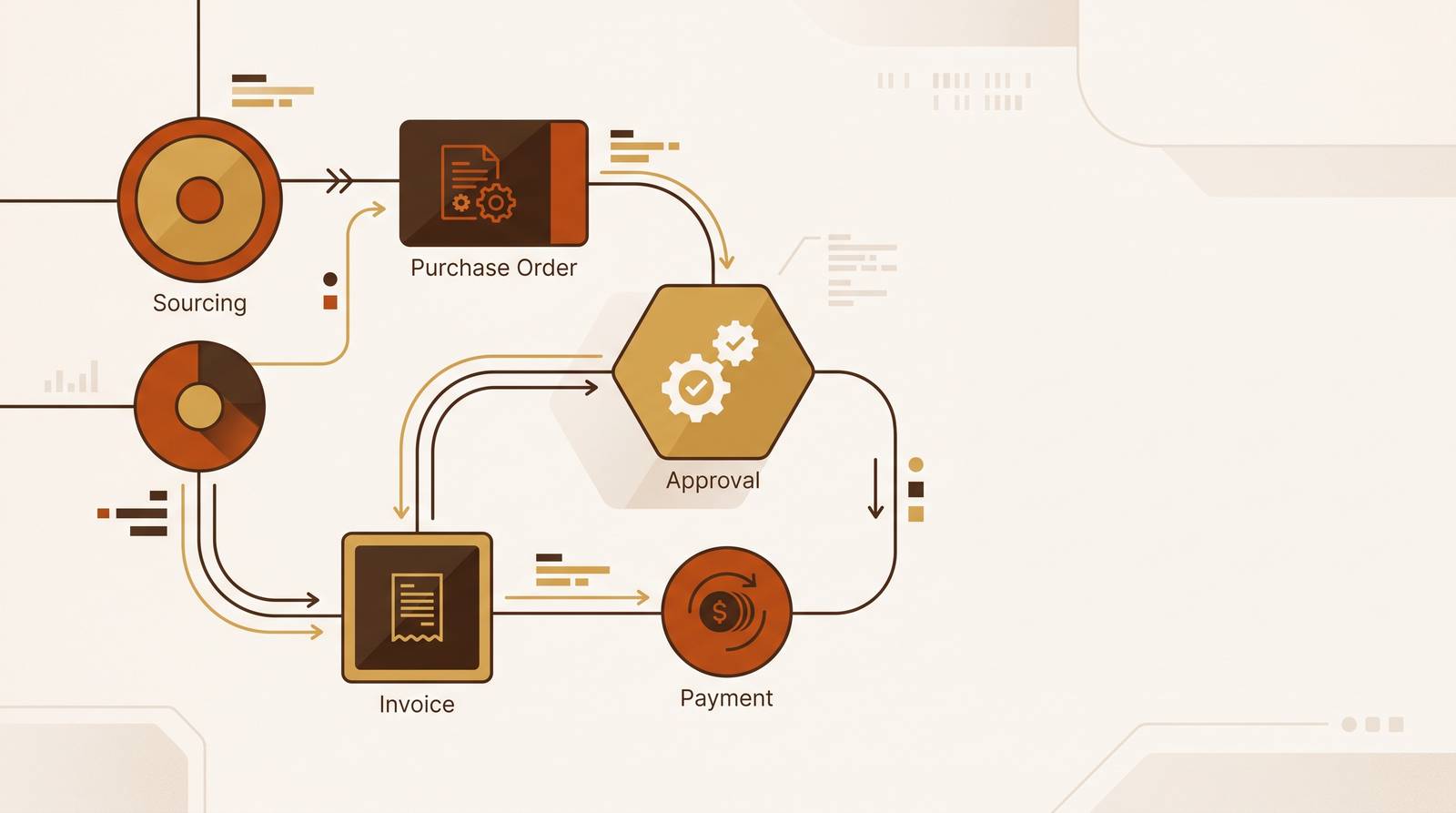
Source-to-pay is not a single process. It is two linked phases, source-to-contract and procure-to-pay, each carrying distinct data types, decision logic, and compliance requirements. The difficulty lives at the seams, and like any seam under pressure, when it splits, everything falls apart fast.
Every major handoff, from sourcing to contract, contract to purchase order, PO to invoice, requires translating context across systems and teams. That translation is where manual effort concentrates. Point solutions automate within a step reasonably well. They leave the connective tissue, the routing decisions, reconciliation, exception handling, to humans. And humans become the bottleneck they were never supposed to be.
Rule-based automation, the RPA generation of tools, handles predictable sequences competently. It breaks on exceptions, novel supplier situations, and unstructured data. Procurement has all three in constant rotation. A supplier returns with non-standard terms. A commodity price shifts mid-sourcing cycle. An invoice arrives with line items that don't map cleanly to a purchase order. The rules engine stalls. Someone opens a ticket. The queue builds.
Single large-model approaches face a different ceiling. Under real enterprise volume, they hit throughput limits. More importantly, they lack the domain specialization to handle category-specific sourcing logic, legal clause review, and payment compliance with equal depth simultaneously. Asking one model to be your category manager, your contract attorney, and your AP director in the same breath is like asking one person to simultaneously parallel park, solve a crossword, and negotiate a hostage situation. Unreasonable for any intelligence, artificial or otherwise.
Full-workflow automation requires something that can hold context across steps, distribute specialized work to the right capability, and handle exceptions without demanding human re-entry at every boundary. Multi-agent orchestration is built for exactly that problem.
How the Orchestrator-Plus-Specialist Architecture Works Across S2P
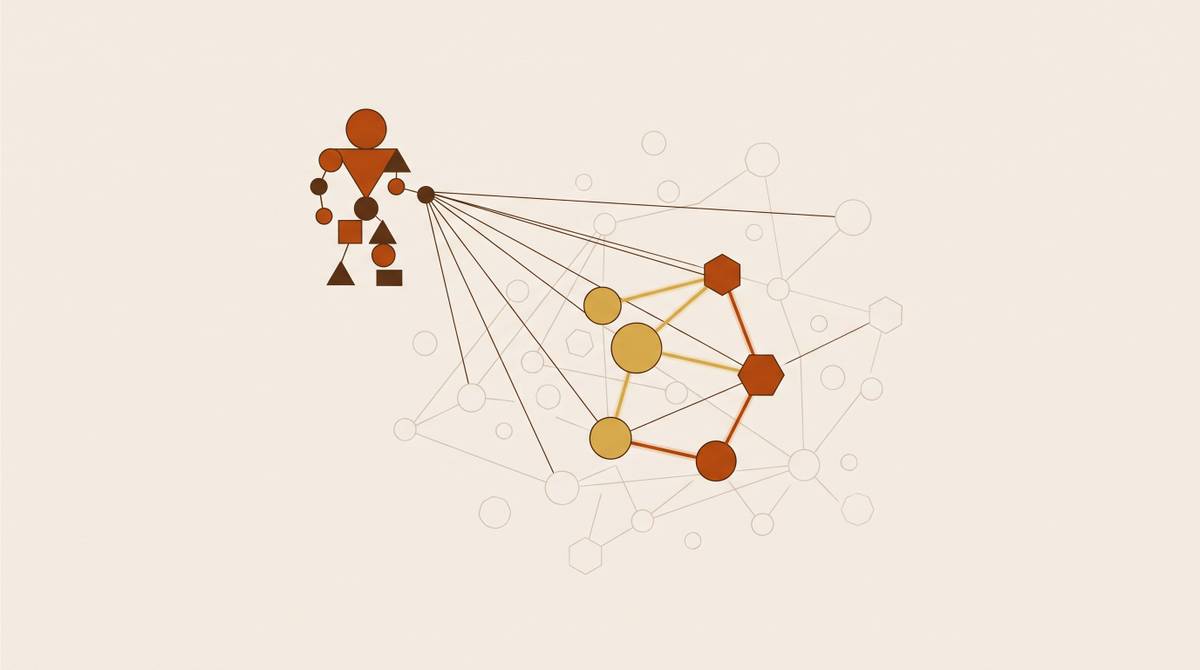
The central pattern is a procurement orchestration layer governing groups of specialized agents operating across sourcing, planning, risk, contract management, and payment. The orchestrator doesn't execute tasks itself. It sequences them, manages inter-agent handoffs, and ensures that each specialized agent is working from shared enterprise data rather than siloed inputs. That last detail is the difference between agents that inform each other and agents that inadvertently contradict each other.
When a new RFx is triggered, the orchestrator calls sourcing agents. When terms need review, contract agents. When an invoice arrives, AP agents. It also connects outward to market intelligence feeds, supplier intelligence platforms, benchmarking services, and geopolitical analysis. The agents don't go find the world. The orchestrator surfaces it to them.
What specialization actually buys is precision. A supply chain workflow requires one agent monitoring supplier risk indicators, another cross-referencing inventory levels, and a third generating procurement recommendations. Each operates within its domain, deeply, rather than one model attempting everything at shallower resolution. The outputs compound rather than average out.
Failure handling is where the architecture's advantage becomes structurally meaningful. When one agent fails, the workflow reroutes or escalates to human review. That's a fundamentally different failure mode than a monolithic rule-based system, which either completes or stops entirely. The multi-agent system degrades gracefully, keeps moving, and surfaces the problem. It doesn't produce a silent failure that someone discovers three steps later wondering how things got so off track.
The trajectory of the category is toward what some practitioners call intake-to-outcomes convergence: a unified architecture where agents run continuously from intake through sourcing, negotiation, contracts, payment, and supplier management. Not a collection of tools bolted together. A procurement operating system where the connective tissue is designed rather than improvised.
What Each Specialized Agent Does at Its Stage of the Workflow
Intake Agents
The intake agent's job is translation and routing. It takes a business user's request, often underspecified, converts it into a structured intake document, assesses it against procurement policy and approval thresholds, and routes it to the appropriate buying channel based on category, value, urgency, and complexity. Per PwC's analysis of agentic AI in procurement, agents can partly automate roughly 80% of intake work, driving consistency across systems that previously required manual re-entry at each boundary.
The practical effect is that intake becomes a trigger rather than a transaction. Requesters stop re-entering data at every system handoff. Downstream agents receive clean, structured inputs. The whole workflow starts better than it used to. That sounds minor until you've watched a sourcing cycle go sideways because the original request was ambiguous and nobody caught it until week three.
Sourcing Agents
Sourcing agents compress an operational sequence that used to take weeks: spend analysis, supplier shortlisting, RFP generation, bid evaluation, scenario modeling. In large organizations managing numerous concurrent RFx requests, AI can transform existing institutional knowledge into machine-readable models that interpret questions, match them to relevant data, and produce formatted proposals. The category manager's role shifts from assembly to judgment. Reviewing recommendations, adjusting scenarios, approving strategy. The cognitive work intensifies; the administrative work recedes.
Negotiation Agents
Walmart deployed AI negotiation agents managing simultaneous negotiations with over 2,000 suppliers. Sit with that number for a moment. Replicating that capacity with human negotiators would have required hundreds of additional employees. The outcomes from that deployment, per Pactum client data, included a 3% average gain across negotiations, payment terms extended by an average of 35 days, 68% to 72% of invited suppliers reaching a final agreement, and 83% of suppliers describing the system as easy to use.
The mechanism worth understanding is the dynamic trade-off capability. These agents can offer suppliers faster payment in exchange for lower unit cost. A rules engine cannot make that kind of conditional exchange. It requires reasoning across variables simultaneously, which is exactly what the agent does.
Here's what I think isn't being discussed nearly enough: the next phase of negotiation automation moves toward AI-to-AI interactions, where supplier bots negotiate directly with buyer bots, with no human reviewing terms in real time. The transparency, accountability, and dispute resolution protocols for that scenario are unsettled. Nobody has a clean answer. Design governance frameworks now, before deployment, not in response to the first incident.
Contract Lifecycle Management Agents
CLM agents handle the repetitive, high-volume work of contract drafting and extraction: analyzing historical data, recommending clauses, shortening review cycles. Selecta AG's deployment of AI-driven contract extraction and approval orchestration illustrates the operational shift. Cumbersome manual workflows became automated processes that accelerated the full contract lifecycle and reduced compliance exposure. The drafting and data extraction work moves to agents. Legal accuracy and missing-clause judgment stay with humans. That division of labor is the appropriate design, not a concession to the technology's current limitations.
Accounts Payable and P2P Agents
Accounts payable has the highest current adoption rate of any S2P function. Per Hackett Group research, 21% of companies are already running agentic AI in AP in production. Invoice processing times have compressed from 10 to 14 days down to 2 to 3 days in organizations deploying AI-powered capture, with late payments dropping 57%. Best-in-class touchless invoice rates reached 52.8%, up from 29% in 2023, and organizations achieving 30% or more touchless processing deliver 3.5 times higher AP productivity than their peers.
Scale AI's 2024 deployment of an enterprise procure-to-pay platform achieved a 50% reduction in PO and payment processing times. AP is where the ROI is most legible because the inputs and outputs are relatively standardized. It's also where most organizations start, which means it's generating the most mature evidence base available right now. If you're trying to build an internal business case, AP numbers are your most defensible starting point.
Supplier Management Agents
Supplier management agents execute multistep tasks: reviewing contracts, benchmarking suppliers, managing onboarding, monitoring compliance, alerting teams to emerging risks. The structural advantage is direct access to unified S2P data. Workflows that previously required days of manual data collection complete in minutes. The human team receives synthesized signals rather than raw data, which means their attention goes to decisions rather than aggregation. That reallocation of cognitive capacity is more valuable than it sounds on paper.
What Measured Outcomes from Early Deployments Actually Show
The most instructive example in the current evidence base is a McKinsey case involving a technology company that deployed linked AI agents to rebuild its external-services sourcing strategy. One agent integrated spend and market data to generate real-time price-trend insights. Another simulated demand evolution under different scenarios. The coordination between them, not either agent independently, produced the insight that mattered. The outcomes: 12 to 20% savings on contact-center spend, and 20 to 29% savings on BPO and financial-services spend.
A separate McKinsey pilot in the chemicals sector deployed autonomous sourcing agents handling tender preparation, supplier identification and prequalification, bid analysis, and query routing. Procurement staff efficiency increased 20 to 30% while value capture improved 1 to 3%. In a domain where a single percentage point of savings on nine-figure spend is a material result, those numbers deserve to be taken seriously.
The macro projections extend the directional argument. PwC expects agentic AI to transform at least 75% of procurement activities in the near term, with productivity improvements of at least 30% and as much as 70% in agent-driven tasks. McKinsey's analysis projects that technology will reshape procurement into an organization 25 to 40% more efficient and increasingly agentic in its operating model.
What the published numbers don't tell you: the majority of results come from large enterprises with relatively clean data infrastructure and dedicated implementation resources. The evidence base for mid-market organizations, or for environments where data is fragmented across legacy systems, is thin. The architecture is sound. The lift required to get data into a state where agents can perform well varies enormously by organization, and that variance is poorly documented in public research. Anyone selling you a clean deployment story without asking hard questions about your data environment first is selling you something other than the truth.
Where Multi-Agent Coordination Still Creates Real Operational Risk
The transparency gap is the most persistent concern. When an orchestrator delegates across multiple specialized agents, the decision trail becomes harder to audit. Which agent produced which output, on what data, under what reasoning logic? In a regulated procurement environment, that question carries compliance weight, not just operational weight. Most organizations don't have a satisfying answer.
Compounding errors present a different kind of risk, and honestly, I find this one more insidious. In a sequential multi-agent workflow, a misclassification at intake can propagate forward without triggering any alarm. Wrong routing leads to wrong sourcing scope leads to misaligned contract terms. The handoff that eliminates manual glue work also eliminates the human checkpoint that used to catch those errors. The system moves faster in both directions: faster when things go right, and faster when a small mistake builds into a consequential one before anyone notices.
AI-to-AI negotiation is where the sharpest version of these concerns converges. When supplier bots and buyer bots negotiate directly, accountability for what was agreed, how disputes get resolved, and who bears responsibility for misunderstandings is genuinely unresolved. This is not speculative risk. It is a design question that needs an answer before organizations move into that operating mode at scale. The industry is moving toward that capability faster than it is moving toward that answer. That gap should concern you.
Data dependency is more subtle but equally important. Agents with access to unified, high-quality S2P data produce materially better outputs. In organizations where data is siloed, inconsistent, or incomplete, agent performance degrades in ways that are harder to detect than a failed rules-based process. A rules engine fails loudly. An agent operating on poor data produces plausible-looking but incorrect outputs, like a confident navigator reading the wrong map. That is the more dangerous failure mode, precisely because it doesn't look like a failure until it's too late to course-correct cheaply.
The fallback question deserves direct attention. Multi-agent systems can reroute when one agent fails and escalate to human review. That escalation only works if humans have maintained enough operational familiarity with the workflow to intervene effectively. That is a skill that atrophies under sustained high automation. Teams need to design for its preservation deliberately, rather than assume it persists on its own.
How Procurement Teams Govern a Multi-Agent System Without Recreating the Manual Overhead They Replaced
Here is the core tension: the goal is to oversee agents without re-inserting the human bottlenecks the agents were deployed to remove. Comprehensive oversight defeats the purpose. Selective oversight, designed in advance and recalibrated over time, is the only version that functions at scale. There is no third option that threads that needle cleanly.
Threshold-based human review is the foundational mechanism. Define in advance which decision types, contract values, supplier risk levels, or exception patterns require human sign-off. Let agents handle everything below those thresholds autonomously. The thresholds themselves should be recalibrated regularly as confidence in agent performance accumulates. Setting them once and treating them as permanent is a governance failure waiting to happen.
Audit trail by design means the orchestration layer logs agent decisions, data sources consulted, and handoff states continuously. Not for retrospective blame assignment, but for real-time anomaly detection. When a pattern breaks, you want to see it before it propagates, not after it surfaces in a contract dispute or a payment failure six weeks later.
Data quality is a precondition, not an afterthought. Agent performance is bounded by the quality of unified S2P data, and organizations that treat data infrastructure as a parallel workstream rather than a prerequisite consistently see inconsistent agent outputs. The sequencing matters: data first, then agents. Reversing that order is one of the more predictable and avoidable mistakes in enterprise technology deployment.
Skill retention requires deliberate attention. Procurement teams need to maintain category and market expertise even as agents surface recommendations and execute workflows. The strategic judgment that makes agent outputs actionable, knowing when a recommendation reflects genuine market intelligence versus a data artifact, still lives with humans. It does not sustain itself passively under high automation. You have to design for it.
Supplier relationship protocols for AI-mediated interactions need explicit design. The Walmart deployment's 83% supplier satisfaction rate was an engineered outcome, not an assumed one. Communication norms, escalation paths, and transparency about AI involvement in negotiations were deliberate choices. Organizations that skip that design work tend to discover its importance through supplier friction. That is an expensive way to learn a lesson that was available in advance.
The procurement team's job ultimately shifts from executing the workflow to designing, calibrating, and improving the system that executes it. That is a different skill set from the one most procurement functions have historically hired and developed for. It combines systems thinking, data literacy, supplier strategy, and governance design in proportions that look unfamiliar to a traditional category manager. The organizations that start building for this shift now, before it becomes urgent, are the ones that will have optionality when it does.