Agentic AI for RFP Response Analysis in Procurement
Agentic AI automates RFP evaluation at scale, not just keyword matching.

Procurement is a $3 trillion industry still largely evaluated by a person opening a PDF. That mismatch, between the scale of what's at stake and the primitiveness of how decisions get made, is the core problem agentic AI is positioned to solve. But "AI in procurement" has become a phrase that covers everything from a chatbot answering supplier questions to a fully autonomous multi-agent system analyzing competing bids and generating ranked award recommendations. The difference between those things is not incremental. Understanding the architecture, the documented gains, and the prerequisites for deployment is what separates procurement teams that capture real efficiency from those collecting another stalled pilot.
What Earlier Automation Actually Did, and Where It Stopped
Robotic Process Automation was the first serious attempt to take the grunt work out of procurement. The premise was straightforward: map a repeatable process, script the steps, let software execute them. And it worked, until it didn't. The moment a supplier submitted an invoice in an unfamiliar format, or an approval chain changed, or a required field was blank, the system stopped and waited. RPA is brittle by design. It executes what it's told, and no more.
In procurement, exceptions aren't edge cases. They're the texture of the work. A supplier misses a deadline. A vendor's certifications don't match the spec. A bid comes in three formats from the same company across three divisions. RPA doesn't navigate those situations; it creates new queues for humans to manage, which often defeats the purpose.
First-generation AI tools, things like document search, keyword extractors, and early chatbots, improved on this only slightly. They could answer questions, surface documents, and pull terms from contracts. Useful for lookup, not for evaluation. The human still had to initiate every action, interpret every result, and decide what to do next.
Gartner's taxonomy for AI maturity in enterprise systems is a useful frame here. At the base level, AI assistants and chatbots are reactive: they respond when prompted, they draw on static training data, and they have no autonomy. One tier up, simple AI agents can handle task-specific work with some autonomy, but they still require a human in the loop at each meaningful decision point. At the top, advanced AI agents are proactive, capable of orchestrating complex multi-step workflows, collaborating with other agents or systems, and adapting when conditions change.
The defining limitation of everything below that top tier is the same: a human has to define what happens next. The system cannot reason about what to do when the situation departs from the script. For procurement teams fielding more than 200 RFPs per quarter, where a single complex evaluation can consume 10 to 20 hours of staff time, that limitation compounds into a structural problem. It's not a staffing problem or a motivation problem. It's an architectural one.
What Makes an AI System Genuinely Agentic
An agentic AI system is one that can perceive inputs, reason about a goal, select the tools or sub-agents needed to pursue it, sequence its own steps, and act without a human scripting each move. That's the definition in practical terms, and it's worth taking seriously rather than treating "agentic" as a marketing label.
Several architectural properties make this possible. Dynamic problem-solving means the agent determines its own approach to a task by selecting relevant tools and adjusting as inputs evolve, rather than following a fixed decision tree. Multi-step reasoning means it doesn't answer a single question and stop; it plans a chain of actions to accomplish an objective. Tool use and delegation means it can invoke external databases, call sub-agents specialized for particular tasks, and integrate outputs across all of them. Goal persistence means it keeps working toward an objective across multiple steps without requiring re-prompting.
The shift from keyword matching to semantic understanding is where this becomes visible in practice. Earlier tools found what you asked for using surface-level pattern recognition. An agentic system understands intent. If an RFP asks a vendor to describe their approach to business continuity, the agent knows that question is about resilience, redundancy, and disaster recovery, not just the phrase "business continuity." That semantic understanding is what makes cross-document comparison tractable at scale.
Retrieval-Augmented Generation, or RAG, is the mechanism behind the knowledge retrieval capability. Rather than relying on what was baked into the model at training time, the agent searches a centralized repository: past proposals, product documentation, approved messaging, compliance records. It pulls the most relevant passages to inform its outputs. This is why a well-organized knowledge base is a deployment prerequisite, not a nice-to-have.
One clarification worth making explicitly: "agentic" is an architectural property, not a product category. A tool can carry an AI label without being agentic. When procurement teams are evaluating vendors, this distinction matters, because the efficiency gains documented for agentic systems don't transfer to tools that simply generate text on demand.
How an Agentic AI System Works Through an RFP Evaluation End-to-End
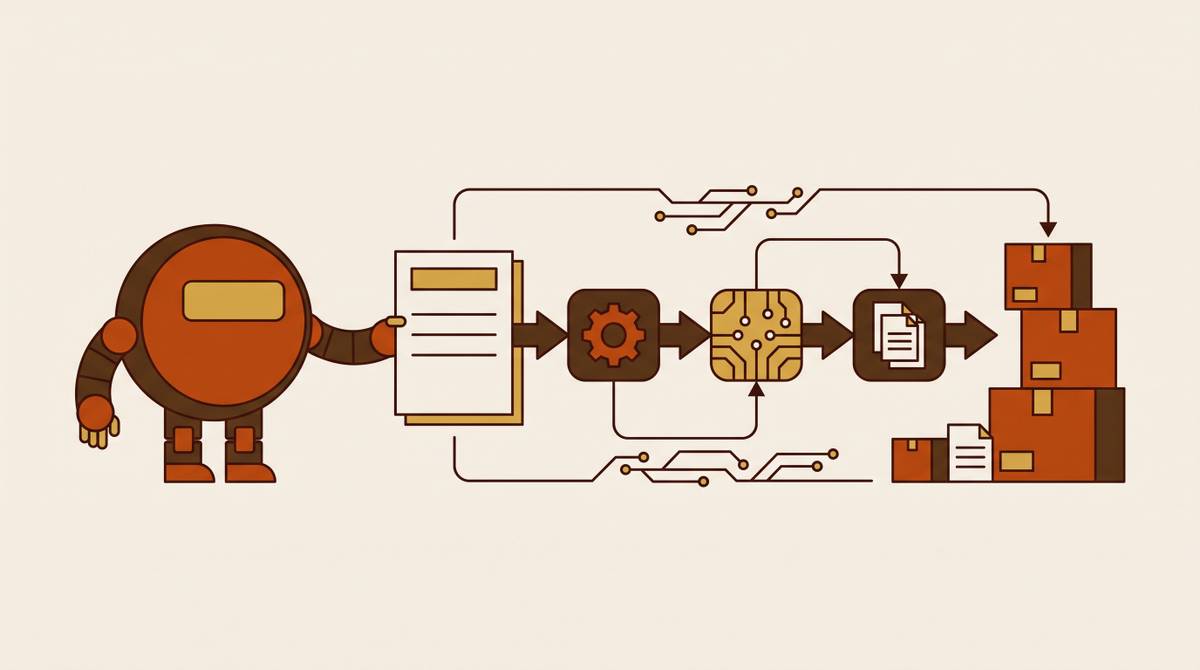
The entry point is document ingestion, and it's less glamorous than it sounds. Real-world RFP responses arrive as PDFs, Word documents, Excel workbooks, and scanned images. An agentic system applies OCR to extract text from scans and tables, normalizes the input, and proceeds without requiring clean, structured data. This matters because procurement teams can't control how vendors submit.
Once the documents are ingested, semantic parsing begins. The agent analyzes each requirement or question for intent. It's not pulling keywords; it's building a representation of what the question is actually asking, and what a responsive answer would look like. This is where the departure from earlier tools becomes visible.
Knowledge retrieval follows. The agent queries the centralized knowledge hub and surfaces relevant passages: pricing history, technical specifications, compliance documentation, approved messaging language. It assembles the context needed to evaluate each vendor's response against internal benchmarks, not in the abstract.
The scoring and evaluation layer is where the analysis becomes actionable. Natural language processing-driven semantic analysis scores vendor answers section by section or in aggregate against pre-defined rubrics. The agent extracts key data points from unstructured text: pricing, timelines, technical specifications, liability terms. It flags risks, contradictory statements, missing documentation, compliance gaps. And it generates concise summaries for human evaluators rather than asking them to read hundreds of pages raw.
Anomaly detection operates as a distinct capability alongside scoring. The agent identifies statistical outliers in bid pricing, cross-references vendors against financial stability and compliance databases, and surfaces issues that a fatigued human reviewer working under deadline might miss. This is one of the more underappreciated contributions of agentic systems; the consistency of attention that a scoring model applies to every submission is something no human team can replicate at volume.
Structured reporting and scenario analysis complete the loop. Raw evaluation data becomes ranked vendor comparisons. Teams can run "what-if" analyses to reweight priorities, without re-running the full review. If the evaluation committee decides to weight price less heavily and technical capability more, the model recalculates rather than requiring a manual re-score.
Microsoft's open-source agent accelerator for RFP response illustrates what full-loop automation looks like in production: an agent that autonomously parses incoming emails, summarizes the RFP, analyzes requirements, generates draft response documents including compliance and security sections, assigns a confidence score to each response section, and posts the assembled package to Microsoft Teams via Copilot Studio. No human input is required to initiate or complete those steps.
The multi-agent sourcing chain is worth mapping in sequence, because it shows how agents delegate across a workflow. A sourcing agent initiates the event. A web agent identifies qualified suppliers. A quality agent checks candidates against internal policies. A document agent retrieves certifications and performance records. The sourcing agent then assembles the bid package and generates an award recommendation. Each agent is specialized; the orchestrating agent coordinates them. The human receives a structured recommendation, not a pile of documents.
What the Documented Efficiency Gains Actually Look Like in Practice
McKinsey's enterprise case from early 2026 is the anchor data point here. An organization deployed procurement agents to automate tender preparation, supplier identification and prequalification, and competing bid analysis. The result was 20 to 30 percent efficiency gains for procurement staff and 1 to 3 percent value capture improvement. Those two numbers are worth sitting with separately.
The efficiency gain isn't primarily headcount reduction. It's reallocation. Staff time that was going to document assembly and manual comparison now goes to strategic decisions, supplier relationships, and evaluation judgment. The nature of the role changes, not the headcount.
The value capture improvement reflects what happens when the evaluation process is more thorough and consistent. Better analysis produces better vendor selections. Better selections produce better contracts. The downstream financial impact of procurement quality tends to be underestimated precisely because the connection is indirect and delayed.
Speed gains are more immediately legible. AI agents review hundreds of pages in minutes rather than days. Thalamus AI, drawing on their 2025 internal data, reports a 40 percent reduction in turnaround time for teams using agentic systems. Accuracy gains compound on top of that: proposal teams using agentic AI reported more than twice the response accuracy compared to teams using general-purpose AI tools alone. The comparison matters. The gains attributed to agentic systems aren't gains over manual work alone; they're gains over the first wave of AI adoption.
The manual step reduction figure from Thalamus's 2025 data is striking: enterprises that adopted AI agents reduced manual steps by 70 percent. That's not a productivity improvement at the margin. It's a workflow transformation.
At scale, teams using RFP automation handle substantially more RFPs annually than those relying on spreadsheets, suggesting the throughput ceiling lifts rather than just the speed within the existing ceiling. A pharmaceutical supplier onboarding case, adjacent to RFP evaluation but architecturally similar in its document-processing demands, shows what semantic document understanding does to cycle times: what took 35 days took 4 after AI-driven document understanding was applied, an 89 percent reduction.
Consistency deserves its own note. Human reviewers have off days. Unconscious bias influences how a vendor's response reads depending on how fatigued the evaluator is, how familiar the vendor name is, and what order the submissions arrive in. A scoring model applies the same criteria to every submission, every time. The decisions are easier to defend when a vendor challenges a selection, and they're fairer in aggregate.
The Gap Between Procurement Leaders' AI Ambitions and Where Deployments Actually Stand
The intent is unambiguous. Gartner data shows 72 percent of Chief Procurement Officers prioritizing AI investment. EY's 2025 Global CPO Survey found 80 percent of global CPOs planning to deploy generative AI in some capacity over the next three years. These are not fringe positions; this is a stated consensus.
The execution reality diverges sharply. Only 19 percent of organizations had actually implemented GenAI tools for procurement tasks when Gartner surveyed 258 global respondents in 2024. Only 13 percent had invested meaningfully in AI adoption training. Nearly half of procurement teams piloted generative AI in 2024; only 4 percent reached scaled deployment, according to Hackett Group data. Most organizations are stuck at proof-of-concept, sometimes permanently.
The PwC projection of 70 percent productivity gains in agent-driven tasks gives a sense of what's theoretically accessible. The gap between that projection and the 12 percent of organizations reporting large-scale AI implementation, even as 43 percent actively pursue deployment per Zycus's April 2026 data, is where the real story lives.
What's driving the gap is not mystery. The knowledge repository problem is foundational: RAG-based agents retrieve from what's available, and teams without organized content libraries can't unlock semantic retrieval. The 13 percent figure on adoption training investment explains most of the stalled pilots; capability without workflow integration and user fluency doesn't scale. And ambiguity about sequencing stalls action. CPO survey data shows spend analytics and RFP and RFQ generation as the top stated use cases, but organizations without a sequenced deployment plan tend to stall before either gets implemented.
This is not a technology gap. The technology exists, is commercially available, and is demonstrably producing the gains described in the previous section. The gap is operational and organizational, which means it's addressable, but only if teams are honest about what it actually requires.
What Procurement Teams Need in Place Before Agentic AI Can Deliver on RFP Analysis
The knowledge repository is the most foundational prerequisite, and also the most commonly underestimated. An agentic system doing RAG-based retrieval is only as good as the content it can access. Past proposals, product documentation, approved messaging, security whitepapers, compliance records: these need to exist, be organized, and be maintained. Teams that deploy an agentic system against a fragmented or outdated content library are essentially asking the agent to work from a bad briefing book. The outputs reflect the inputs.
Scoring model design is a human responsibility that precedes deployment, not something the system handles by default. The agent scores vendor responses against criteria the team defines. If evaluation rubrics aren't explicit and documented before the system goes live, the consistency gains don't materialize. What the agent produces is only as fair and defensible as the criteria it's given.
Data access and system integration are deployment dependencies, not afterthoughts. For an agentic system to cross-reference vendor bids against compliance records, financial stability data, and internal performance history, it needs connections to the systems where that data lives: ERP, contract management platforms, supplier databases. Building those integrations during a pilot is possible; deferring them indefinitely is a primary reason pilots don't scale.
Human-in-the-loop design is a deliberate workflow choice, not a default setting. Not every step in an agentic evaluation should be fully autonomous, and deciding which steps warrant human review is part of the deployment design. Award recommendations and final vendor selections warrant human sign-off; the agent produces the ranked analysis, a person makes the call. Anomaly flags, unusual pricing, missing compliance documentation, contradictory statements, should route to a human immediately rather than being resolved by the agent autonomously. These are workflow design decisions that need to be made before deployment, not discovered during it.
Security and data sensitivity require explicit policy decisions. RFP responses contain proprietary vendor information and internal pricing strategy. Teams need clarity on where data is processed, whether models are trained on it, and what data isolation looks like. Private or dedicated large language model deployments for sensitive procurement content are an active trend in the market precisely because the data governance question is real and consequential.
Adoption training is where the 13 percent figure becomes an explanation rather than just a statistic. Agentic capability deployed into a team that doesn't understand how to use it, doesn't trust its outputs, or hasn't restructured workflows to integrate it produces underperformance. The technology works; the workflow integration requires investment.
Where Agentic AI in Procurement Is Heading Through the End of the Decade
The market trajectory provides context without requiring hype. AI in procurement is projected to grow from around $3.32 billion in 2025 to nearly $40 billion by 2035, at a compound annual growth rate of 28 percent. That rate of expansion exceeds most enterprise software categories. The category is not niche and not early-stage.
Gartner's April 2026 projection for supply chain management software with agentic AI capabilities is the more structurally significant signal. That segment is expected to grow from under $2 billion in 2025 to over $50 billion by 2030, with 60 percent of enterprises using SCM software expected to have adopted agentic AI features by 2030, up from 5 percent in 2025. This means agentic AI in procurement doesn't stay a differentiator; it becomes a baseline expectation, the way ERP systems became baseline by the mid-2000s.
Gartner's projection that 90 percent of B2B buying will be AI-agent intermediated by 2028, moving more than $15 trillion in B2B spend through AI agent exchanges, is where the implications become most urgent for procurement teams. "Agent intermediated" means vendor agents will increasingly be responding to buyer agents. The evaluation loop becomes agent-to-agent, with humans reviewing outputs rather than raw documents. Procurement teams that haven't built agent-compatible workflows, structured knowledge repositories, scoring models, integration architecture, will find themselves operating manually against counterpart systems that are not.
The compounding advantage is worth naming plainly. Organizations that pilot and reach scaled deployment now are building the institutional knowledge that makes the next capability step accessible. The knowledge repositories get richer. The scoring models get more refined. The integration architecture becomes more robust. Organizations still cycling through proofs-of-concept in 2027 face catch-up against adversaries who have two years of operational learning embedded in their systems.
The larger reframing is this: agentic AI doesn't eliminate procurement judgment. It eliminates the document-assembly work that was consuming the time needed for judgment. The 10 to 20 hours per complex RFP that went to manual review is time that could go to supplier development, strategic sourcing decisions, and category expertise. The teams that make that shift will redefine what procurement contribution looks like inside their organizations. The teams that don't will keep explaining why they need more headcount to do the same work they've always done.