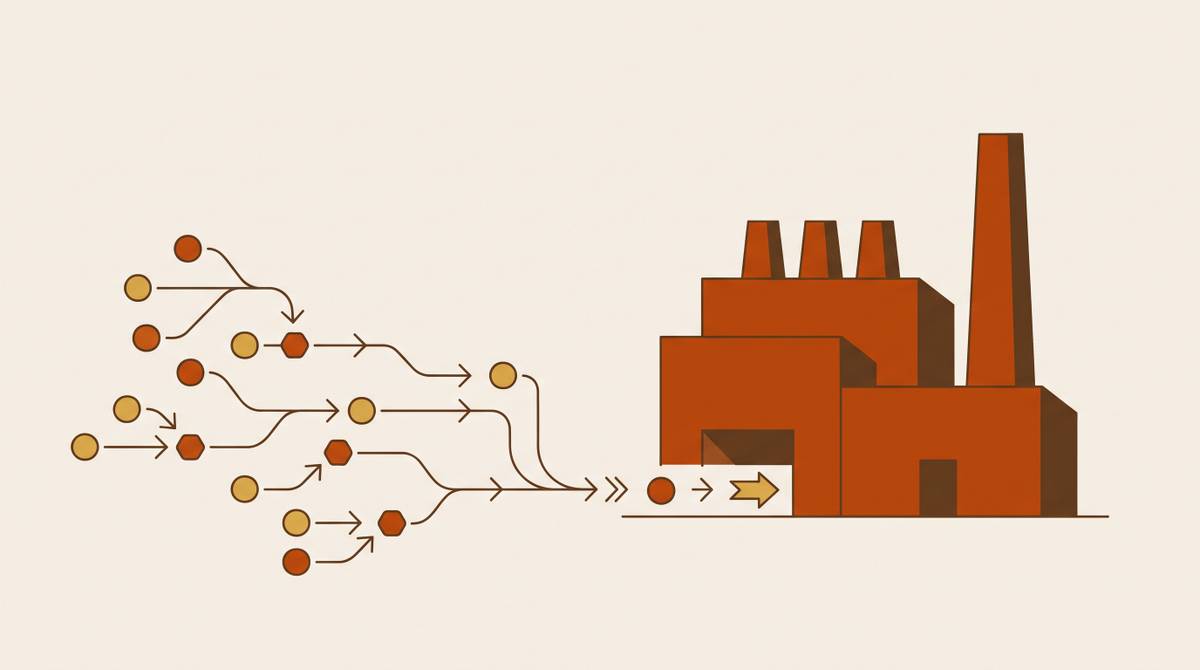
AI Agents for Automated Purchase Order Generation
AI agents handle contract reasoning and exceptions that rule-based bots cannot.
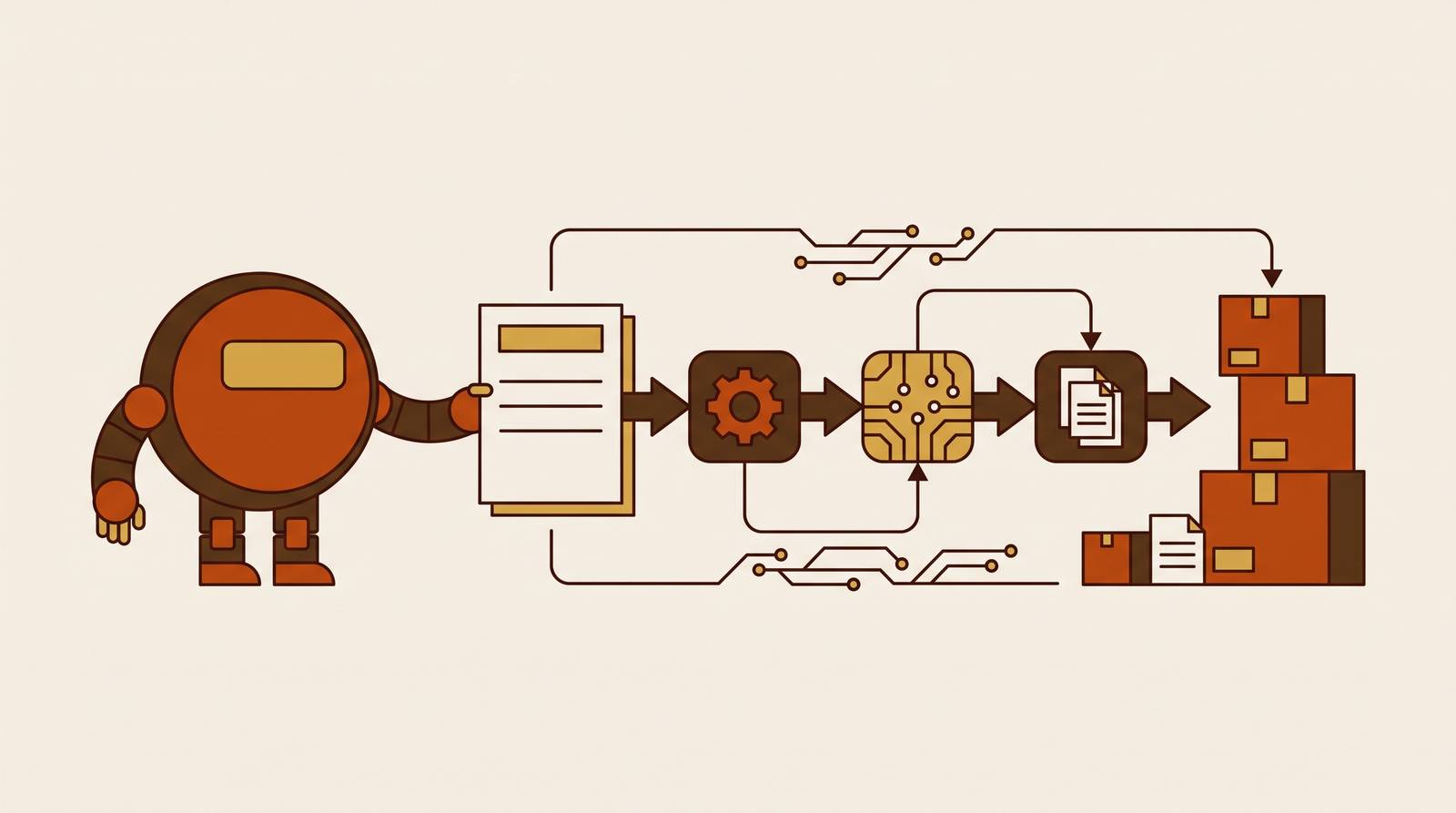
Rule-based bots and RPA were a genuine step forward from pure manual effort. They execute repetitive, predictable tasks quickly and without complaint. But the limitation is categorical, not incremental: when something unexpected happens, they stop. They wait. A bot can populate a PO template. It cannot reason about whether that PO violates a newly negotiated contract clause, surface a compliant alternative, confirm budget availability in real time, and route the document to the right approver without a human ever touching it.
That end-to-end reasoning is what separates an agentic system. An AI agent maps out a multi-step plan, acts on it, handles the exceptions that arise mid-process, and completes the workflow. The underlying technologies work in concert: machine learning for pattern recognition across historical spend data, natural language processing and large language models for understanding procurement documents, intelligent document processing for pulling structured information from unstructured inputs. Machine learning held the largest share of the AI in procurement market in 2025, per Precedence Research, but NLP is growing fastest as contract and document intelligence matures. That trajectory tells you where the hard problems actually live: in understanding documents, not just processing them.
This distinction matters practically for organizations that already deployed RPA for procurement tasks. Those implementations were built on a core assumption: the process is predictable, and exceptions go to humans. Agentic AI inverts that assumption entirely. The integration architecture, data requirements, and governance model are all different. Carrying RPA-era thinking into an agentic deployment is like trying to navigate a highway with a horse and buggy — you will recreate the exact bottlenecks you are trying to eliminate, just in a shinier wrapper.
The Full PO Workflow an AI Agent Can Own, Step by Step
The purchase order lifecycle has six discrete stages. A mature agentic system can own all of them.
Demand signal and intake. The agent receives a requisition, whether submitted manually or triggered by an inventory threshold, a forecasting model, or a system event. It classifies the spend request to the correct category and cost center. More importantly, it checks the request against procurement policy at intake, before anything else moves. Violations get flagged. Compliant alternatives get surfaced. Policy enforcement at the beginning of the process is fundamentally different from policy enforcement at the end. One prevents problems. The other cleans them up.
Supplier and contract validation. The agent queries vendor master data, confirms preferred supplier status, checks current contract pricing, and cross-references historical purchase patterns. More sophisticated implementations add supplier risk signals here: sanctions screening, financial health indicators, performance history. All of this happens before a document is generated.
Budget confirmation. The agent checks available budget against the cost center before the PO is drafted. Routine, in-policy orders that fall within budget clear automatically. Finance does not need to manually approve them.
PO document generation. The agent pulls data from requisitions, contracts, and supplier records to populate the document. Fields are validated in real time. Anomaly detection flags duplicate orders or unusual spend patterns before issuance. Intelligent document processing compares the new PO against historical ones to surface suspiciously similar details, a fraud-prevention layer that manual review rarely catches consistently, because humans are inconsistent by nature.
Approval routing. The agent routes the PO through the appropriate approval workflow based on spend threshold, category, and organizational hierarchy. In-policy orders below threshold move through without a human touchpoint. Exceptions get escalated with context already surfaced, so the approver decides rather than investigates.
Supplier transmission and downstream linkage. The approved PO goes to the supplier. The system links it to the originating requisition, the approval record, and downstream goods receipt and invoice records. This linkage is the single source of truth. Without it, three-way matching is a manual reconciliation exercise every single time.
Three-Way Matching and Exception Handling as the Test of a Mature System
Three-way matching is where the quality of everything upstream becomes visible. Matching a purchase order, a goods receipt, and a supplier invoice sounds mechanical. In practice, invoices arrive in varied formats, line-item descriptions rarely align perfectly between the PO and the invoice, quantities get adjusted after the original order, and every mismatch generates a manual exception. The error accumulation is not random; it reflects the compounding of upstream imprecision. Small inconsistencies at each prior stage stack up by the time matching runs, and no single stage explains the result. Think of it like a game of telephone: the message that arrives at the end is only as clean as every handoff along the way.
One documented implementation improved three-way matching accuracy from 78% to 99.1% after deploying agentic PO automation, per Fluxity AI. That is not primarily a matching achievement. It is the downstream consequence of consistently structured, cleanly generated PO data from the start. The matching just makes the improvement legible.
What differentiates an agentic system in exception handling is the escalation logic. A rule-based tool routes every mismatch to a human queue. An agent attempts autonomous resolution first. It checks a contract for permitted quantity tolerances, for instance, and escalates only when it genuinely cannot resolve the discrepancy. The human role shifts from processing a large queue of routine exceptions to reviewing a smaller, harder set of judgment calls.
Getting the exception boundary right requires deliberate governance before go-live. Policy violations, new supplier onboarding, and high-value anomalies should require human review. Routine quantity tolerances and minor pricing variances within contract terms can reasonably be agent-owned. Organizations that give agents too much autonomy take on real regulatory and financial risk. Those that give agents too little recreate the bottleneck in a different form. The boundary is a procurement policy decision, and it needs to be treated as one before anything goes live.
What the Documented Efficiency Gains Actually Reflect
The headline figures circulating in AI procurement automation are striking: up to 75% faster approval cycles, 30% reductions in procurement costs among early adopters, per Leverage AI. McKinsey analysis cited by CogniAgent found that procurement teams using AI-driven decision making reduced operational costs by 10% and accelerated supplier selection by 30%. Error rates dropped by over 50% in companies that automated data entry, per Leverage AI.
What these numbers reflect, structurally, is the removal of process friction that manual workflows generate by design: redundant data entry, sequential approval waits, manual exception queues, reconciliation work at matching. When those activities are removed rather than accelerated, the time and cost gains are real. This is worth saying plainly, because a lot of AI efficiency claims are about doing the same thing faster. These gains are about eliminating entire categories of activity.
Deloitte's 2025 Global CPO Survey found that "Digital Masters," the most advanced procurement organizations in the survey, achieved a 2.8x return on generative AI investments compared to 1.6x for followers. The gap is not primarily about tool selection. It reflects implementation maturity. Organizations that have built the data foundations and governance structures to deploy agents effectively extract compounding returns. Those that deploy agents on top of an unprepared environment get incremental automation at best, and sometimes something worse.
The harder-to-quantify benefit is the data spine itself. When every requisition, PO, approval, goods receipt, and invoice is linked in a single coherent system, spend visibility improves, audits run faster, and compliance reporting becomes a reporting task rather than an investigation. That structural benefit does not appear cleanly in efficiency percentages, but procurement leaders who have lived through a major audit in a fragmented environment understand its value immediately.
Vendor case studies reflect early adopters in favorable conditions. Organizations should calibrate expected gains against their own starting point. The more manual and fragmented the current process, the larger the initial improvement, and the more preparation required to get there.
Where Procurement Organizations Actually Are in AI Adoption Right Now
The honest picture of current AI adoption in procurement is significant intent and uneven execution. As of 2025, 80% of global CPOs plan to deploy generative AI in some capacity over the next three years, per EY's Global CPO Survey. Only 36% of procurement organizations currently have meaningful generative AI implementations in place, per ISG data cited by Art of Procurement. That gap between stated intention and operational reality is not unusual at this stage of a technology cycle, but it is worth naming directly.
Ardent Partners surveyed more than 300 CPOs and senior procurement leaders and found that 58% of the procurement market is actively using or piloting AI of some kind. The critical qualifier is that "using or piloting" covers a wide range: from basic intelligent document processing at one end to fully autonomous PO workflows at the other. Most organizations are somewhere in the middle of that spectrum, which is neither alarming nor cause for complacency. IBM Institute for Business Value data shows that CSCOs and COOs identify procurement as the top supply chain workflow to be impacted by generative AI in 2025, which reflects both the opportunity size and the pressure on procurement leaders to move faster than feels comfortable.
North America holds approximately 45% of the AI in procurement market in 2025, per Precedence Research. Adoption is geographically concentrated, and organizations benchmarking against peers should account for this. Best-practice comparisons drawn from North American early adopters may not reflect what is achievable in markets with different regulatory environments, supplier ecosystems, and technology infrastructure.
Most procurement teams are past the exploratory phase. The question is no longer whether to automate. It is which capabilities to build in which sequence, and what foundational work has to happen first.
How the Current Vendor Platforms Approach Agentic PO Automation Differently
The platforms in this space are not offering equivalent products. Their architectural starting points differ, and those differences carry real implications for buyers.
Coupa built its agentic capability on top of more than $8 trillion in spend data from its user community. The agents draw on patterns from thousands of organizations, not only the buyer's own transaction history. Coupa launched Coupa Compose in May 2026, deploying more than 20 specialized agents without requiring migration or new code. Acquisitions of Rossum, for intelligent document processing, and Tonkean, for agentic orchestration, extended the document understanding and workflow layers. The data network effect is the central differentiation argument.
SAP Ariba relaunched in March 2026 as an AI-native rebuild with embedded agentic intelligence. The Joule Agent routes requests across SAP and non-SAP systems, checks policy at intake, and classifies spend automatically. The notable design choice is abstraction: the requester interacts with the agent, and the agent handles the underlying system complexity. The requester does not need to know or care what systems are involved. Gartner named SAP a Leader in the 2026 Magic Quadrant for Source-to-Pay Suites, citing the strength of this rebuild directly.
GEP positions its platform, GEP Qi, as agentic AI-native, built from the ground up for orchestration across procurement and supply chain rather than retrofitted onto an existing suite. That architectural distinction matters for buyers evaluating integration complexity, because the assumptions underlying a purpose-built orchestration platform are different from those of an incumbent adding agent capability incrementally.
JAGGAER launched JAI in May 2026, focused on procurement policy questions, flagging off-contract buying, and surfacing supplier risk. The platform claims a 50% reduction in year-one support tickets and holds ISO/IEC 42001:2023 certification for AI governance. That certification is worth noting as regulatory scrutiny of AI systems increases.
IBM watsonx Procurement Agents offers prebuilt enterprise-ready agents deployable within an existing IT environment. For organizations that want to layer agent capability onto their current stack rather than migrate to a new platform, this approach reduces transition risk, though it introduces integration complexity that purpose-built platforms avoid.
The real architectural question for buyers is not which platform has the most features. It is which model fits the organization's actual data situation and integration constraints: agents built on a large shared spend dataset, an AI-native orchestration platform, an enterprise suite with embedded agents, or an overlay layer on existing infrastructure. Each carries different tradeoffs on day one and different trajectories over a three-year horizon. There is no universally correct answer, only the correct answer for a given environment.
What Capabilities and Data Conditions an Organization Needs Before Deploying PO Agents
An AI agent is only as reliable as the data and policy structures it operates against. This is the implementation reality that separates deployments that work from deployments that are expensive to maintain and eventually abandoned.
Clean supplier master data is the first prerequisite. Agents validate purchasing decisions against vendor records. An incomplete or outdated vendor master does not slow the agent down politely; it generates a continuous stream of exceptions that defeats the purpose of automation entirely.
Structured, accessible procurement policy is equally critical. Agents enforce rules they can read. Policy that lives in a PDF on a shared drive, in an approval matrix that exists only in a senior buyer's memory, or in a series of exceptions that accumulated over years without documentation cannot be operationalized. Before an agent can enforce policy, the policy must be explicit, consistent, and accessible to the system. This work surfaces organizational disagreements about what the policy actually is, and that surfacing is uncomfortable but necessary.
Real-time integration with source systems is the third requirement. Agents need live access to ERP budget data, contract repositories, inventory systems, and approval hierarchies. Stale data syncs recreate the same bottlenecks the agent is supposed to eliminate. The integration layer is frequently where implementation timelines extend, because it exposes data quality and system fragmentation problems that existed long before the agent project started.
A maintained spend category taxonomy is necessary for automatic classification to work reliably. Organizations with ad hoc or inconsistent category coding will need to establish this first, or intake classification will generate exceptions at a rate that undermines trust in the system.
Exception governance must be defined before go-live. Which decisions does the agent own? Which require human review? Who reviews them, and within what time window? These questions have risk and compliance implications, and discovering the answers in production is costly.
Cloud deployment is now the dominant infrastructure model, with approximately 72% of AI procurement implementations cloud-based in 2025, per Precedence Research. Organizations still on on-premise ERP need to consider migration timing alongside agent adoption, because on-premise environments frequently cannot support the real-time data access agentic systems require.
Change management is not optional. The agent's value depends on adoption. Procurement professionals who have built supplier relationships through the PO process and who understand the business through daily transactional work need to understand clearly how their role shifts: away from document processing and toward exception handling, supplier strategy, and the judgment calls that agents escalate. That shift is not a diminishment. It is a concentration on higher-value work. Making that case before deployment, rather than after resistance has already formed, determines whether the organization captures the efficiency gains or actively undermines them.
A Phased Path from Automating Single Steps to Running a Full Autonomous PO Workflow
The organizations that extract the most from agentic PO automation do not start with full autonomy. They build toward it deliberately, using each phase to fund the next and to establish the data and governance foundations that later phases require.
Phase one: automate document extraction and validation. This is the lowest integration risk and the highest immediate return. Intelligent document processing extracts fields from requisitions and invoices, validates them against the PO, and flags missing or inconsistent data. The direct benefit is error rate reduction. The strategic benefit is that this phase forces the data quality work that every subsequent phase depends on. Organizations that skip phase one and move directly to more autonomous capabilities discover their data problems in production. That is the most expensive place to find them.
Phase two: automate straight-through processing for in-policy, below-threshold orders. These are the highest-volume, lowest-complexity POs in any procurement function. Human review remains in place for exceptions. This phase also builds organizational trust in the system, which matters more than it sounds. Trust is the precondition for expanding agent autonomy in later phases, and it has to be earned incrementally through demonstrated reliability.
Phase three: add approval routing automation and three-way matching. Connecting the PO to the approval workflow and downstream receipt and invoice matching is where the single-source-of-truth benefit becomes fully realized. This is also where the exception handling governance established before go-live gets tested and refined against real conditions. The matching accuracy improvements documented in vendor implementations are the visible output of getting this phase right.
Phase four: expand to agentic supplier selection and demand-triggered ordering. In the most mature implementations, agents act on demand signals directly: inventory thresholds, forecast models, reorder point triggers. A human requisition is no longer the initiating event. This phase requires the most mature data and governance foundations, which is precisely why the earlier phases are not optional preparation but structural load-bearing work.
The Deloitte finding that Digital Masters achieve returns nearly twice those of followers clarifies why phased progression matters. The compounding value comes from moving through the stages. Early automation generates the ROI and organizational confidence that justify investment in later stages. Organizations that attempt phase four without completing phases one and two are spending against a foundation that does not yet exist, and they will feel that in ways that are difficult to explain to a CFO.
Throughout every phase, audit trails and explainability are non-negotiable. Agents should log the reasoning behind every autonomous decision, not merely the output. This is what makes the system auditable, what makes escalations meaningful to the human reviewer, and what satisfies compliance requirements that will only intensify as agentic systems become more prevalent. The organizations best positioned to move quickly are those that treat the data cleanup and governance work in early phases as the real implementation. The agent capabilities are visible. The foundation is what determines whether they hold.