Multi-Agent Workflows for Strategic Sourcing
Specialized agents working together can automate sourcing from intake through payment.
Most procurement teams that experimented with AI started the same way: one tool that drafts RFPs, another that classifies spend, a bot that routes approvals. Each solves a discrete problem. Each stops there.
That is the ceiling, and it is structural — like a relay race where every runner stops at the baton and no one crosses the finish line.
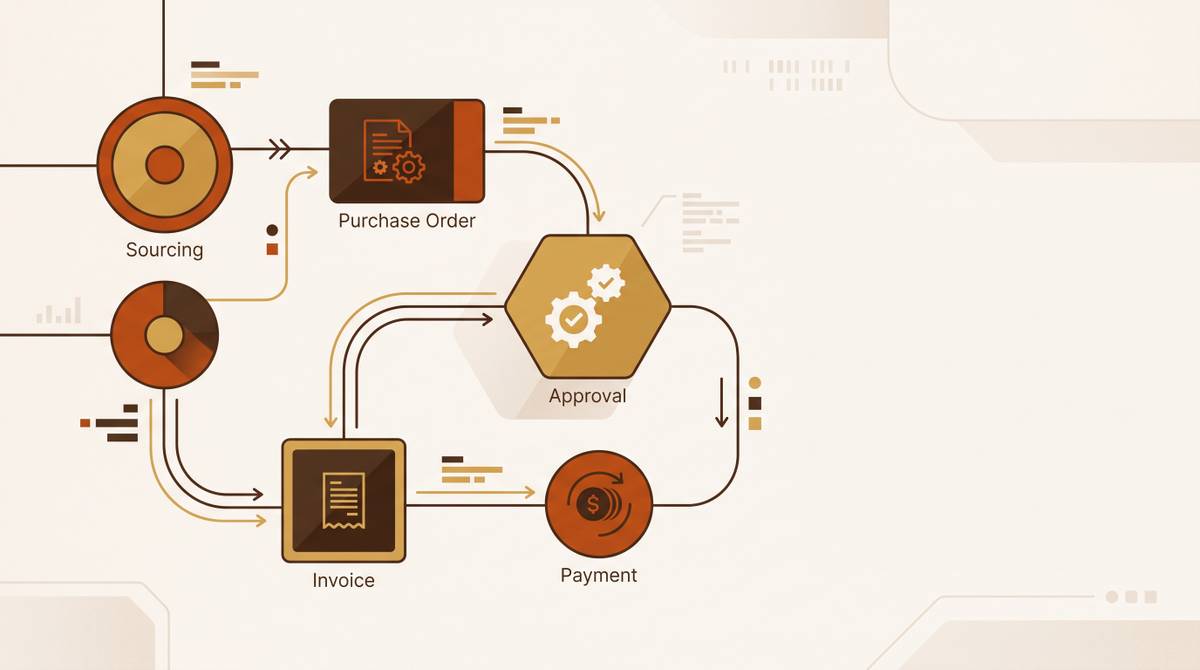
Strategic sourcing is sequential and interdependent by nature. Intake feeds sourcing. Sourcing depends on supplier vetting. Supplier vetting informs contracting. Contracting governs the purchase order, which connects to payment. Every step carries context from the one before it. In a single-agent model, the agent finishes its task and goes quiet. The bottleneck does not disappear; it relocates.
Here is the distinction that gets conflated constantly: predictive AI forecasts outcomes from data, generative AI produces content from training patterns, and agentic AI acts. It perceives signals, reasons through options, executes decisions, and feeds results back into a learning loop. The shift is from "show me the data" to "handle it." That is not incremental improvement. It is a categorically different mode of software behavior inside a workflow.
Autonomous agents capable of executing multistep procurement tasks, benchmarking, contract review, supplier onboarding, compliance monitoring, became practically viable around 2024. The question became coordination: how do you get multiple specialized agents working across an end-to-end sourcing process without recreating the same handoff failures you were trying to eliminate?
How a Multi-Agent Sourcing System Is Actually Structured
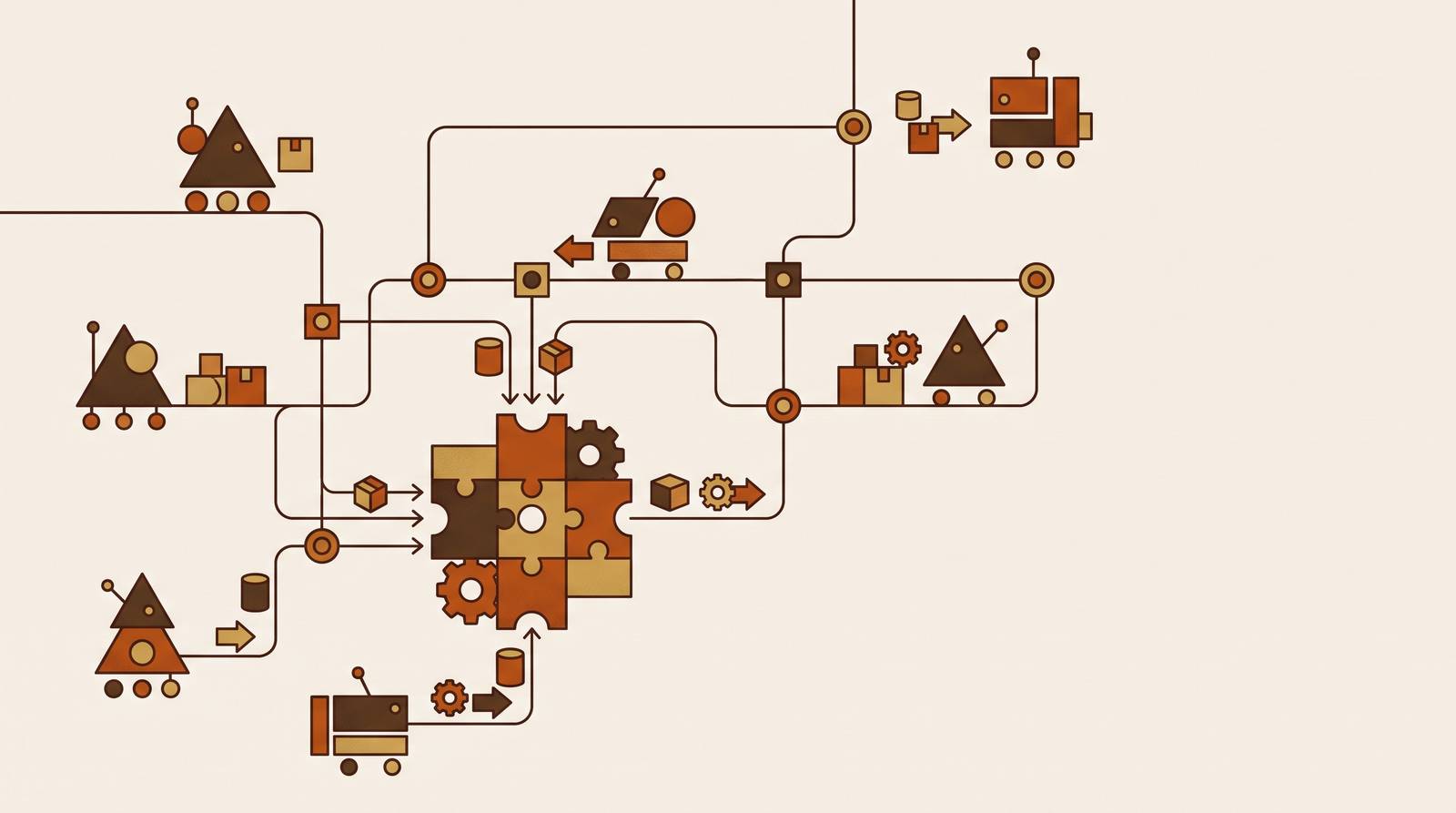
The architecture that solves the handoff problem is an orchestration layer sitting above a set of specialized agents. One governing layer, multiple domain agents handling sourcing, planning, risk, and compliance. The orchestration layer does not do the work; it makes sure the agents doing the work can actually communicate with each other.
What each agent does in practice matters more than the abstraction, so walk through it concretely.
An intake agent takes a business user's request, typically vague and underspecified, and translates it into structured procurement data. Before any human reviews the request, the agent has already checked policy, approval thresholds, preferred supplier lists, existing contracts, and current inventory. Intelligent routing happens before review, not after. That sequencing shift alone removes a significant volume of back-and-forth that most teams have simply accepted as the cost of doing business.
A sourcing or RFx agent compresses spend analysis, supplier shortlisting, RFP generation, bid evaluation, and scenario modeling into a single coordinated pass. The category manager's job shifts from assembling the picture to judging it.
A supplier risk agent runs continuously, monitoring structural supplier vulnerabilities, external disruptions, and trade and regulatory constraints. When it surfaces an exposure, it does not just flag it; it ranks executable responses, dual sourcing, nearshoring, supplier transition, vertical integration, and once a decision is approved, initiates onboarding and updates sourcing allocations in enterprise systems. No one has to assign a follow-up task.
A negotiation agent prepares the pre-negotiation fact base, surfaces suggestions during live negotiations, evaluates trade-offs across cost, service levels, and risk, and generates counteroffers calibrated to the negotiation's parameters. Telecommunications companies managing long-tail software spend have deployed this specifically because the volume of negotiations historically outpaced the human bandwidth to conduct them. The backlog was not a staffing problem. It was an architecture problem.
A compliance or contract agent handles downstream verification work that consumes disproportionate procurement time: reading an incoming email, verifying delivery claims, checking invoice eligibility, confirming prior payment status, surfacing a ranked set of actions. The human makes the call. The agent handles everything else.
What separates this from a sophisticated collection of point tools is multi-hop orchestration. A port delay triggers a logistics agent to flag the exposure window. An inventory agent reassesses safety stock. A procurement agent evaluates alternate suppliers and models switching costs. No human initiates each step. The orchestration layer manages the handoffs.
Cross-platform interoperability has moved from theoretical to practical faster than most expected. Anthropic introduced the Model Context Protocol in late 2024, subsequently donating it to the Linux Foundation in late 2025, standardizing how agents communicate with external tools. The Agent-to-Agent protocol allows third-party agents to collaborate within standardized workflows. SAP's implementation of A2A lets its Joule agents call external agents mid-task, meaning a procurement agent can query a logistics agent for inventory data while a finance agent reconciles cash, all inside a single sourcing decision. That kind of coordination was an integration project eighteen months ago. Now it is an architectural default.
What the Outcomes Data Actually Shows — and Where Results Concentrate
The most rigorously documented case in public sourcing literature is Walmart's autonomous negotiation program. Supplier agreement rate: 68%, against an initial target of 20%. Average cost savings: 3%. Average payment-term extension: 35 days. ROI: 4x. Eighty-three percent of suppliers rated the system easy to use.
Seventy-five percent said they preferred negotiating with the AI over a human counterpart. That number gets less attention than the cost figures, which is backwards. Better supplier experience, consistently, reliably, at scale, without any people — that is a signal about what was broken in human-led tail-spend negotiation in the first place. The old process had a people problem, and the fix turned out to be fewer people.
Harvard Business Review reported that roughly 80% of Walmart's suppliers had not been engaged in negotiations at all, because there was no bandwidth to reach them. The AI solved a coverage problem first and a speed problem second. The program has since expanded across Chile and South Africa, with Maersk, Henkel, Rolls-Royce, and Honeywell following similar patterns.
Before extrapolating, interrogate the conditions. Walmart's tail-spend negotiation is high-volume, low-complexity, and rule-bounded. The architecture fits that problem well. Reading it as a proxy for complex strategic sourcing, where relationships, custom commercial structures, and long-term supply decisions are genuinely at stake, is a category error.
Broader benchmarks from independent analysis are consistent, if wide-ranging. BCG estimates AI can streamline manual work in key procurement processes by up to 30% and reduce overall costs somewhere between 15% and 45%, a range that reflects variance in data maturity and deployment scope rather than methodological imprecision. McKinsey documented a technology company capturing 12% to 20% savings on contact-center spend and 20% to 29% on BPO spend through linked AI agents handling strategy and scenario modeling. A chemicals company piloting autonomous sourcing in consumables reported 20% to 30% efficiency improvement for procurement staff alongside 1% to 3% improvement in value capture. When agents coordinate across a full source-to-pay cycle, 30% process-efficiency gains have been reported, with 25% of the cost reduction attributed to orchestration specifically, not to individual agent performance.
Where is production adoption actually concentrated right now? Payables management. Hackett Group data shows 21% of companies running agentic AI in production there. Best-in-class touchless rates of 52.8% are delivering productivity roughly 3.5 times higher than the peer average. The pattern is not surprising: payables is structured, rules-bound, and data-rich. Those are precisely the conditions under which agents perform most reliably.
Strategic sourcing use cases, specifically negotiation, risk monitoring, and category strategy, show strong pilots and considerably lower at-scale deployment. PwC's modeling suggests agentic AI will eventually transform at least 75% of procurement activities. The gap between that projection and the current 12% large-scale implementation rate is where the real decisions are being made and, more often than not, deferred.
The Adoption Gap — and What Is Actually Blocking Most Procurement Teams
Research from AI at Wharton found that 94% of procurement executives use generative AI at least weekly. Yet research from Suplari in 2026 found that only 8% of procurement professionals use AI integrated into their actual procurement platforms. Nearly 90% of usage lives in general-purpose tools: ChatGPT, Copilot, Claude.
High familiarity with AI as a personal productivity aid has not translated into orchestrated, workflow-embedded deployment. Using Claude to summarize a supplier contract is not the same as deploying an agent that monitors that supplier's financial stability against live external feeds and flags a dual-sourcing recommendation when the signal deteriorates.
Data readiness is the first concrete blocker. Fragmented ERP instances, inconsistent spend taxonomy, and incomplete supplier master data undermine agent reasoning before it starts. You can deploy the most sophisticated orchestration layer available and still get unreliable outputs if the underlying data environment is incoherent. The agent is not the problem in that scenario. The data is.
Governance is next. Autonomous agents taking procurement actions without a defined human-approval layer create real compliance and audit exposure. Most organizations do not yet have agent governance frameworks. They are building policy for a capability they are simultaneously trying to deploy, which is genuinely uncomfortable, but there is no clean sequence available. You have to do both at once.
Integration complexity is the third barrier. MCP and A2A protocols are nascent. Connecting a sourcing agent to live ERP data, supplier networks, and external risk feeds requires technical investment that procurement teams rarely own internally. It requires real partnership with IT and, frequently, with the platform vendor itself.
Trust calibration is the most underestimated of all. Procurement leaders need to know which agent decisions to validate and which to let run autonomously. That judgment develops through organizational learning over time, not through configuration settings. No vendor ships it. You earn it through exposure to real decisions, including the ones the agent gets wrong.
The 43% of organizations actively pursuing deployment signals genuine momentum. But deployment and production use are different thresholds, and most organizations are still in the pilot zone.
How Procurement Teams Sequence Multi-Agent Adoption Without Overreaching
Start where the data is cleanest and the processes are most rule-bound. Payables and tail-spend are the natural entry points, which is exactly why payables already shows 21% production penetration. High transaction volume, defined rules, limited exception complexity, clear success metrics. Beginning somewhere more ambitious is usually a mistake born of impatience rather than strategy.
Use the first deployment to build the data foundation the next one requires. Clean supplier master data, consistent spend taxonomy, documented approval thresholds: these are prerequisites for sourcing and risk agents, not afterthoughts. Organizations that treat the first phase as infrastructure-building tend to move considerably faster in the second.
The sequencing logic is fairly consistent across enterprise contexts. First comes intake and routing: structured, policy-bounded, low-consequence errors, and a real mechanism for building organizational trust in autonomous action without betting anything material on it. Second comes RFx and bid analysis, high time-cost activities where speed gains become immediately visible to stakeholders who have been skeptical. Coupa's Bid Evaluation Agent and SAP's Bid Analysis Agent are both in production and serve as concrete reference points for what this phase looks like at scale. Third comes supplier risk monitoring and negotiation, higher complexity, higher value, requiring richer data and clearer human-in-the-loop checkpoints before autonomous action.
The human-in-the-loop design is not a temporary concession to organizational anxiety. It is the correct architecture for decisions involving supplier relationships, contract terms, and risk trade-offs. Agents that surface ranked options and then wait for approval consistently outperform both fully autonomous systems and fully manual approaches in high-stakes sourcing decisions. Judgment still matters in ways that are difficult to fully encode.
McKinsey's chemicals company example is instructive here. Agents prepared tenders, prequalified suppliers, and routed supplier queries. Category managers closed the deals. The 20% to 30% efficiency gain came from removing assembly work, not from removing judgment. That is the right mental model for most organizations entering this space.
Build the governance framework early: which agent actions require human sign-off, how are agent decisions logged for audit, who is accountable when an agent makes a consequential error. These questions become urgent faster than most teams expect, usually right after the first decision that surprises someone in finance or legal.
What the Leading Platforms Offer — and Where the Differences Are Material
The procurement software market was valued at roughly $6.6 billion in 2024 and is projected to reach $8.6 billion by 2029. The broader AI agents market is growing considerably faster, and the two are converging. Platform selection is increasingly inseparable from agent strategy, which means choosing a platform without a clear sequencing plan is choosing blind.
SAP's next-generation Ariba suite has been rebuilt on SAP Business Technology Platform. The Bid Analysis Agent is live. An Intake Management agent through Joule is expected to reach general availability in mid-2026. SAP was named a Leader in the 2026 Gartner Magic Quadrant for Source-to-Pay Suites. The Bid Analysis Agent evaluates supplier bids simultaneously across total cost, quality, delivery reliability, sustainability ratings, and risk profile, replacing days of manual scoring with a single structured comparison. For SAP-native organizations, the genuinely differentiated capability is the data layer: custom agents have direct access to the customer's SAP data through SAP Business Data Cloud, enabling orchestration across procurement, supply chain, HR, and ERP in a single agent chain. A2A interoperability allows Joule agents to collaborate with third-party agents in standardized workflows, which becomes more consequential as the agent ecosystem matures beyond its current early-adopter phase.
Coupa's Navi agent portfolio launched in April 2024 and expanded multi-agent capabilities in May 2025, with more than a hundred AI-driven enhancements added by late 2025. The Analytics Agent generates custom reports significantly faster than manual compilation. The Bid Evaluation Agent automates supplier scoring. The Request Creation Agent converts unstructured requests into structured procurement actions. Coupa's real competitive differentiator is its network: tens of millions of buyers and suppliers, with a community-generated spend dataset exceeding $9 trillion underpinning its AI models. Spend classification accuracy benchmarks in the 85% to 90% range against UNSPSC and custom taxonomies, sufficient for most enterprise use cases. Coupa holds a Leader position in both the 2025 and 2026 Gartner Magic Quadrant.
Other significant platforms in the source-to-pay category include GEP SMART, JAGGAER, Ivalua, and Zycus, each with distinct architectural approaches and vertical strengths. Zycus deployments have demonstrated measurable improvements in spend under management across large enterprise rollouts.
The differentiator question that actually matters is not which platform's demo is most compelling. It is which platform fits your data environment, specifically SAP-native versus best-of-breed, aligns with your current agent governance maturity, and maps to the sequencing phase your team is genuinely in. An organization deploying intake and routing agents for the first time has different platform requirements than one working on negotiation and risk orchestration. Conflating those requirements produces expensive mismatches that are uncomfortable to explain to a CFO.
Where Multi-Agent Sourcing Is Headed and What Procurement Leaders Should Do Now
Autonomous agents will handle a growing proportion of structured procurement tasks. The orchestration layer will coordinate longer chains of agent action with progressively less human initiation at each step. Interoperability protocols will mature, making cross-platform and cross-system agent collaboration less technically burdensome. None of this is speculative; the trajectory is legible in what is already running in production today.
The most consequential near-term shift is from isolated agent deployments to systems that learn from their own outputs. An agent that runs the same bid evaluation process a hundred times and refines its scoring model based on outcomes is qualitatively different from one that resets after each task. That feedback loop is where compounding value accumulates.
Autonomous negotiation will expand beyond tail spend as governance frameworks develop and organizational trust is earned through track record rather than promised by vendors. Risk monitoring will move from periodic review to genuinely continuous intelligence. Category strategy will increasingly be informed by agent-synthesized market data that no team can realistically gather manually, which changes not just what category managers do with their time but what they are actually for.
Here is what to do now, and I mean specifically. Quantify your efficiency gap using the same framework Hackett uses, not because the exercise is intellectually satisfying, but because a number focuses investment decisions in a way that a felt sense of pressure cannot. Audit your data environment before you select a platform, because the sequencing logic only holds if you are honest about what your data actually looks like today, not what it is supposed to look like after the next ERP migration. Deploy something in production rather than in pilot. The trust calibration gap does not close through demos; it closes through letting an agent handle real intake routing or real bid scoring and watching carefully where it performs and where it requires correction. That watching is not overhead. It is the work.
Build the governance framework before you need it urgently. The organizations navigating this transition most effectively are not the fastest movers. They are the ones who knew, before anything went sideways, exactly who was accountable and why.
The efficiency gap is structural and it is widening. The tools exist. What remains is the organizational discipline to deploy them in the right order, on honest data, with governance that does not get built in a panic.