Carbon Emissions Reporting in Digital Freight Platforms
Digital freight platforms must now embed emissions calculations that regulators will actually audit.
Freight emissions reporting stopped being a slide in someone's sustainability deck around 2023 and turned into an operating requirement with real deadlines and real fines attached. This piece looks at where that requirement actually gets carried out day to day: digital freight platforms, which have become the place where data collection, calculation rules, and compliance reporting all collide. I've spent enough time in the weeds of freight data to tell you the collision is messier than any regulator's slide deck suggests, and the sections below walk through why.
The regulatory stack shippers and carriers are now navigating
Freight demand is on track to roughly double by 2050, per the Smart Freight Centre, and the rules for measuring that freight went from proposal to enforcement in a window of about two years, 2024 to 2026. That's the whole story in one sentence: what felt like a slow policy conversation for a decade suddenly became a deadline with teeth.
Start with the EU's Corporate Sustainability Reporting Directive. Around 50,000 companies fall under its double-materiality rules, and the first reports, covering 2024 activity, came due in 2025. CSRD pulls carriers and freight forwarders in through Scope 3 Category 4, the upstream transportation category, so plenty of companies that never thought of themselves as "in scope" now answer to a customer's compliance team anyway.
Then there's the EU Emissions Trading System, expanded to cover maritime shipping in 2024. Shipping lines now surrender allowances for a growing slice of their emissions each year, climbing to full coverage by 2027. That allowance cost, running somewhere around €80 to €100 per ton of CO2 right now, doesn't sit quietly on the carrier's books, since it shows up on the shipper's invoice as a carbon adjustment line item, passed straight through.
CBAM adds quarterly submission requirements starting in 2026. The EU's Green Claims Directive bans the loose language that used to pass for sustainability marketing, phrases like "carbon-neutral" with no lifecycle math behind them. Across the Atlantic, California's SB 253 requires Scope 1 and 2 disclosure starting in 2026 and Scope 3 in 2027, for any company doing business in California with more than a billion dollars in revenue. That threshold reaches well past companies headquartered there; sell into California and this applies to you no matter where your mail gets delivered.
The IMO's 2023 Strategy targets net-zero shipping by 2050, with a 40% carbon intensity cut required by 2030, and its EEXI and CII rules already bind existing vessels today. The European Commission has put forward CountEmissionsEU, aimed at building shared databases and calculation practices across transport. That's a signal worth sitting with: more standardization is coming, not less.
No single rule here catches every player in freight. Stack them together, though, and there's almost no major shipper, forwarder, or large carrier left with a clean way to opt out.
What ISO 14083 and the GLEC Framework actually require platforms to do
The GLEC Framework, built by the Smart Freight Centre, is the methodology the industry actually leans on to measure freight emissions. ISO 14083, published in March 2023, is the global version of it, and it replaced the older European standard, EN 16258. That swap matters more than it sounds like it should; EN 16258 left gaps that ISO 14083 was built specifically to plug.
One of those gaps was hub facilities. ISO 14083 covers every transport mode, and for the first time it pulls in ports, warehouses, and intermodal terminals, places where freight sits and gets handled but never showed up in the emissions math before.
The bigger shift is about the data itself. ISO 14083 pushes companies away from rough estimates and toward actual fuel burned, real distances traveled, real load factors. This is the standard that quietly exposes how thin most legacy reporting has been. A lot of what companies called "emissions data" for the last decade was closer to an educated guess wearing a spreadsheet as a costume.
There's a scope distinction worth sitting with too: well-to-wheel versus tank-to-wheel. Well-to-wheel counts upstream fuel extraction and refining, while tank-to-wheel counts only what burns in the vehicle itself. GLEC version 3 defaults to well-to-wheel, but plenty of legacy calculation tools still default to tank-to-wheel, and auditors keep flagging it, because the gap between the two isn't cosmetic and moves the reported number by a real, meaningful amount.
ISO 14083 also draws a hard line between measuring emissions and offsetting them. EU ETS allowances and carbon offset certificates can't get netted against a reported figure. A platform that lets a customer subtract offsets from their reported total is not in conformance, full stop, no asterisk. GLEC's tiered data quality system, running from basic estimates built off shipment details up to advanced calculations built off actual vehicle-specific data, requires companies to disclose which tier they're using. Auditors watch that disclosure closely now, because claiming "advanced" while quietly running "basic" math underneath is exactly what third-party assurance exists to catch.
What this means for platforms is pretty simple: showing a number on a dashboard isn't enough anymore. The methodology logic, the emission factor selection, the data tier, the well-to-wheel or tank-to-wheel scope, all of it has to live inside the calculation engine itself, applied the same way every single time, automatically.
Why emissions figures vary so widely across platforms and how data quality explains the gap
Regulators and buyers want precise, auditable numbers now, yet most of the industry's current data habits produce wildly different results for freight that should look nearly identical on paper. This isn't a rounding error. It's a methodology problem, and it runs deeper than most people assume.
Transporeon's 2024 Green Freight Report, drawing on more than 700 shippers and carriers across Europe and North America, found that only 20% of respondents measure emissions using primary data, while forty percent still lean on estimates. That gap between "actual" and "estimated" is where most of the wild variation in reported numbers comes from.
Generic calculators running average emission factors get you into a rough ballpark, nothing more. Vessel-specific data, pulled from AIS tracking and actual fuel consumption logs, gets you into the tighter precision ISO 14083 actually asks for. The gap between those two approaches isn't marginal. It's the difference between a guess and a measurement, and no amount of dashboard polish closes that gap.
One example makes it concrete. A retail customer saw its reported Scope 3 emissions jump 30% when it switched from spend-based estimation to activity-based calculation. The emissions themselves didn't go up overnight; the spend-based method had simply been undercounting them the whole time, because how much you spend on freight and how much carbon that freight produces don't move together in any reliable way.
Mode intensity gets conflated constantly, and it shouldn't be, because the spread here is enormous. Rail running on renewable electricity sits near the bottom of the motorized emissions spectrum, while air freight sits near the top. Use a blended modal factor, or the wrong one entirely, and your resulting figure isn't off by a few percentage points; it can be off by an order of magnitude.
Underneath all of this sits a structural mess: transport data lives across systems that were never built to talk to each other, scattered across supply chains with dozens of stakeholders, each running its own reporting habits. Pulling that into one clean dataset can take months, sometimes years, in a decentralized setup with no single owner.
So when two shippers report different numbers for freight that looks the same on paper, the difference is usually about method, not operations. That's exactly the opening platforms are built to close, by baking the methodology into the transaction itself instead of leaving it to whoever ends up doing the math after the fact.
The collaboration gap between shippers and carriers that makes platform-level data collection necessary
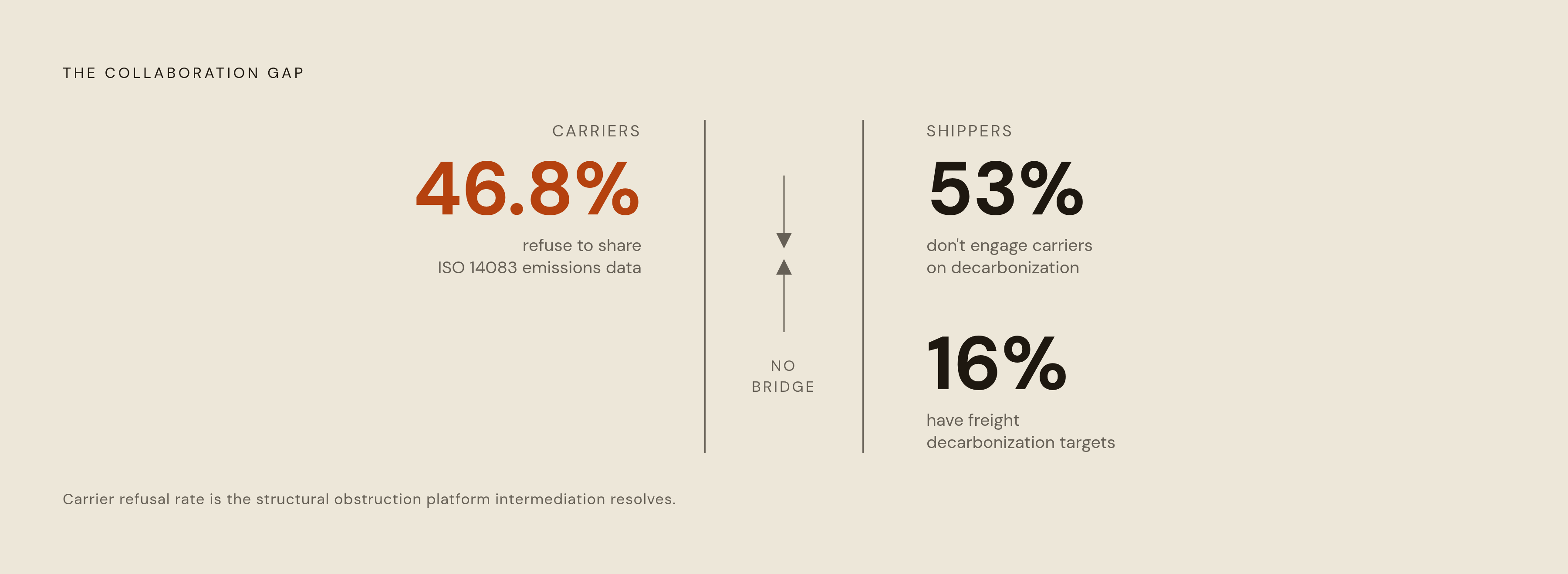
Here's the part that would be funny if it weren't so expensive. ISO 14083 requires primary data, yet nearly half of carriers, 46.8% according to that same Transporeon report, say they won't share the exact data needed for someone else to calculate their emissions. The standard asks for the one thing a huge chunk of the industry refuses to hand over.
Shippers aren't exactly leading a charge in the other direction either. More than half, 53%, don't actively engage their carriers on decarbonization at all. And 56.91% of shipper respondents said they weren't even sure whether their own company had a freight decarbonization strategy; only 16% said, with any confidence, that their company had actual targets in place. Only 45% of shippers use the GLEC Framework or ISO standard for their calculations, which means most of the market isn't even working off the same baseline yet.
Part of this is scale, plain and simple. U.S. trucking alone involves hundreds of thousands of companies, most of them small operators without the staff or systems to run detailed reporting. Bilateral data-sharing agreements between every shipper and every carrier they touch don't work at that volume; there aren't enough hours in a year to sign that many contracts.
Part of it is trust, and the trust problem has a commercial root, not an emotional one. Carriers worry that handing over fuel consumption data hands their cost structure to the shipper sitting across the table negotiating rates. Shippers worry that disclosed routing data tips off sourcing decisions to competitors. Neither fear is irrational, and neither side is wrong to be cautious.
This is where the platform actually does something useful. If emissions calculation happens inside the system already processing the shipment, neither side has to hand raw operational data to the other directly, since the platform holds it, runs the math, and produces a conformant figure. The data-sharing standoff turns into a platform design question instead of a trust exercise, which is a far easier problem to solve.
How leading digital freight platforms have built emissions reporting into their core transaction layer
There's a real difference between a platform that bolts on an emissions calculator as a side feature and one that generates emissions data continuously, as a byproduct of moving freight. The second version is what conformance at scale actually requires, because the number was never separate from the shipment to begin with.
Flexport calculates an emissions footprint for every shipment it moves, using EcoTransIT World as the calculation engine, accredited by the Smart Freight Centre under both GLEC and ISO 14083. It handles batch calculation across large shipment volumes in seconds, which answers a fair question up front: does accreditation hold up at real scale, or only for boutique volumes? Apparently it holds.
Transporeon, now part of Trimble, runs a network covering more than 1,300 industrial shippers, around 100 large retailers, and over 145,000 carriers, moving a high volume of transports every day. It rolled out a Carbon Visibility tool globally after phased testing. Scale is the point here: the platform already sits on top of the transaction data that primary-data calculation depends on, so it isn't hunting for that data somewhere else.
PSA BDP's Carbon Dashboard, also built on EcoTransIT World, tackles a specific headache: pulling emissions reports from multiple forwarders and carriers into one view instead of a dozen mismatched spreadsheets nobody wants to reconcile. Its membership in the Clean Cargo Alliance also gives it access to carrier-specific ocean freight emissions factors, a good example of industry membership translating directly into data quality.
Dockflow uses GPS and AIS data for real-time carbon intensity monitoring across ocean, road, rail, and air, and automates CSRD-aligned reporting in a standardized format. Live tracking data is what closes the gap between an estimate and an actual measurement here.
Einride is a different animal: it's the transportation provider itself, so it holds primary transport data natively instead of collecting it from someone else. Its emissions methodology got accredited under GLEC, and it draws on that same primary data for further operational insights. Vertical integration turns out to be a genuine structural edge when it comes to primary-data access.
The thread running through all of these: GLEC and ISO 14083 accreditation is turning into table stakes, not a selling point. Platforms without it will start hitting procurement questions they can't answer.
The technology choices that determine whether a platform's emissions data is auditable
Not all emissions numbers are created equal, and the difference usually comes down to a handful of technical choices most people never notice.
The first is whether the number is embedded or extracted. Platforms that build calculation engines directly into freight audit and invoicing workflows produce emissions data as a natural byproduct of processing the transaction. There's no separate export step, no manual re-entry, no risk that the freight record and the emissions record quietly drift apart six months later.
For ocean freight specifically, AIS-derived vessel data, actual fuel consumption tied to actual voyages, is what moves a calculation from rough estimate into the tighter accuracy ISO 14083 demands. A platform relying only on route distance and average vessel factors can't get there, no matter how nice the dashboard looks.
AI-driven route optimization tools increasingly show that optimization and emissions measurement were never really separate jobs. The same activity data that makes routing more efficient is the data needed to calculate emissions from primary sources; one dataset, doing two jobs at once.
There's a resource-efficiency angle worth flagging too. Data from Full Truck Alliance, China's largest online freight platform, shows platform-based matching cuts down on empty runs and half-loaded trucks. That's an emissions benefit built into how the platform runs day to day, not something bolted on afterward for a sustainability report nobody outside the compliance team reads.
API connectivity matters more than it sounds like it should. In a fragmented carrier and forwarder landscape, API-based data ingestion is the practical way to pull in primary data without asking carriers to rip out and replace their internal systems. Less friction here chips directly away at that 46.8% data-sharing refusal rate mentioned earlier.
Auditability, in the end, comes down to provenance. A platform needs to show which emission factor it applied, which data tier it used, whether the scope was well-to-wheel or tank-to-wheel, and the date the calculation ran. A number without that trail behind it won't survive third-party assurance under CSRD or SB 253, no matter how accurate it happens to be underneath.
One more wrinkle worth mentioning: the EU's Green Claims Directive means a platform slapping a "carbon neutral shipment" label on something without the lifecycle math behind it isn't just sloppy work, since it's legal exposure for the shipper using that label downstream. The technical architecture has to actually support the claim, not just gesture in its direction.
What the green logistics market growth means for how platforms will be evaluated going forward
The green logistics market is projected to grow from $1.39 trillion in 2025 to $2.06 trillion by 2030, an 8.29% compound annual growth rate according to Mordor Intelligence. This isn't a niche market expanding at the edges; that's emissions reporting getting absorbed into ordinary logistics procurement as a baseline expectation instead of a specialty add-on somebody pays extra for.
Adoption of digital freight corridor platforms among tier-1 logistics companies has climbed substantially since 2021, per Dataintelo, and the growth curve there has moved well past the early-adopter phase into mainstream deployment. Platforms aren't selling to the enthusiasts anymore, since they're selling to everyone, including the companies that would rather not think about any of this.
What that changes is the evaluation criteria itself. Early platform selection ran on booking efficiency and rate visibility, plain and simple, nothing more complicated than that. The next wave of procurement decisions will layer in GLEC and ISO 14083 accreditation, clarity about which data tier is in use, and compatibility with third-party assurance, as basic requirements rather than nice-to-haves buried in a sales pitch.
The assurance bar is rising on a fixed schedule too. California's SB 253 requires limited assurance on Scope 3 starting in 2027, stepping up to reasonable assurance by 2030. Reasonable assurance is a genuinely high bar; it demands data that's verifiable, not just calculated and presented with a straight face. Platforms that can't produce a clean audit trail aren't just falling behind on features, since they become a liability for the customers who relied on them to get this right.
The 46.8% of carriers unwilling to share primary data won't shrink because everyone suddenly feels more cooperative. It'll shrink because platform architecture makes sharing structurally safe, or because regulation makes withholding the more expensive option. Either way, the direction is the same.
Put it together and the pattern is hard to miss: as assurance requirements tighten and methodology conformance becomes something an outside auditor can actually check line by line, platforms with embedded, accredited, primary-data calculation stop being a nice convenience. They become the infrastructure that makes compliance possible in the first place, and everything without that quietly becomes someone else's problem to explain.