Fleet Carbon Footprint Reduction Through Route Optimization
Software can cut fleet emissions 25-35% faster and cheaper than buying new trucks.
In 2024, transportation released 8.4 gigatons of CO2-equivalent, making up 15.9% of worldwide greenhouse gases, second only to power and manufacturing. Road vehicles make up three-quarters of that total, with freight trucks being a bigger contributor than their numbers suggest. The clear solution, swapping out trucks or switching to electric, takes the longest time. Cutting emissions faster and cheaper means using software to direct existing trucks and manage their idle time, not buying new ones.
Why vehicle replacement and electrification cannot be the only answer
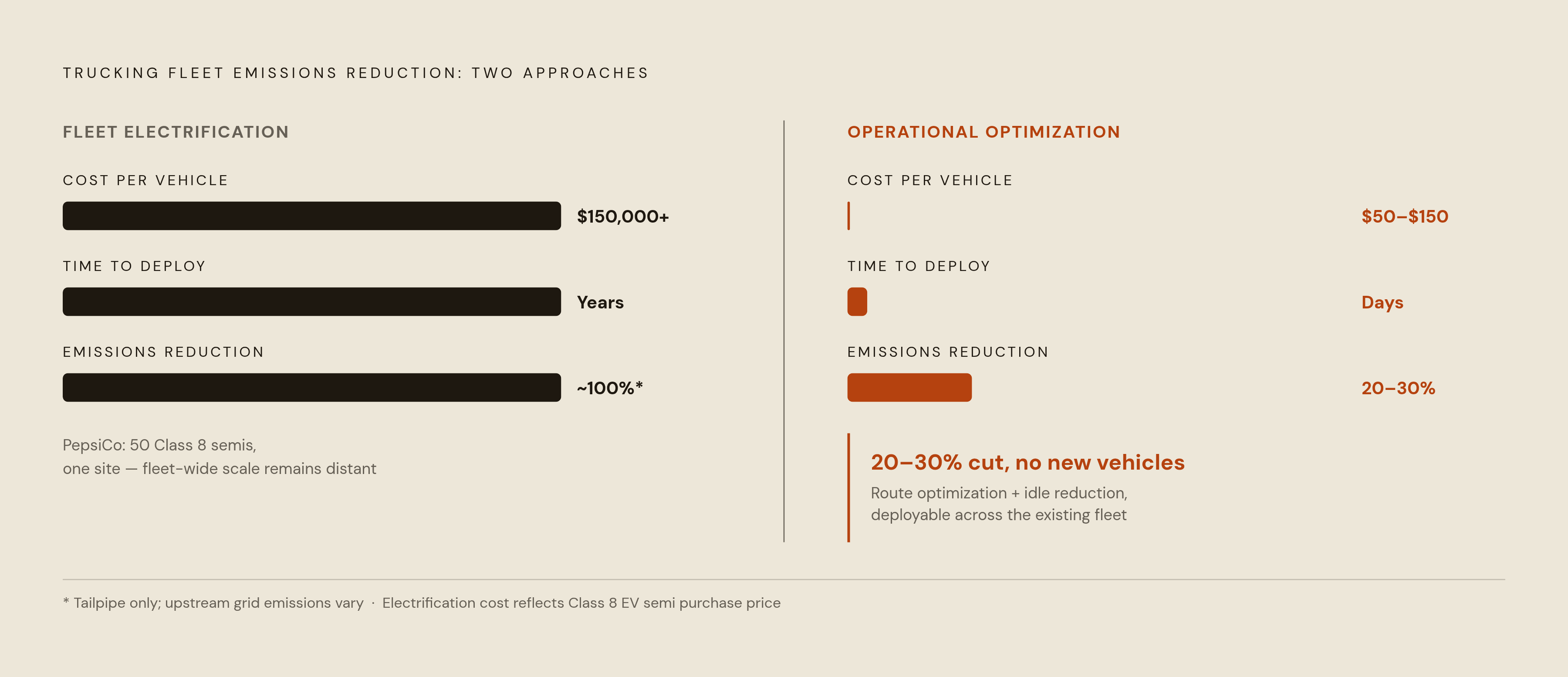
Fleet replacement happens on a calendar measured in years. Electrification takes years due to permit waits, power upgrades, and long equipment backlogs. PepsiCo's 2025 milestone, deploying 50 Class 8 electric semis at one Fresno site, was called its largest electric Class 8 rollout ever. Fifty trucks, against a fleet logging hundreds of millions of miles a year. A big rollout like that barely makes a dent in the fleet's total mileage, and that's the whole point in a nutshell.
Step back, and the outlook remains largely unchanged. Battery-electric registrations for medium- and heavy-duty vehicles increased in 2024, but compared to the whole U.S. commercial fleet, the share remains small. Biodiesel and renewable diesel use is rising. Changing fuels won't lower miles driven. It just cleans up each mile a bit. A substitution is not a reduction, no matter how the press release words it.
These tweaks work on their own schedule. Fleets can deploy route optimization, idle reduction, and preventive maintenance for $50 to $150 per vehicle, cutting emissions right away without needing new trucks. Combine those measures and most fleets can realistically cut emissions by 25 to 35% through efficiency alone, often before any new vehicle arrives. Operational optimization isn't a stopgap fleets settle for until the "real" solution shows up. It's the quickest fix available now, and operational improvements add to electrification benefits later, not replace them. Anyone who sees fleet electrification as the main emissions fix for the next five years is focused on 2030 and overlooking the trucks already in their yard today.
How route optimization actually reduces emissions, the direct mechanism
Route optimization is confused with a shortest-path problem. It isn't one. Real systems factor in traffic patterns, road grade, delivery windows, vehicle capacity, and fuel burn simultaneously, producing the most efficient route overall, not just the shortest one.
The calculation for emissions is surprisingly straightforward. Cutting mileage by 10% directly reduces emissions by about 10%. No need for conversion tables or new engines and special fuels. Less driving equals less carbon out the tailpipe, period.
Three mechanisms get it done. Better sequencing stops trucks from driving extra miles that don’t get packages any nearer. Tighter scheduling cuts the time trucks waste idling at docks and stoplights, which we'll examine more closely next. Load consolidation, which groups deliveries logically and fits vehicle size to the task, lowers the total number of trips needed.
What happens when an algorithm replaces a human dispatcher? Simulation studies have compared AI routing models like Ant Colony Optimization, Neural Networks, and Hybrid Genetic Algorithms to standard routing methods. These models can reduce fuel consumption and carbon emissions. That tracks with the basic shape of the problem: a human planner juggling a delivery schedule holds fewer variables than an algorithm can process simultaneously. The distance between those two numbers is free efficiency sitting on the table in most fleets, waiting for someone to bother picking it up.
Machine learning provides an additional tool. Traffic, weather, and vehicle data update the system nonstop, so routes change as conditions change instead of staying fixed when sent out.
Idling: the emissions loss that route scheduling directly controls
Idling for an hour wastes a gallon of fuel, covering no distance and accomplishing nothing. A delivery truck idling 1,800 hours yearly, common in city traffic and dock lines, wastes 1,500 gallons of fuel and over $4,000 each year. Scale that across a fleet, and the cost shifts from oddity to something worth shouting over in a budget review.
Every day, unnecessary idling in the U.S. burns 3.8 million gallons of fuel. Fuel turns into exhaust as trucks wait for loading docks, day after day, fleet after fleet.
Cutting idling can save 10 to 20% on fuel in 90 days. One fleet management provider reported that its customers cut idle time by 373,000 hours from July 2024 to July 2025, saving about 186,000 gallons of fuel and reducing over 1,650 metric tons of CO2. That's not a lab simulation. These are actual fleets, with real drivers navigating real traffic, facing real fuel costs each month.
Route optimization plays a key role here. Tighter schedules cut waiting at docks and delivery bottlenecks, while smarter sequencing reduces time idling in traffic with the engine on and the truck stationary. By combining idle reduction and route optimization, total emissions drop 20 to 30%, all without vehicle replacement. The two levers work together, not just in tandem, as tighter routes reduce idling opportunities and less idling improves route timing predictability.
What realistic emissions and cost reductions look like in practice
Better route planning with software usually reduces fuel use by 15 to 25%. Redesigning delivery zones can further reduce total mileage by 20 to 30%.
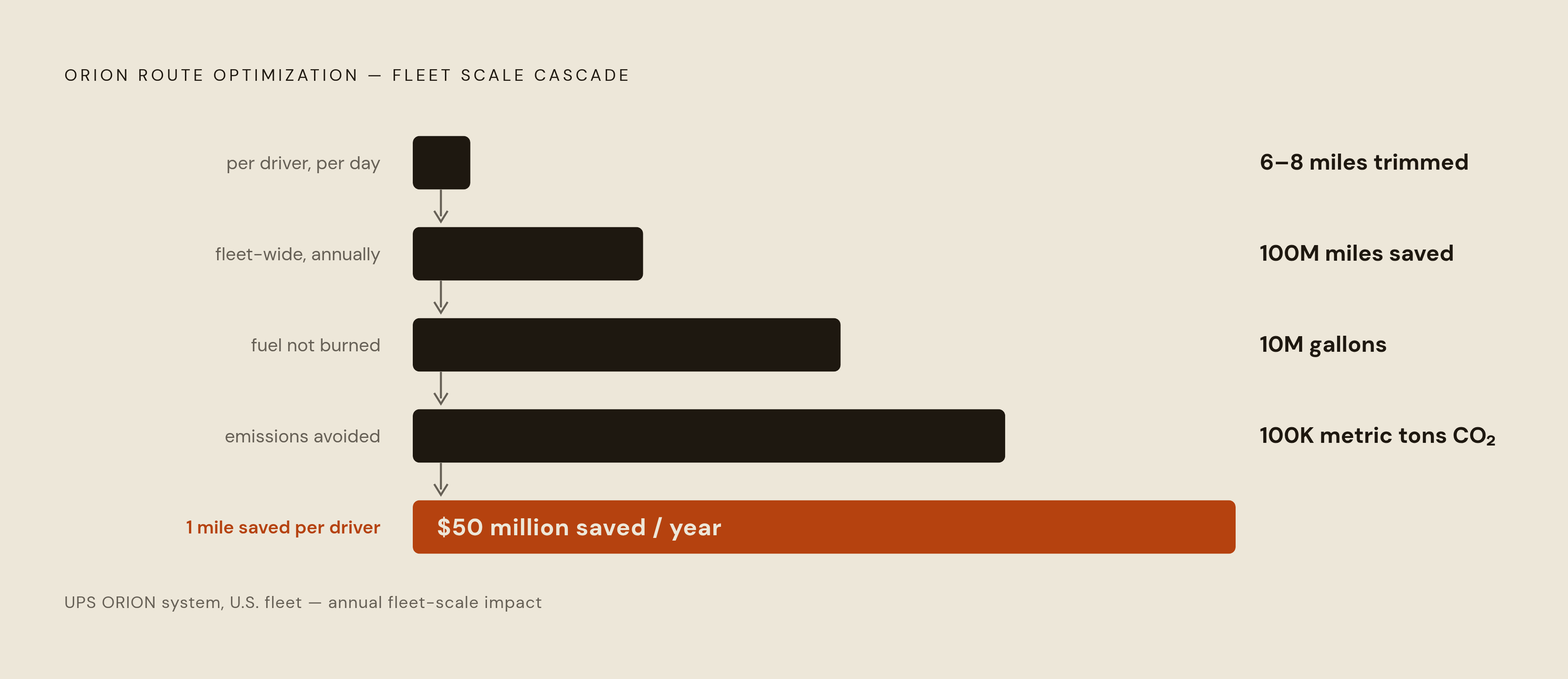
UPS's ORION system (On-Road Integrated Optimization and Navigation) is likely the best-documented example in this field. UPS's ORION system optimizes many of its tens of thousands of U.S. routes, reducing average daily driving by 6 to 8 miles per driver. Spread that across the whole fleet, and it means 100 million fewer miles driven each year, 10 million gallons of fuel not used, and 100,000 metric tons of CO2 kept out of the air annually, equivalent to permanently removing tens of thousands of cars from the road. Yearly savings are estimated at hundreds of millions of dollars. UPS found that shaving a single mile from each driver’s daily route across the fleet saves them $50 million annually. Only one mile.
Even before ORION, UPS's Package Flow Technology alone saved millions of gallons of fuel and cut tens of thousands of metric tons of CO2 annually. Each optimization brought unique benefits beyond previous ones, so no single solution should be seen as the finish line.
PepsiCo uses the same strategy in its North American drinks unit, optimizing routes, loads, and driver efficiency over hundreds of millions of yearly fleet miles. This isn’t just for big logistics companies with specialized teams. The 2025 Energy Report from Teletrac Navman says 84% of fleet operators now slash emissions with tweaks like these. This practice is now standard, even if the trucking press hasn't reported it yet.
Telematics as the data foundation that makes optimization actionable
An optimization algorithm can't be smarter than the data it gets. Telematics provides that data: live vehicle location, speed, idle times, fuel use, and maintenance info, all streaming in real time so the routing engine can keep updating instead of using a fixed plan made at 6 a.m. and left unchanged.
GPS tracking users have seen fuel savings increase from 8% in 2021 to higher levels in 2025. That's not just better software. That's operators improving how they put the data to use. Fleets using telematics devices can cut fuel costs and idle time through real-time data and driver coaching.
Driver coaching through telematics takes efficiency beyond the route and into how people drive. Using eco-driving methods like smoother acceleration, earlier braking, and gentler lane changes can reduce fuel use, with carbon emissions dropping too. Real-time alerts for harsh braking, speeding, and idling correct behavior on the spot, not weeks later in a forgotten performance review.
Another benefit is maintenance compliance. Tires with low air and missed maintenance both increase fuel use, but telematics spots these issues before they affect many vehicles. Buying telematics with route optimization isn't extra spending. It keeps the optimization layer delivering consistent results over time, not just a single strong quarter before gradually slipping back. Without telematics, route optimization operates blindly, guessing at conditions rather than responding to them.
How to implement route optimization systematically across a fleet
Begin with a baseline, since you can’t manage what you haven’t measured first. It's simple arithmetic: multiplying each vehicle's annual fuel consumption by its emission factor yields its yearly CO2 output in kilograms, and adding these up gives the fleet's total emissions. The emission factors used here are publicly available, not proprietary data hidden behind a paywall.
Roll it out step by step, and don't try to change everything immediately. For weeks to a few months, the short term involves cutting obvious wasted miles from current routes, activating idle-reduction warnings, and managing tire pressure and routine maintenance checks, at a modest cost per vehicle. Over the next several months to a year, add real route-planning tools with AI scheduling, connect the telematics data, and launch a driver training effort. Long term means redesigning delivery zones and networks, aligning vehicle replacement with emissions targets, and using alternative fuels or electrification only where infrastructure supports it. The order is important: fleets that go for electrification before sorting out routing and idling spend the most money for the least payoff.
You can't make this work unless you track key metrics from the start: CO2 per kilometer, idle hours per vehicle, out-of-route miles, and fuel used per delivery stop. Without tracking these metrics, leadership won't see the benefits, and you can't report them under CSRD or similar rules.
Drivers carry out the plan, so getting their commitment is essential, and most rollouts overlook this step. The best route planning is useless if drivers ignore it, take habitual shortcuts, or idle their engines for fifteen minutes at a dock. Drivers learn better habits through training and instant feedback, so the plan on paper matches what they do behind the wheel.
When looking at software, you should check real-time traffic updates, multi-stop route planning, idle time tracking, driver behavior ratings, and how well it connects with your current fleet management system. The vendor market is now a multibillion-dollar segment, with more competition, better products, and shrinking payback timelines. Companies using AI route optimization now often see payback in months instead of the multi-year periods this software once needed.
Fleets with CSRD reports or eco-friendly contract bids need documented emission cuts from route optimization; it's more than good practice. They give you an advantage that's visible in the proposal and clear to the client. Doing the routes and the paperwork help each other, but that only happens when you plan the tracking upfront, not patch it on later.