Instant Ocean Freight Rate Quotes on Digital Platforms
Digital platforms show rates in seconds, but the data behind them moves at vastly different speeds.

Ocean freight quoting used to mean picking up a phone or firing off a dozen emails and waiting hours, sometimes days, for a number to come back. Today a shipper opens a browser tab and has a rate in under a minute. This piece looks at how that shift actually happened under the hood, and why "instant" doesn't mean quite what people assume once you trace the number back to its source.
Before Maersk built Spot, booking a container reportedly ran through 13 separate steps, most of them offline: phone calls, faxed rate sheets, one agent checking with another agent, someone re-typing a number into a spreadsheet that was stale by the time it saved. I've watched a forwarder do this dance in real time, three tabs open, two phone calls on hold, and a rate sheet from Tuesday that everyone quietly agreed was probably still fine. The process ran this way by design. Rates got negotiated bilaterally between shippers and carriers, so nobody had a clear view of the market, and leverage sat with whoever had the fattest Rolodex. Ocean spot rates can move within hours, which makes for a genuinely absurd setup: a quote from Monday morning could be worthless by Wednesday afternoon, and the forwarder who issued it might eat the difference out of their own margin. Even the standard 7 to 14 day quote validity window, meant to buy shippers time to decide, mostly meant they had to move fast inside a process that never moved fast to begin with.
How digital platforms source the rates that power instant quotes
Where does the number on your screen come from? Three places, mostly, and the mix behind any given platform matters more than most people bother to check.
The cleanest source is a direct carrier API: rate data pushed or pulled straight from the carrier's own system, no middleman. Second is rate sheet ingestion, which sounds dull until you learn Okargo alone processes over 4,000 rate sheets a month for more than 150 independent forwarders. That volume is well past what a human can review line by line; it needs parsing software, not manual review. Third is the contracted and spot rate database itself. iContainers draws on more than 250,000 ocean freight rates, and SeaRates claims over 70 million price points across transport modes.
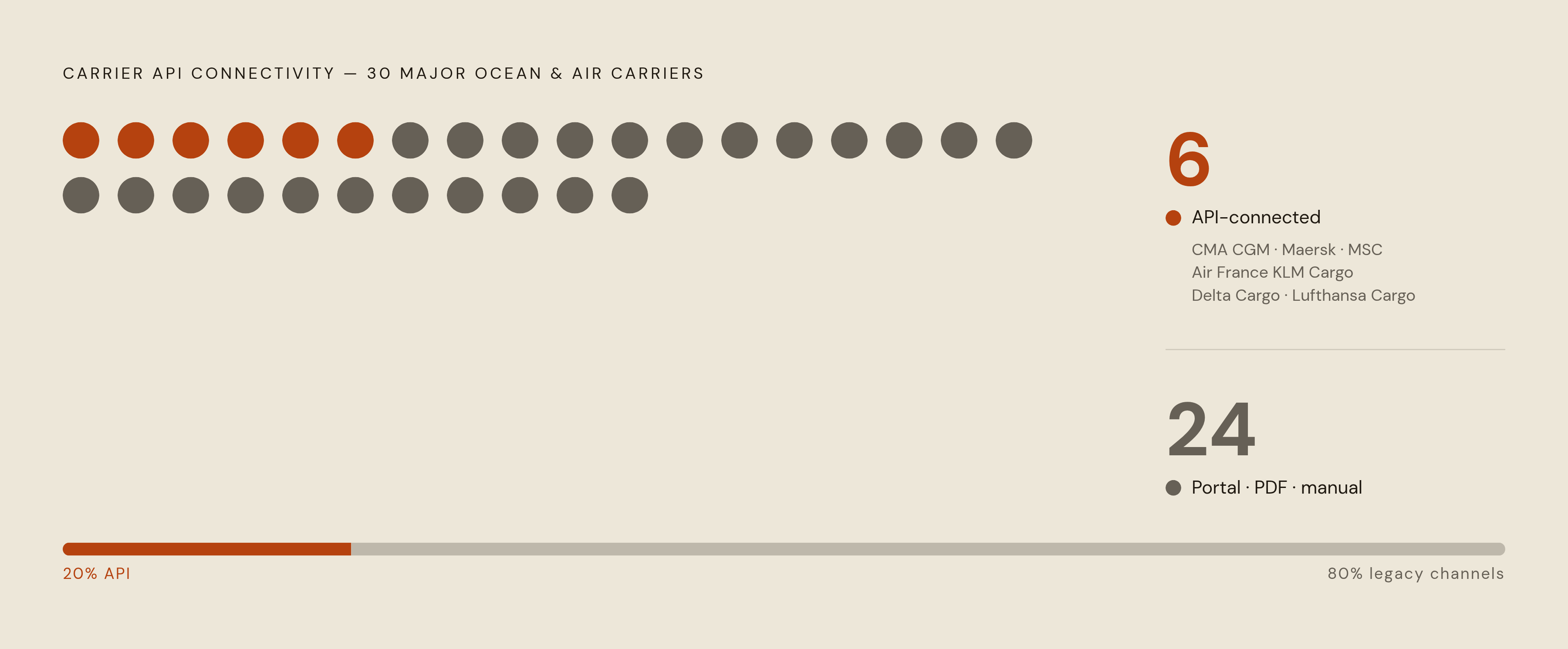
And here's where the tidy version falls apart a bit. Freightos surveyed 30 major ocean and air carriers and found only six, CMA CGM, Maersk, MSC, Air France KLM Cargo, Delta Cargo, and Lufthansa Cargo, actually connect with customers via API. Most carrier rate data is still moving through slower channels: portals, PDFs, manual uploads. No API means someone uploads and refreshes rates by hand, and that hand-off is exactly the delay these platforms were built to kill. Add surcharges on top, BAF, CAF, general rate increases, peak season charges, each shifting on its own schedule, and the actual engineering problem comes into focus. The challenge runs deeper than showing a number fast; it's keeping 70 million numbers current at 70 million different speeds. None of it runs without serious infrastructure underneath, either; cloud deployment held a 65.32% share of the US digital freight forwarding market in 2025, and that's the plumbing that makes this volume possible at all.
What an instant quote actually contains, and what it often leaves out
Pull two instant quotes for the same lane off two different platforms and check whether they mean the same thing. Often they don't, and nobody flags it at checkout.
A properly built quote carries a base freight rate (the carrier's core charge for hauling the container), a Bunker Adjustment Factor for fuel, which moves constantly, a Currency Adjustment Factor hedging exchange rate swings, and Terminal Handling Charges, set by the carrier rather than the port authority, a detail that trips up more people than it should. Fine so far. The trouble starts at comparison, since one quote is door-to-door, another is port-to-port, a third assumes a different Incoterm or just quietly drops inland transport. Same headline number, completely different scope, and nothing on the screen tells you which parts are missing.
FCL and LCL pricing structures don't collapse into a clean per-unit comparison without someone doing the math first. Meanwhile, the details that actually shape your supply chain, transit time, transshipment count, equipment guarantees, loading priority, rarely show up in the number at all. A lower quote is not automatically a lower cost. Reading what's included matters as much as reading the price, arguably more.
The two types of platforms and the different problems they solve
Two fundamentally different tools wear the same "get an instant quote" badge, and mixing them up is where most of the frustration in this space starts.
Shipper-facing marketplaces aggregate rates across multiple forwarders or carriers so an importer or exporter can compare and book directly. The value is visibility: you're not stuck with one provider's number. The trade-off is depth of service. The actual relationship with the people moving your box can end up thinner than what a dedicated forwarder offers, and thin relationships tend to show their cracks right when a shipment goes sideways.
Forwarder-facing quoting tools serve a completely different customer, the forwarder, who needs to pull and compare carrier rates fast enough to quote their own client before that client calls someone else. Speed is the entire pitch here, turning a process that once ate hours of portal-hopping into something closer to 30 seconds.
Then there's the carrier-native portal: Maersk Spot, CMA CGM SpotOn, OOCL FreightSmart. These offer direct booking with a single carrier, often backed by price and space guarantees, genuinely useful if you already know who you want to sail with. CMA CGM SpotOn alone drives more than 60% of CMA CGM's own spot volume without exposing that pricing to any outside system. So which are you actually after: confirming your rate is good, quoting faster, or figuring out where to book? Three different jobs. Grab the wrong tool and all three end up underserved at once.
How the major shipper-facing platforms work in practice
Freightos.com runs as a marketplace where over 10,000 importers and exporters get instant quotes and book online; you're comparing forwarders against each other, not carriers directly. iContainers offers AI-powered instant quotes for FCL and LCL across more than 40,000 routes and shows a detailed price breakdown right at the point of quote, which makes the scope question from the last section a lot easier to answer. SeaRates runs a real-time marketplace with direct connections to major carriers including Maersk and MSC, and claims some of the broadest multimodal coverage around.
Flexport takes a different path. It's a tech-forward forwarder offering guaranteed all-in rates through its own platform, but the rates you see are Flexport's rates, full stop. You trade comparison breadth for a more managed, single-provider relationship, which suits some shippers fine and frustrates others who'd rather shop around. Cargorates.ai brings AI-powered rate management to NVOCCs, forwarders, exporters, and importers, with real-time access to spot and contract rates across air, ocean, and land, and picked up recognition at the Logistics Warehouse and Supply Chain Awards 2025 for its work in AI.
Figure out which you actually want before picking a tool: the widest possible view of the market, or a guided experience with one accountable provider on the other end of the phone. Neither is the wrong bet. They're just different bets, and I've seen shippers pick the wrong one simply because it was the first search result.
How forwarder-facing tools change the speed of the quote a shipper receives
When your forwarder gets back to you in four minutes instead of four hours, that's rarely because they made new friends at six carriers overnight. It's because software did the lookup for them, quietly, in the background, while they were probably doing something else entirely.
Okargo, founded by a former MSC veteran, connects to ten major carrier portals and produces quotes online in under 30 seconds. It's built for independent forwarders who don't move enough volume to justify negotiating their own deep carrier integrations. Cargofive pairs ocean rate management with AI contract processing across more than 25 shipping lines and was acquired by cargo.one in February 2026, now sitting as the ocean piece of a larger multimodal AI stack. Freightify puts more than 30 ocean carriers and over 90 airlines on one screen, and its white-label portal lets forwarders show instant quotes under their own branding, so the customer never sees the tool doing the work behind the curtain.
WebCargo, Freightos's own tool, extended from air freight into ocean rate management in November 2025, tying the forwarder-facing quoting layer into the same data infrastructure behind the Freightos shipper marketplace covered earlier. Wisor generates door-to-door quotes in as little as 60 seconds and automatically tracks rate changes and quote expiration, aimed squarely at the revenue-loss problem from the introduction. A forwarder can't lose money on an expired rate if the software already told them it expired, which sounds obvious until you remember how many still find out the hard way.
How carrier-native portals fit, and where they stop
Maersk Spot, launched in June 2019, took that infamous 13-step offline booking process and compressed it into five steps online, with guaranteed space, a fixed price, and amendments handled entirely digitally. It's the clearest case of a carrier digitizing its own quoting process front to back instead of waiting for someone else to do it for them.
CMA CGM SpotOn, launched in 2022, offers a 24-hour fixed quote with priority booking and guaranteed loading, and has been adopted by more than 6,300 clients, now carrying over 60% of CMA CGM's spot volume. That's real traction, not a pilot program gathering dust somewhere. OOCL FreightSmart offers instant fixed-rate quotes, booking, and add-on services across more than 180 weekly worldwide services, and just marked its fifth anniversary in December 2025.
Here's the ceiling, though, and it's a hard one: each of these portals gives you a solid, reliable quote for exactly one carrier's network. Nothing more. A shipper relying only on carrier portals is still comparing manually across browser tabs; the tabs just load faster now. Fine, if you already know you're sailing OOCL on a given lane and just want the guarantee locked in. Less fine if the actual question is "who has the best rate on this lane this week," because no single carrier portal answers that, and pretending otherwise burns an afternoon for nothing.
Where AI and machine learning are changing quote accuracy, not just quote speed
Speed gets the headlines. Accuracy is the part that decides whether your finance team raises questions three weeks later, usually at the worst possible moment.
A quote generated in 60 seconds that's still pricing in last month's BAF is, functionally, worse than a slower quote built on current numbers. This is where machine learning does something more interesting than retrieval: algorithms trained on historical shipping data start anticipating how a lane's rates are likely to move, instead of just reporting where they sit today. Predictive analytics push further into forecasting transit times, flagging delays before you've booked, and optimizing how LCL loads get consolidated, stretching the platform's usefulness well past the moment you clicked "get quote."
Cargofive's AI contract processing is a decent concrete example. Automatically ingesting and interpreting carrier contract terms cuts down the manual labor of keeping a rate database current, which is a direct answer to the surcharge volatility problem raised earlier. But does any of this solve the underlying issue, or just paper over it faster? An AI system is only as current as the data feeding it, and when a carrier has no API and rates get typed in by hand, the model works from stale inputs no matter how sophisticated it looks on the surface. Quality of integration still caps quality of output. No amount of machine learning fixes a data entry backlog.
What shippers and forwarders should check before trusting an instant quote
Run through a short list before trusting the number on the screen. Takes a few minutes, saves a much longer conversation later, possibly with a customs broker who is not smiling.
Start with scope: port-to-port or door-to-door, which Incoterm it assumes, whether inland transport is actually in there. Check surcharge completeness next; BAF, CAF, THC, and any peak season or GRI charges should be itemized, because a low base rate with surcharges tucked in later isn't a low total cost. Ask about rate freshness too, especially on a volatile lane, since the standard 7 to 14 day validity window tells you nothing about how old the rate was when that window started ticking.
Worth checking, also, whether the platform connects to the carrier via API or relies on hand-uploaded sheets, since that one fact predicts a lot about how current the number really is. Don't skip the service-level questions just because they're printed small: transit time, transshipment count, equipment guarantees, whether loading is actually guaranteed the way it is with Maersk Spot or SpotOn. For forwarders specifically, tools that flag rate expiration and track changes automatically are about the cheapest insurance available against quoting a client on a rate the carrier no longer honors.
Why the market for instant quoting is still expanding, and what's still being built
The digital freight forwarding market was valued at $67.61 billion in 2025 and is projected to hit $405.56 billion by 2033, growing at a 25.1% compound annual rate, roughly five times the pace of the broader freight forwarding industry's 5.4% CAGR. That gap says something. This growth reflects a structural rebuild of how the business gets done, not incremental digitization of an existing business, and the growth numbers are the receipt.
Asia-Pacific leads that shift, holding a 40.24% share of the digital freight forwarding market in 2025 and growing at a projected 19.48% CAGR through 2031, powered by infrastructure investment, dense intra-Asia trade lanes, and high platform adoption on the ground. Retail and e-commerce made up 35.64% of end-user demand in 2025, which tracks, since an e-commerce shipper needs quote-to-book speed that older, manual processes were never built to deliver.
So what's still unsolved? Mostly the API gap. Only six of the 30 carriers Freightos surveyed connect via API, meaning most rate data still crawls through slower channels, and that remains the single biggest ceiling on how accurate this whole system can get. Quote comparability across platforms is still a mess, too; nobody's standardized what "all-in" actually means, and that's an industry-wide problem no single company's engineering team can fix on its own. Complex shipments, hazardous cargo, oversized freight, multi-modal routes tangled up with customs, still need a human on the phone. Instant quoting tools mostly step around that category rather than through it.
Where does this head next? Fuller API coverage across more carriers, AI that starts predicting rate movement instead of just reporting the current number, and tighter stitching between quoting, booking, and the paperwork that follows after. Whoever closes those gaps first ends up deciding what "instant" means for the next several years. Everyone else just adapts to it.