Spot Rate Volatility and Digital Freight Booking Strategies
Shippers who book spot freight in real time beat those waiting for rate calm.

Spot rate volatility has become the operating condition for shippers, full stop, and the ones who figure out how to book freight inside that condition, rather than pausing until it calms down, are turning a chaotic market into cheaper freight.
Start with trucking. Van spot rates climbed 6% quarter-over-quarter in Q2 2025, and reefer rates were up 8% year-over-year. That looks like a rebound, and it is one, but the pattern underneath is messier than the headline number. FreightWaves pointed out that the rate spikes in late 2025 were sharp and short, not sustained climbs. Carriers held off raising rates until they had no choice, which masked how tight capacity actually was. Through October 2025, 2,125 carriers left the market entirely. And here's the detail that matters most: 91% of for-hire asset-based carriers run fewer than six trucks. These are small operators who burned through whatever cash cushion they built during COVID and put off replacing aging equipment. That's a supply base one bad month away from a shock.
Ocean freight tells a similar story with a different mechanism. Global shipping demand rose 7.1% in 2024, but supply grew 10.5%, which on paper should mean soft rates and plenty of room to breathe. Then the Middle East conflict rerouted vessels away from the Suez Canal, the Baltic Exchange flagged rising volatility in container freight through 2025, and MSC pulled a U.S. East Coast to Europe service in mid-August 2025, tightening capacity on a major lane overnight. The math said oversupply. The map said otherwise.
Here's the pattern worth sitting with: tariffs, geopolitical rerouting, a carrier base concentrated among fragile small operators, and demand surges tied to weather and climate events are all pulling on rates at the same time, from different directions. Ease one and another takes its place. This is the operating environment now, and the rest of this piece is about working inside it rather than waiting for it to end.
What makes spot rate swings so hard to absorb under traditional booking methods
The contract-versus-spot decision isn't really a decision at all, it's a moving spread, and treating it like a fixed choice is where most shippers get hurt. In a soft market, spot can run well under contract, and shippers locked into heavy contract commitments miss out on savings sitting right in front of them. In a tight market, it flips: spot premiums show up faster than most procurement cycles can respond, so by the time a bid gets adjusted, the market has already moved twice.
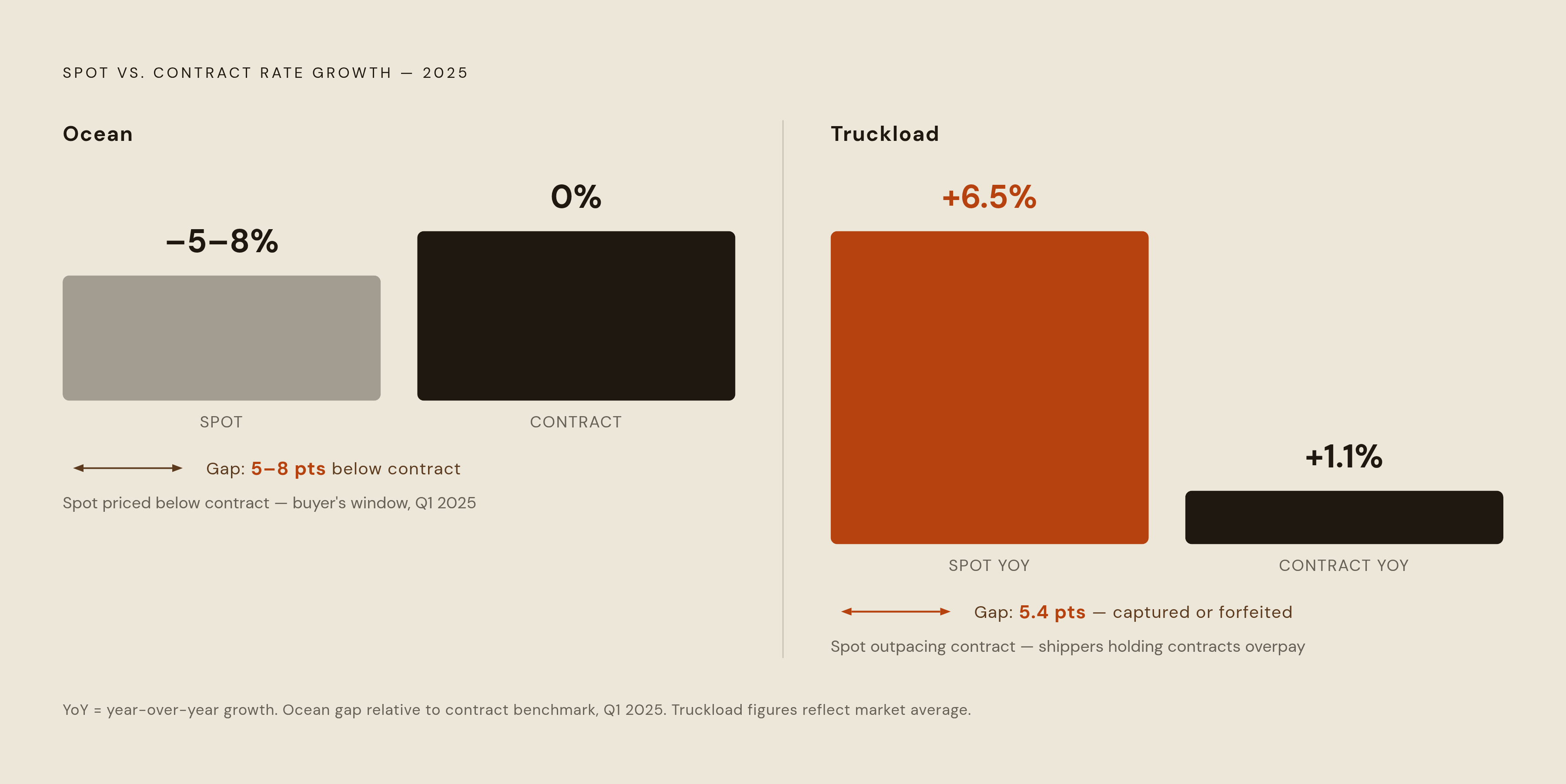
The numbers show how much is at stake. In Q1 2025, ocean spot rates traded 5% to 8% below contract rates, which is real money for anyone paying attention in real time. On the truckload side, spot rates grew 6.5% year-over-year in 2025 while contract rates crept up just 1.1%. That gap, roughly five and a half points, is what's sitting on the table for shippers who can move fast and what's quietly lost for shippers who can't.
And most can't, because most are still running rate discovery the old way: emails out to a handful of carriers, phone calls, quote cycles that stretch across days, account reps who, understandably, get slower exactly when the market gets faster. Add a regional wrinkle on top: East Coast port capacity has been tightening under tariff-driven rerouting while the Midwest sits oversupplied. A national average rate tells you nothing useful about either situation. You need lane-level data, and manual processes weren't built to produce it fast enough to matter.
Carrier rejection rates sat at 5.6% in Q3 2025, well under the 8% threshold that typically signals real pricing leverage for shippers. That's a buyer's market, arguably a good one. But leverage you can't access in time doesn't help you after the opportunity has closed. Fixing that gap isn't a matter of hiring smarter procurement people. It's an infrastructure problem.
How digital freight platforms give shippers a real-time information edge
Digital freight platforms solve one specific problem: they show rates across many carriers at once, updated close to real time, instead of trickling in through phone tag over a week. DAT Freight and Analytics runs the largest open load board in North America, posting close to 700,000 loads a day. That kind of scale creates price discovery no single carrier relationship can match.
DAT's July 2025 acquisition of Convoy's automated freight-matching technology from Flexport is worth pausing on. It brought AI-driven broker workflow automation and carrier fraud prevention into DAT's open marketplace. Flexport had relaunched Convoy back in February 2025, connecting hundreds of thousands of truck drivers with tens of thousands of carrier companies, before deciding to sell off the platform technology months later. That's a fast pivot for a platform that size, and it says something about how quickly this space is consolidating around a handful of players.
The category itself is growing at a pace that's hard to write off as hype. The global digital freight brokerage market was valued at $7.51 billion in 2025, with projections putting it at $78.32 billion by 2035. Digital marketplace platforms held the largest slice of that market in 2025, while AI-based freight matching is the fastest-growing piece of it, which tells you the category is maturing and specializing at the same time, not just getting bigger.
What changes operationally when a shipper has this kind of access? A team can see the moment spot dips below contract on a specific lane and act within hours, not wait for the next quarterly bid cycle to roll around. North America already accounts for roughly 43% of the global digital freight brokerage market, so this isn't an early-adopter conversation anymore. It's closer to table stakes.
The booking strategies that actually work when rates are moving fast
Blend spot and contract dynamically. Don't set a fixed ratio and defend it regardless of market conditions. Watch the spread between spot and contract on your key lanes and shift volume toward whichever is cheaper at that moment. This only works if your rate visibility surfaces the spread automatically; a manual benchmarking spreadsheet updated once a week won't cut it, no matter what anyone calls it. Keep contracted capacity locked in for your highest-priority freight, the time-sensitive or high-value stuff, and use spot opportunistically on everything with flexibility built in.
Watch lanes, not the market average. National averages flatten out exactly the imbalances that create opportunity, like East Coast tightening against Midwest oversupply through 2025. Set alerts on specific origin-destination pairs and act when a lane diverges from your baseline, rather than waiting for a quarterly market report to confirm what already happened.
Diversify your carrier base through digital networks. With 91% of carriers running fewer than six trucks, leaning on a small circle of preferred carriers is a fragility problem waiting to surface. Digital platforms surface qualified alternatives fast enough to build in redundancy before a crisis, not just after one of your regulars exits the market.
Adjust booking lead times by mode. On ocean, Suez disruptions and abrupt capacity pulls, MSC's USEC service cut being the clearest 2025 example, mean longer planning horizons reduce your exposure to sudden spikes. On truckload, the sharp, short-burst spike pattern FreightWaves flagged for 2025 suggests booking a little ahead of need on lanes with predictable seasonal demand beats paying the spike premium after the fact.
Use rejection rates as a leading indicator, not a lagging one. Rejection rates under 8% have historically pointed to a buyer's market. Watching publicly available indices lets you time spot purchases instead of reacting once the rate has already climbed past where you wanted in.
Where AI fits into freight pricing and what it can and cannot replace
AI earns its keep in freight pricing by doing the grunt work faster than any team of humans possibly could: chewing through carrier, lane, and rate data, spotting pattern-based pricing anomalies, automating carrier selection against rules a team has already set. Dynamic pricing tools trained on historical rate data, load board signals, weather patterns, and regional capacity can generate rate recommendations in something close to real time, shrinking the lag between a market move and a shipper's response.
That lag matters more than it sounds like. The Baltic Clean Tanker Index and Container Freight Rate Index have both shown year-over-year swings over 40% in recent periods. When moves are that big and that frequent, an algorithm watching the data around the clock is going to beat a human checking rates once a day.
But AI has a blind spot, and it's not a small one: geopolitical shocks, sudden carrier exits, and regulatory curveballs create breaks in the pattern that historical training data simply hasn't seen before. Asia-to-North America West Coast container rates fell 39% in two weeks in March 2025, according to Freightos. A move that fast and that steep is an outlier, not a trend line, and an AI model built on normal market cycles has no real basis to see it coming.
So the honest framing is this: AI compresses the gap between signal and action, but the judgment call about how much risk your business can absorb, the strategy underneath your booking decisions, and the response when something genuinely unprecedented hits the market still rest with your team. When you're evaluating a platform, look for tools that surface signal and automate the routine tasks. Be skeptical of anything that claims it can predict the unpredictable, because that's a promise no dataset, however large, can actually keep.
How to structure your freight budget when the rate floor keeps moving
Traditional annual freight budgets assume rates hold roughly steady across the year. That assumption doesn't survive contact with the 2025-2026 market. Contract rates have leveled off near carrier breakeven, according to Arrive Logistics' 2025-2026 forecast, and they're unlikely to drop much further from here. But spot rates keep swinging sharply above and below that floor, sometimes in the same month. UNCTAD estimates that elevated shipping rates working through supply chains could push global consumer prices up 0.6% by 2025, which is a reminder that freight cost shows up on the P&L, not just as a logistics line item.
The fix is range-based budgeting instead of fixed-rate budgeting. Set three numbers: a baseline built on the contract rate floor, a likely case blending contract and spot based on your actual historical lane mix, and a stress case that assumes a chunk of volume, say a defined percentage, gets forced onto full spot pricing.
Freight hedging fits alongside digital booking rather than replacing it. Forward freight agreements and FAK rate hedging exist specifically so shippers can lock in pricing on the lanes most exposed to swings. That market is growing precisely because the Baltic indices and container rate indices have shown swings north of 40%; adoption tends to follow volatility, not lead it.
Internally, track a blended rate, contract plus spot weighted by volume, rather than reporting contract rate alone to finance. That's the number that actually reflects what you're paying, and it's the number that makes smart spot purchasing visible as a win instead of an unexplained budget variance. One more thing worth building into the process: set a defined spread threshold between spot and contract on a given lane that automatically triggers a pre-approved spot purchase, rather than routing it through a procurement sign-off that eats the two days you don't have. Speed is the advantage here, and waiting for a meeting costs money.
Choosing the right digital booking setup for your freight volume and complexity
Not every shipper needs the same stack, and buying more platform than your freight volume justifies is its own kind of waste. The right setup scales with how much you ship, how many modes you're managing, and how spread out your geography is.
Open load boards like DAT make sense for shippers who need broad spot market access and real-time rate benchmarking without a steep barrier to entry. They're most useful in truckload, where lane-level transparency is the whole game. Digital freight brokers with AI-driven matching make more sense once volume justifies a managed layer: the broker handles carrier qualification and fraud screening, and the shipper still gets competitive rates without doing that vetting work in-house. FTL brokerage is the largest and most mature segment in this space for a reason; it's where the volume already is.
For shippers dealing with ocean and air complexity, digital freight forwarders that combine booking, documentation, and rate management into one system solve a different problem: the paperwork and compliance layer that domestic truckload doesn't have to deal with. Asia-Pacific leads adoption here, but North American import and export shippers are catching up fast.
For shippers running enough volume that all of this needs to talk to each other, connecting your booking platform into a TMS closes the loop, feeding the lane-level monitoring and blended-rate tracking described earlier instead of leaving it as a separate spreadsheet exercise. The tools that combine rate intelligence with workflow automation consistently beat standalone point solutions, for the same reason a GPS with live traffic beats a paper map: both may be accurate, but only one tells you what's happening right now.
When you're evaluating any of these platforms in a volatile market, ask specific questions. How often does it actually update rates, hourly, daily, less? Does it show lane-level data or just national averages dressed up in a dashboard? Can you set custom rate alerts? Does it plug into the TMS or ERP you're already running? And one thing to actively avoid: any platform offering rate transparency without carrier vetting. Fraud risk climbs when carriers are under financial pressure in a soft market, and DAT's decision to fold Convoy's fraud prevention tools into its marketplace is a clear signal of how real that risk has become at scale.