AI Procurement Agents vs Traditional Workflow Automation
AI agents handle exceptions and reasoning; RPA excels at stable, repeatable tasks.

Robotic process automation does one thing well: it records what a human does on a software interface and replays it, reliably, at scale. Purchase order creation, invoice routing, supplier onboarding steps, three-way match verification. If the process is stable and the interface is static, RPA delivers. Implementation is fast, and ROI timelines of three to six months have been reported in industry analyses.
The ceiling arrives faster than many business cases acknowledge. When a button moves, a field renames, or an API updates, the bot breaks. Not gracefully. It breaks silently at 2 a.m. or loudly at the worst possible moment, and then someone has to hunt down the failure and fix it. Teams that scale RPA aggressively can eventually spend more hours maintaining existing bots than deploying new ones. That maintenance spiral is a recurring cost that often does not appear in the original justification document.
The deeper limitation is structural. A significant share of enterprise procurement processes involve exceptions that require judgment, and RPA cannot reason through an exception. It can only follow a script, so it stalls precisely where procurement most needs help: the supplier who didn't respond, the invoice that arrived formatted like nothing your system has ever seen, the approval chain that changed because a business unit reorganized last quarter. For most mid-to-large organizations, these situations are common rather than rare.
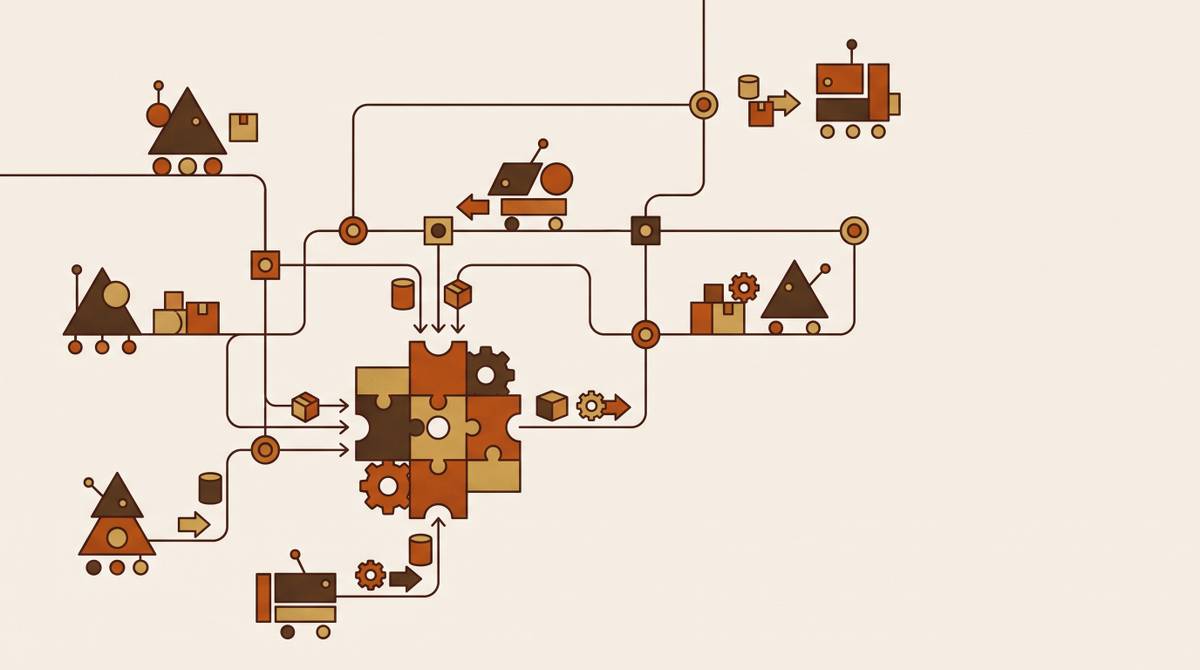
What most organizations end up with is a collection of disconnected automations. Spend analysis runs here, contract renewal alerts fire over there, onboarding workflows operate somewhere else entirely. None of them connect into end-to-end workflow intelligence. They are islands, each delivering value locally, each incapable of orchestrating the larger process they were ostensibly built to streamline.
How an AI agent approaches the same procurement tasks differently
An AI agent perceives its environment, sets goals, and takes action without requiring explicit programming for every situation it encounters. Here is what that means in practice.
A rules-based workflow routes a purchase requisition through a fixed approval chain. An AI agent can evaluate the same requisition against current market conditions, the supplier's recent performance history, the department's budget position, and applicable policy, then act or escalate based on that synthesis. It isn't following a script. It is reasoning toward an outcome.
Exceptions are where the difference becomes significant. For RPA, an exception is a failure mode. For an AI agent, exception handling is a core capability. Supplier non-response, invoice format variation, a disrupted approval chain: the agent adapts rather than halts. This is a different architecture entirely, built for the parts of procurement that require judgment.
Contract management illustrates the distinction concretely. A rules-based system flags contracts sixty days before expiration. An AI agent can analyze the supplier's performance over the contract term, benchmark current pricing against market rates, and recommend whether to renew, renegotiate, or switch, with rationale attached. One produces an alert. The other produces something actionable.
Modern agents don't just surface insights; they read, assess, route, and resolve discrepancies between systems without someone watching over every step. The human's role moves from processor to reviewer. That shift becomes significant when you calculate what your team's hours are worth on a per-decision basis.
The middle of the spectrum: hybrid orchestration as the dominant real-world model
Very few production deployments in 2026 are fully autonomous agents. The architecture that commonly appears in practice is a hybrid: RPA and AI agents orchestrated within a single framework, each handling the work it is structurally suited for. This is a deliberate design choice, and in many cases an appropriate one.
RPA executes reliable, repeatable tasks on stable interfaces. AI agents handle planning, reasoning, exception management, and cross-system coordination. Deterministic execution is an asset where the process is stable. Adaptive reasoning is essential where rules break down. Knowing which applies to each specific process step is a key design decision.
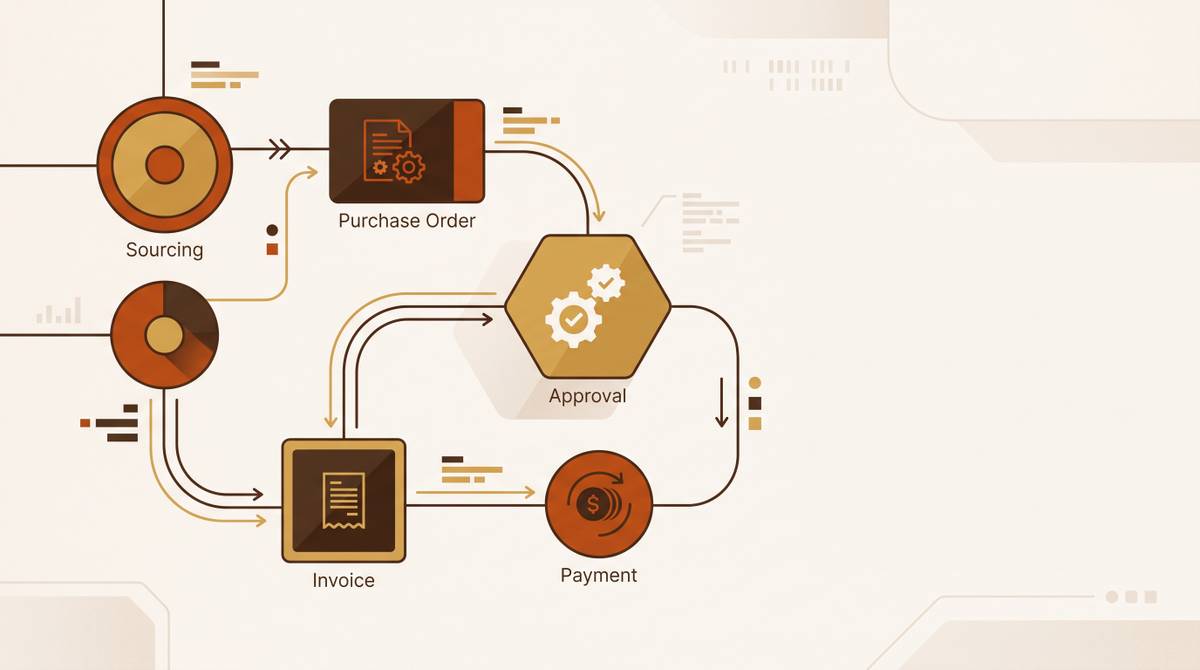
Consider a sourcing lifecycle end to end. Demand signal aggregation, RFQ generation, bid comparison, purchase order routing: each step is individually automatable. Orchestrated together, with rules-based components handling structured steps and AI agents managing exceptions and decisions at each handoff, the combined system can eliminate manual cycle time that neither approach achieves alone.
This hybrid architecture is also where procurement buyers can be misled. A platform marketing itself as "AI-powered" may be predominantly RPA with a thin machine learning layer added on, or it may be a genuine orchestration engine where adaptive reasoning is doing real work. To distinguish between them, ask where the adaptive reasoning actually kicks in, what the system does when an exception occurs, and what happens when the underlying data changes. Those three questions locate a tool more accurately than any product brochure.
Where organizations are actually deploying these tools in 2026
Spend analytics is the most widely deployed application. Hackett Group's 2025 research found that the overwhelming majority of organizations now use some form of AI for spend classification. These tools sit closer to the rules-based end of the spectrum, using machine learning to assist classification rather than autonomous agents making independent decisions.
The performance gap is measurable. Modern AI spend classification tools achieve accuracy in the mid-to-high nineties, compared to accuracy in the sixties and low seventies for purely rules-based approaches, according to industry benchmarks. That delta reflects what moving up the spectrum can deliver, and spend classification is one of the more tractable, well-defined applications available.
Agentic AI is advancing, but enterprise-scale deployment remains the exception rather than the rule. As of 2025 and 2026, most organizations have deployed agentic AI at pilot or limited scale; enterprise-wide deployment represents a small fraction of that group. The ProcureCon CPO Report from 2025 found that most CPOs have identified specific use cases for AI agents and are actively considering deployment, but the majority are still running agents on simple, rule-adjacent tasks rather than complex autonomous decision-making.
The gap between "pilot" and "at scale" is where most organizations stall. And it is not primarily a technology problem.
What the performance differential looks like when deployment moves up the spectrum
McKinsey estimates that agentic AI can make procurement functions materially more efficient, primarily by shifting staff time from routine task processing toward strategic work. That shift can compound in ways that simple headcount reduction does not. Reallocating cognitive capacity toward decisions that move the business is a different outcome than cutting hours.
Walmart's use of AI agents for supplier negotiations is a documented case. The agents managed negotiations with a segment of suppliers that procurement teams could not reach due to bandwidth constraints, not because those relationships lacked value, but because the team did not have the hours. AI agents extended procurement reach without extending headcount.
A mid-size U.S. manufacturer that deployed AI agents on several hundred monthly exception events saw resolution time drop substantially over ten months, according to published case study data. Staff time allocated to exception handling fell significantly. Production incidents attributable to unresolved exceptions also declined. These outcomes came from eliminating an exception backlog rather than from replacing staff.
Deloitte's 2025 Global CPO Survey captures a compounding effect at scale. Organizations in the top quartile by technology investment achieved more than double the return on generative AI investments compared to followers, and their rate of meeting or exceeding cost savings plans was meaningfully higher. Deloitte attributes these outcomes to organizations that consistently matched the right spectrum position to the right problem class, rather than defaulting to whatever the vendor demo showed them.
Why most AI procurement pilots fail to scale
MIT Sloan research from 2025 puts the pilot failure rate at 95%. Gartner expects a substantial share of agentic AI projects to be abandoned by the end of 2027. Those numbers point to infrastructure problems underneath the technology, not to the technology itself.
Hackett Group research from 2026 identified insufficient data quality and integration as the top barrier for organizations that are not fully AI-ready. Agentic AI amplifies whatever the data underneath it contains. An agent operating on inconsistent category hierarchies or incomplete supplier records will make confident, fast, incorrect decisions. This failure mode is sometimes attributed to the technology when it is, in fact, a data governance problem that predated the AI deployment.
The second failure mode is organizational, not technical. Siloed operations, competing priorities, and capability gaps ranked as top barriers in Deloitte's 2025 Global CPO Survey. These are change management problems and structural problems that require leadership alignment before a procurement agent is deployed.
Moving up the spectrum requires infrastructure readiness proportional to the autonomy being granted. The higher the autonomy, the more consequential every gap in data quality and organizational alignment becomes. Most pilots fail not because the tool was wrong for the job, but because the organization was not ready for what the tool would expose.
Governance structures that match the autonomy level being granted
A poorly governed AI agent in a procurement context carries real risk. An agent with misconfigured policy logic can bypass approval thresholds, create compliance violations, or execute purchasing decisions that contradict existing contracts. Procurement sits at the intersection of financial risk, regulatory obligation, and supplier relationships. Governance failures there are expensive and visible.
Singapore's IMDA Model AI Governance Framework for Agentic AI, released in January 2026, is the first framework explicitly designed for agentic systems. It addresses multi-agent coordination risks, including cascading errors and unintended coordination between agents operating across systems. Most prior AI governance frameworks were built for narrower, less autonomous systems and do not account for what agents can do when operating across functions and data sources simultaneously.
Four structural requirements should be present in any serious procurement AI governance architecture. First, a defined human-in-the-loop model: specify which decisions agents execute autonomously and which require human approval before action is taken. Second, full audit logging of every agent action and every human override, without exception. Third, a semantic layer that standardizes KPI definitions, spend categories, and approval thresholds before agents operate on that data. Fourth, regular performance reviews using the metrics the agents themselves generate, not just downstream business outcomes that lag by months and obscure cause-and-effect relationships.
Governance requirements should scale with the spectrum position. A rules-based RPA bot requires audit trails. An autonomous negotiation agent requires policy sandboxing, documented override authority, and defined exception escalation paths. Treating these as equivalent leads to either over-governed bots or under-governed agents.
EY research from 2025 found that organizations with stronger responsible AI frameworks outperformed peers on cost savings and operational outcomes. The organizations treating governance as a compliance formality are consistently the ones debugging failed pilots months after launch.
How to assess where a procurement tool actually sits on the spectrum
The vendor label is not diagnostic. "AI-powered" and "intelligent automation" are marketing terms that describe nothing precisely. The useful questions are behavioral: does the tool adapt when inputs change, or does it break? Can it handle exceptions without human intervention? Does it reason across systems toward an objective, or execute a fixed sequence of steps? Those answers locate the tool on the spectrum with more precision than any demo.
Map the use case before the tool. High-volume, stable, rule-governed tasks, such as PO creation and invoice matching, are well-served by the rules-based end of the spectrum. Exception-heavy, context-dependent tasks, such as supplier risk monitoring, contract renewal decisions, and negotiation, require adaptive reasoning. Deploying a rules-based system on the second category produces costs that can be difficult to attribute directly until the damage is already done.
The most useful internal diagnostic is straightforward: identify where in the current process humans are most frequently pulled in to handle exceptions. Those interruption points mark the gaps RPA cannot fill and where moving up the spectrum returns the most concentrated value.
Before granting an agent autonomous action authority, verify data readiness. Check that spend categorization, supplier records, and contract terms meet an accuracy threshold where agent errors are less costly than human errors. If that threshold hasn't been established internally, establish it before deployment.
Start with the hybrid model. Use deterministic execution for stable, well-defined process steps. Introduce adaptive agents at the exception and decision points. Expand autonomy incrementally as governance matures and data quality improves. The organizations that reach enterprise scale do it this way. The ones still troubleshooting pilots skipped a step somewhere in that sequence, usually the one that felt unnecessary at the time.