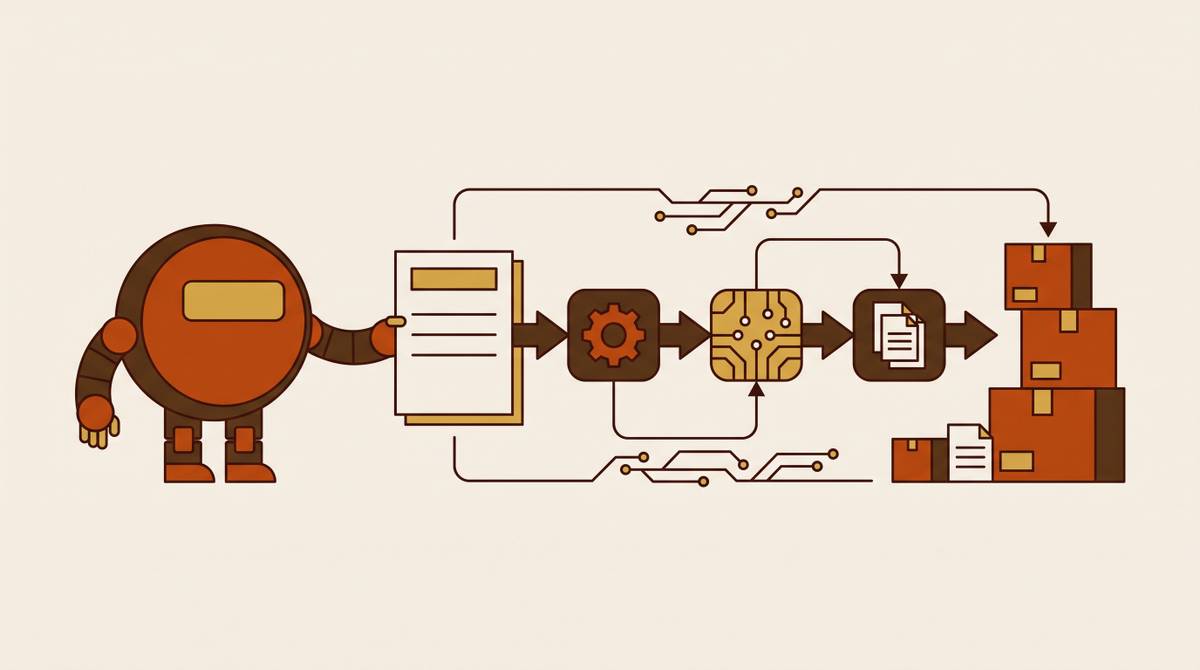
Prompt Engineering for Procurement AI Agents
Mastering prompt design is what actually determines whether procurement AI agents work in practice.

Generative AI adoption in procurement nearly doubled between 2023 and 2024, putting procurement ahead of product development, marketing, and operations in enterprise AI uptake. By 2025, the overwhelming majority of procurement leaders had either considered or started deploying AI agents. "Agent as coworker" stopped being a pilot concept and started showing up in operating budgets.
And yet: when you map AI use cases across enterprise functions, procurement represents a disproportionately small share of actual deployed applications relative to stated leadership intent. The aspiration is real. The organizational transformation, largely, is not.
The Hackett Group's 2025 Key Issues Study tells you exactly why this matters right now: procurement workloads are projected to increase roughly 10% while budgets grow around 1%. That is the efficiency deficit agents are supposed to close. But the constraint is not model capability. Every major enterprise software vendor ships some form of generative AI now; the models exist, the integrations exist, the budget conversations have happened. What stalls deployments is something more unglamorous: the inability to structure instructions and workflows so agents perform reliably in real procurement contexts, with real data, real policies, and real financial consequences for error.
I have watched teams spend months evaluating platforms and three weeks on prompt design, then wonder why their agents hallucinate contract terms or misclassify spend. The sequencing is backwards. Prompt engineering is a practitioner skill, not a configuration task the vendor handles on the way out. You cannot outsource the design of your own decision logic, and no one else can fully encode how your organization buys.
How the practitioner's role shifts from transactional buyer to process architect
The buyers who thrive in an agentic procurement environment will not be the ones who write the best RFPs. They will be the ones who design the process the AI uses to write the RFP. That is not a rhetorical distinction; it demands a genuinely different set of capabilities.
Start with decision logic. You need to understand the reasoning embedded in each procurement workflow deeply enough to articulate it, not code it, but actually describe it: what information does this decision require, in what sequence, and what makes a given output correct versus merely plausible? Most experienced practitioners have internalized this logic over years and never had to externalize it. Prompting forces that externalization. It is often uncomfortable, and it is also clarifying in ways that improve the process independent of the AI.
Then there is the question of where human judgment is genuinely irreplaceable versus where it is just habitual. Those are not the same thing, and conflating them either over-engineers human review into tasks that do not need it or leaves consequential decisions in the agent's hands by default. Getting that boundary right requires honest reflection on where experience and contextual accountability actually matter, and where they are being invoked out of institutional habit.
The third shift is architectural. What belongs in a prompt, what belongs in a policy system, what lives in a data layer, and what needs to be implemented as a tool or integration are four distinct categories, and conflating them is where most early deployments run into trouble. Procurement policy in particular must not live inside a prompt. Prompts can be overridden, misrouted, or injected. Policy belongs in policy systems. The prompt's job is to invoke policy and route decisions through it, not to encode it in natural language that someone can edit or circumvent. The difference between those two approaches is the difference between a system that remains governable at scale and one that quietly drifts out of compliance every time someone adjusts a system prompt.
Structuring the system prompt so an agent knows who it is, what it must do, and where it stops
The system prompt is the agent's operating constitution. It governs behavior before any task input arrives. Whatever the agent encounters later (sourcing requests, supplier documents, contract disputes), it interprets through the fixed frame of that system prompt. This is the single highest-leverage decision in procurement agent design, and it is the one most often rushed.
AWS Amazon Connect best practices recommend organizing the system prompt into six discrete sections. The logic maps cleanly to procurement deployments.
Identity comes first: role, domain expertise, and operating context. "You are a procurement sourcing agent responsible for consumables categories in a manufacturing environment operating under the following approved vendor framework." That is not flavor text. It bounds the agent's domain and prevents it from treating every query as a generalist assistant would.
Response behavior comes second: communication style, tone, output format. Procurement outputs often feed into approval workflows, contract repositories, or ERP systems. Format discipline at the prompt level prevents downstream integration failures that are tedious and expensive to debug.
Agent expectations are third: the primary objective, explicit success criteria, and explicit failure conditions. What does task completion actually look like? What constitutes an output bad enough to halt the workflow rather than pass it forward?
Standard procedures are fourth: pre-action requirements and task workflows in sequence. This is where you encode step order for the procurement process in question.
Restrictions are fifth, and this section requires the most discipline. NEVER, ALWAYS, and OUT OF SCOPE directives need to be written as unambiguous rules. Ambiguity here is not nuance; it is a failure mode that will surface at the worst possible moment.
Escalation boundaries are sixth: specific triggers that require human handoff and the protocol for surfacing them. An agent that does not know when to stop will, eventually, make a decision it was never authorized to make. This documented failure pattern appears consistently across early agentic deployments.
One more thing on this section: any workflow requiring precise calculations, date comparisons, contract values, discount thresholds, or invoice totals should be implemented as a tool call, not a prose instruction. Large language models are not calculators. Embedding numerical logic in natural language introduces compounding error across multi-step workflows. Tool calls remove that risk entirely, and the implementation is not particularly complex.
Using chain-of-thought prompting to make multi-step procurement reasoning visible and debuggable
Chain-of-thought prompting instructs the model to reason step by step before producing a final answer. The technique was formalized in academic research in the early 2020s, and its procurement value is specific: it makes the agent's reasoning auditable before you act on its output.
Bid comparison, compliance assessment, contract redline analysis. All require logical inference across multiple variables simultaneously. Without chain-of-thought, you get a conclusion with no window into how the agent arrived at it. That is a meaningful problem when the output is a supplier recommendation going to a CPO or a contract position that shapes a live negotiation. An error caught mid-chain is substantially cheaper than one discovered after signatures.
In practice, applying chain-of-thought to a procurement prompt means instructing the agent to enumerate evaluation criteria, assess each supplier or clause against those criteria in sequence, explicitly flag any ambiguity or missing data, and only then produce a recommendation. The output is longer. It is also auditable, which makes approval workflows faster because reviewers can check the reasoning rather than relitigate the conclusion from scratch.
Procurement leaders skeptical of black-box AI outputs are not being irrational. They are being responsible, and chain-of-thought outputs give them something concrete to evaluate. Showing the reasoning is a meaningful driver of organizational adoption, not merely a technical feature.
The technique pairs naturally with retrieval-augmented generation. Retrieved evidence anchors the facts; chain-of-thought makes the reasoning that operates on those facts checkable. Together they address two of the most consequential failure modes in procurement AI: fabricated specifics and opaque logic.
Grounding agents in real procurement data through retrieval-augmented generation
A language model trained on general data has no access to your supplier master, your contract repository, your spend history, or your approved vendor list. Without retrieval, agents do not leave those voids blank. They fill them with plausible-sounding inferences, which in procurement can mean fabricated pricing, invented certifications, or contract terms that bear no relationship to the executed document. I have seen this happen in demo environments, and it is more convincing than it should be.
Retrieval-augmented generation addresses this by having the agent retrieve relevant records at query time (ERP data, contract terms, supplier certifications, pricing history) and reason over that retrieved context rather than generating from memory. Vendor-reported studies consistently show AI agents operating with retrieval achieving accuracy in the low 90s on tasks like spend classification and invoice matching, compared to accuracy in the high 70s for manual processes.
The prompt design implications are concrete. Prompts must specify which data sources the agent should query and in what order. When an agent produces an output, the prompt should instruct it to cite the retrieved document, so outputs are traceable. If retrieved context is absent or insufficient, the agent should surface that gap rather than fill it with inference. An agent that says "I could not locate a current contract for this supplier in the repository" is more useful than one that produces a confident fabrication.
Retrieval architecture must be maintained alongside prompt design. If the supplier master is stale, if contracts are inconsistently named or categorized, if the spend classification taxonomy has drifted from actual purchasing behavior, then the agent is retrieving garbage and reasoning over garbage. Retrieval-augmented generation is sensitive to data quality in both directions: good data makes it considerably more reliable, poor data makes it confidently wrong.
Building verification steps into prompts so agents check claims rather than accept them
Agents process supplier documents, emails, and portal submissions with impressive efficiency. They can also accept stated claims (certifications, pricing, compliance statuses) as facts without cross-checking them against authoritative sources, unless the prompt explicitly requires otherwise. This is not a model flaw; it is a prompt design oversight.
AWS best practice is direct on this point: add explicit instructions requiring the agent to independently verify facts using available tools before taking action.
Supplier certifications need to be confirmed against the actual certifying body's records or an internal approved-supplier list, not accepted from a supplier's self-reported summary. Pricing claims need to be checked against contracted rates or market benchmarks. Compliance statuses need to be validated against regulatory or internal list data. Contract terms need to be verified against the executed document, not a supplier-prepared abstract that may or may not reflect what was actually signed.
Writing this into a prompt is not technically complex. Define the verification step as a required procedure that must precede any recommendation or action. "Before accepting any supplier certification, confirm against the approved supplier database and note the verification date in your output." That instruction belongs in the STANDARD PROCEDURES section of the system prompt architecture described above.
A related technique is the self-correction step, where the agent evaluates its own prior output before finalizing. This is particularly useful in iterative procurement contexts (reports, analysis documents, redline markups) where quality is cumulative and a second pass catches what the first missed. The cost is a longer processing cycle. The benefit is substantially fewer errors reaching human reviewers, which in practice means faster overall throughput because reviews stop becoming correction exercises.
Designing prompt pipelines for multi-agent procurement workflows
No sophisticated procurement deployment runs on a single prompt. The operational reality is pipelines: sequences of agents, each with a bounded responsibility, passing structured outputs to the next stage. Designing these pipelines is where the process architect role becomes most visible.
The agent roles map naturally to the workflow. An intake classification agent categorizes and routes incoming requests. A spend analysis agent queries ERP and procurement data for relevant context. An RFQ generation agent drafts tender documents from category templates and policy references. A bid evaluation agent scores responses against defined criteria. A contract drafting agent produces first-pass documents drawing from clause libraries.
McKinsey documented a chemicals company deployment where one agent automated tender preparation, supplier identification, and bid analysis while a separate agent routed, tracked, and synthesized supplier queries and clarifications during the sourcing exercise. Two distinct roles, two distinct prompt architectures, designed to operate in sequence without conflating their responsibilities. The separation matters; when you collapse those functions into one agent, scope creep in the prompting compounds errors across the entire workflow.
A comparable architecture deployed for tender processing by a technology firm used four agents in sequence: retrieval and classification, vision-based extraction for image-heavy PDFs, revision analysis for detecting material changes between document versions, and synchronization to write validated data into a job management platform. Tender document processing accelerated dramatically against the prior manual baseline.
The design principles are specific and non-negotiable. Each agent needs a single, bounded responsibility. Outputs from one agent that serve as inputs to the next must be structured, not narrative; downstream agents need parseable data, not prose summaries that require reinterpretation. Handoff instructions belong explicitly in the prompt: specify what gets passed forward, in what format, and under what conditions a handoff should be withheld pending human review.
Gartner has framed the next evolution of this work as context engineering rather than prompt engineering, meaning practitioners are not just crafting instructions but designing the entire information environment each agent operates within: memory, retrieved documents, tool schemas, conversation history. That framing is useful because it reflects how the scope of the practitioner's responsibility has already expanded.
Where procurement agents require hard guardrails, not just good instructions
Well-written prompts reduce the frequency of bad outcomes. They do not eliminate the category. That distinction matters more in procurement than in most enterprise functions, because the consequences of agent errors are often financially and legally material, not merely inconvenient.
The failure modes that matter most are three. Hallucinations produce plausible but incorrect contract interpretations or supplier risk assessments; a procurement team acting on a hallucinated contract position in an active negotiation has a real, expensive problem. Autonomous purchasing presents a different risk: an agent that detects a supply shortage and has authority to initiate purchasing without a human check can trigger panic buying, exacerbate the shortage, and spike costs for the organization and, in aggregate, the market. Model accuracy degrading over time as market conditions change produces poor forecasts that look credible until the consequences accumulate. That last one is insidious because the degradation is gradual and the feedback loop is slow.
There is also a procurement-specific attack surface that receives insufficient attention in most deployment discussions: prompt injection. Malicious instructions hidden in supplier-submitted documents (PDFs, RFP responses, email attachments) can be processed by an agent and executed as if they were system instructions. A supplier who understands how your agent is configured can use a routine document submission to redirect its behavior. Security researchers have demonstrated this in real deployments. It is not a theoretical risk.
Guardrails address these risks at a different layer than prompts. Specialized safety systems that monitor, evaluate, and control agent outputs in real time are configurable protection layers that can be tuned to specific procurement risk profiles. In practice, guardrails for procurement agents need to address three categories: spend thresholds, defining which categories and dollar amounts permit automated execution versus requiring human validation; supplier actions, ensuring that approving a new vendor, changing payment terms, or modifying contract scope routes to a human regardless of agent confidence; and regulatory compliance, particularly for organizations operating under GDPR, HIPAA, or the EU AI Act.
The governance work of defining those thresholds and categories needs to happen before the prompts are written. That is the right sequence. The prompt reflects governance decisions already made; it does not substitute for making them.
Human-in-the-loop design: which decisions agents own and which they surface
The most mature procurement organizations are not trying to eliminate human judgment from their workflows. They are trying to concentrate it where it is genuinely consequential and remove it from where it is unnecessary overhead. That is a meaningful distinction, and getting it right requires specifying, at the workflow level, which decisions belong to which party.
The operative design question is not "how much can the agent do?" It is "which decisions require human authority, domain experience, or ethical accountability that an agent cannot replicate?" Everything else is a candidate for autonomous execution.
In procurement, some decisions belong clearly to agents: spend classification, invoice matching against contracts, routine PO generation within approved vendor lists, documentation of supplier communications, first-pass contract review against a defined checklist. These are high-volume, rule-bounded tasks where agent speed and consistency create genuine value and where errors are detectable and correctable before they cause material harm.
Other decisions require human involvement regardless of agent capability: awarding significant contracts, approving a new strategic supplier relationship, accepting non-standard payment terms, making a sourcing decision that affects a critical supply chain node, handling a supplier dispute with reputational or legal dimensions. The agent can prepare the fact base, structure the options, surface the relevant policy considerations, and draft the recommendation. The human makes the call. That division is not a concession to AI limitations; it is appropriate governance.
The escalation triggers in the system prompt must be as carefully designed as the task instructions themselves. Which confidence thresholds require surfacing to a human? Which contract values? Which supplier categories? Which regulatory flags? An agent that surfaces everything as requiring human review defeats the efficiency purpose entirely. An agent that surfaces nothing has assumed authority it was never granted. Neither failure mode is acceptable at enterprise scale, and both are the result of imprecise escalation design, not model failure.
Answering those questions requires the practitioner to have done the upstream governance work before sitting down to write a prompt. The prompt is the last step in that process. Teams that treat it as the first step tend to learn that lesson through consequential errors rather than foresight.