Customs Brokerage Automation in Digital Freight Forwarding
Automation cuts manual filing errors from 1-4% to under 1% and prep time by 70%.
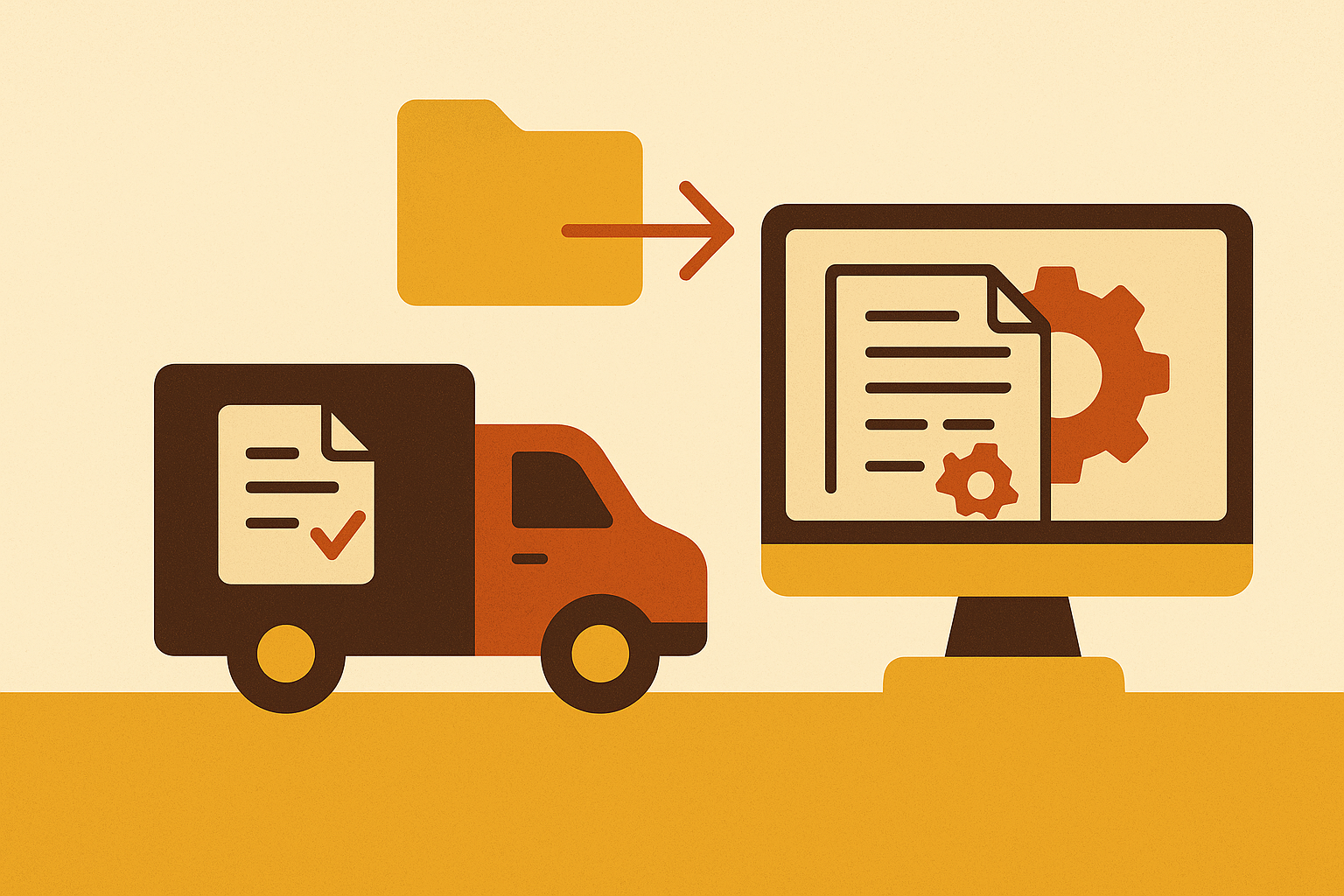
Customs brokerage automation rebuilds the three chokepoints that made cross-border freight slow, expensive, and prone to error: document handling, tariff classification, and compliance checking. This isn't a speed trick bolted onto old workflows — the changes run underneath the surface, in how data moves and gets checked before a shipment ever reaches a border. This piece walks through how each layer works, what the data says about where it helps most, and where a human broker still has to earn their paycheck.
Customs clearance is where documentation, government authority, and regulation collide, and any breakdown at that intersection stops a container cold at the border. For decades, brokers keyed data by hand from invoices, bills of lading, packing lists, and declarations, often dozens of fields per shipment, spread across documents in different formats and sometimes different languages. Manual entry error rates run 1 to 4%, which sounds small until you multiply it across thousands of daily filings; at that scale, small error rates become held shipments, fines, and phone calls nobody wants to make on a Friday afternoon.
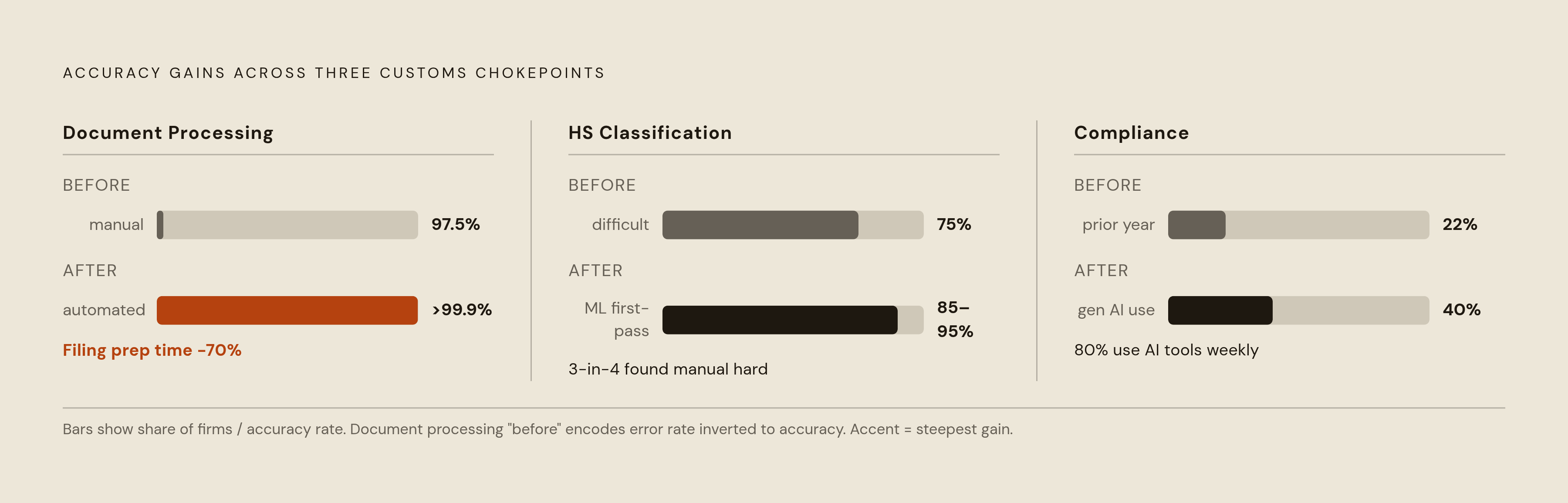
HS code classification is its own recurring headache. Three in four businesses say classifying goods under the Harmonized System is difficult, according to an Avalara and Censuswide survey of more than 900 global executives across 17 countries. Even brokers who've done this for twenty years run into ambiguous product descriptions, overlapping tariff headings, and schedule updates that shift the ground under their feet. Misclassify something and you're looking at penalties, a shipment held at port, or a post-entry audit that drags on for months.
This is a structural problem, not a skills gap. Every trade lane has its own paperwork requirements, its own restricted party lists, its own duty math, and traditional brokerage teams have leaned on institutional knowledge and paper checklists to keep it straight. That works fine until volume grows past what any one person's memory can hold. The result, historically, has been clearance cycles measured in days, and the rest of the supply chain is increasingly unwilling to wait that long.
How the digital freight forwarding market created the conditions for brokerage automation
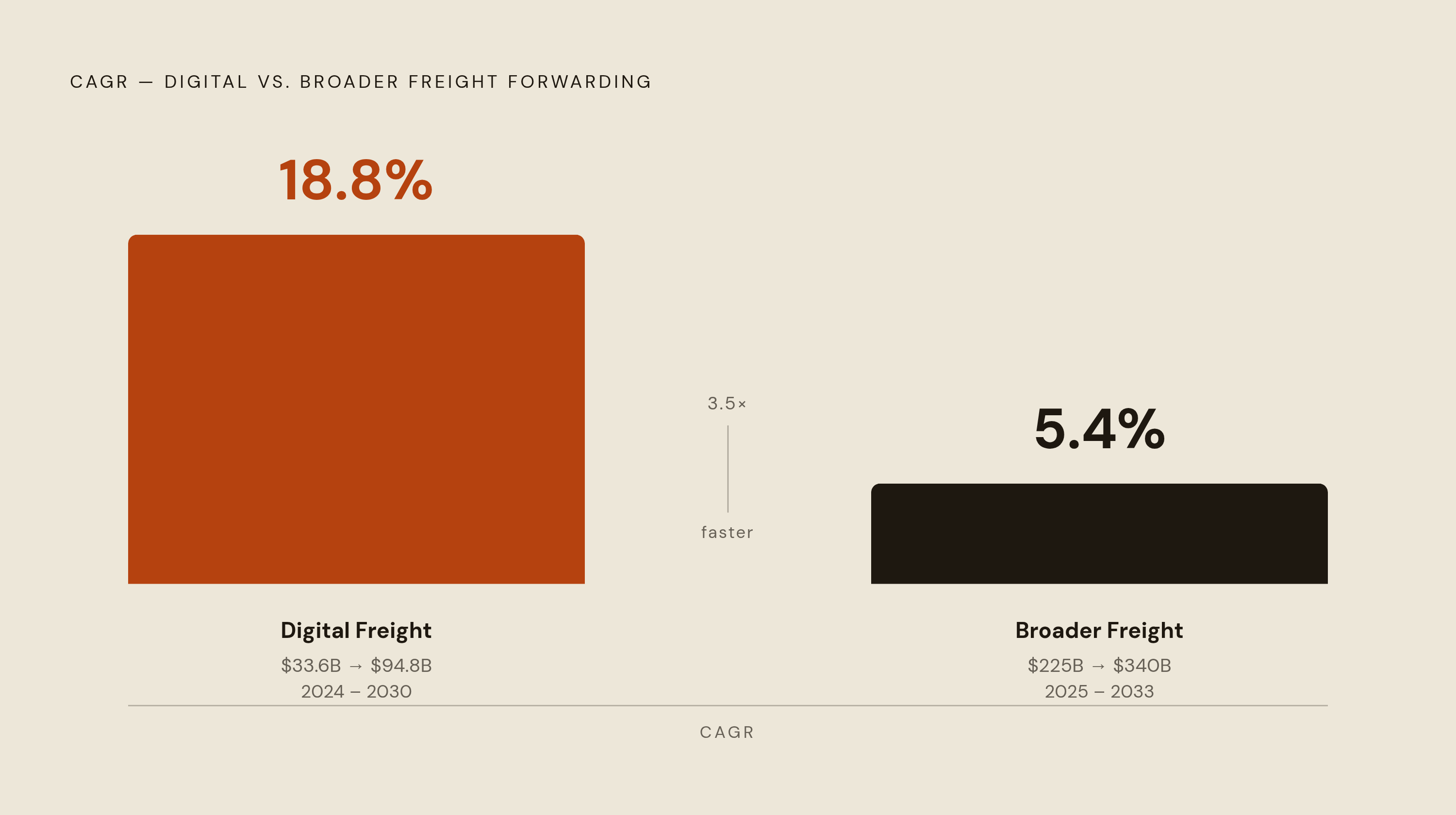
The digital freight forwarding market was valued at $33.6 billion in 2024 and is projected to hit $94.8 billion by 2030, growing at an 18.8% annual rate. That's roughly three and a half times the pace of the broader freight forwarding market, which is expected to grow from $225.38 billion in 2025 to $340.08 billion by 2033 at 5.4% a year. Put plainly: the digital slice of freight forwarding is eating the pie faster than the pie itself is growing.
What did digital forwarders bring that old-line brokerages couldn't just copy overnight? Cloud-based transportation management systems, open APIs, and data pipelines that connect shippers, carriers, and customs authorities in something close to real time. Multi-client, multi-country platform designs let one brokerage team manage filings for dozens, sometimes hundreds, of clients at once. Add visibility tools that flag a problem before it becomes a three-day delay, and you've got an operational model that's hard to replicate with spreadsheets and institutional memory alone.
The market hasn't fully tipped yet, though. Traditional brokerages still held a 77.32% share of the U.S. customs brokerage market in 2025. But digital-first platforms are growing at a 10.45% annual clip, and if that keeps up, the digital-only segment could roughly triple by 2031. Large, tech-enabled forwarders are pouring money into automation to protect their margins; smaller traditional brokerages are facing something closer to displacement than a gentle nudge toward modernization.
The real question for anyone running freight or supply chain operations is which layer to automate first, and how far to take it.
How automated document processing eliminates the first layer of manual work
Every shipment shows up with a stack of paper, or PDFs pretending to be paper: commercial invoices, packing lists, bills of lading, certificates of origin, import and export declarations. Some of it is structured, like an EDI message; a lot of it is not, like a scanned invoice with a coffee stain and a font nobody's used since 2003.
AI-powered document processing pulls data out of all of it, in real time, whether the source is a shared drive, a cloud platform, an API feed, or an email attachment somebody forwarded three times. It normalizes the fields, flags what's missing or inconsistent, and does this before filing, ahead of any rejection notice coming back from customs.
The accuracy gap here is not subtle. Automated extraction on structured fields regularly exceeds 99.9% accuracy, compared to that 1 to 4% manual error rate mentioned earlier. Production deployments report extraction accuracy above 95% and cut customs filing prep time by 70%. That's not a marginal improvement; that's the difference between catching a typo at your desk and catching it after a container's already sitting at a port with a hold notice taped to it.
The upstream effect matters more than the raw numbers suggest. Fixing an error at the extraction stage is cheap. Fixing it after a customs authority rejects the entry is not, and it costs time nobody in the supply chain has anymore. The same extracted data set can also populate bill of lading generation, customs declarations, and trade compliance pre-checks, so nothing gets re-keyed at each handoff.
What's left for humans? Genuinely illegible documents, contradictory shipment details between two parties who can't agree on what actually shipped. Systems surface these for a broker to sort out; they don't pretend to resolve a dispute between a shipper and a consignee who disagree on the invoice value.
How machine learning classification handles HS code assignment at volume
Classification is a tougher nut than extraction, and it's worth asking why. Tariff schedules run thousands of headings and subheadings deep, and getting the right one means interpreting a product description against legal text, not just matching a pattern on a page. Bundled goods, ambiguous descriptions, and customs authorities in different countries interpreting the same schedule differently create real uncertainty, and that uncertainty trips up even brokers who've been doing this since before e-commerce existed. Get it wrong and you're either underpaying duty, which brings penalties, or overpaying, which you can recover but only after burning time and money chasing it.
Current machine learning classification systems hit 85 to 95% first-pass accuracy on common commodity categories, with a confidence score attached to each suggestion. High-confidence codes file automatically. Low-confidence ones route to a broker with the suggested code and the reasoning behind it, so the broker is validating a suggestion rather than starting from a blank page. U.S. Customs and Border Protection's Automated Commercial Environment, ACE, now processes more than 35 million formal entries a year with 98% adoption among licensed brokers, and leading brokers are running ML classification tools inside that system at better than 95% code-assignment accuracy.
That changes what a broker's day looks like. Time shifts from classifying line by line to handling exceptions, and the same headcount handles a lot more volume than it used to. But the limits are real: novel product categories, tariff schedules that change fast (2025's U.S. tariff volatility is a good example of just how fast), and classification differences between customs authorities in different countries remain genuinely hard problems. A confidence score is only as good as the data it was trained on, and brokers need to see why a code was suggested, not just accept the output on faith.
Landing in the 85 to 95% range on first pass means automation soaks up the routine volume, freeing up expert judgment for the cases where it actually earns its keep.
How compliance automation moves from reactive error-checking to proactive risk management
Traditional compliance review happens at the end: brokers check a completed entry against a checklist and jurisdiction rules, and by the time they find something wrong, document prep and classification are already done. That's a lot of wasted motion if the answer turns out to be no.
Compliance automation flips the order. Machine learning models and business rules run continuously against incoming data, checking not just for missing fields but verifying entries against jurisdiction-specific regulations, customs codes, and documentation standards as the data arrives. Restricted party screening, sanctioned country checks, and export control classification happen at the point of booking now, ahead of the point of filing, which means a problem gets caught while there's still time to fix it cheaply.
Adoption numbers back up how far this has spread. As of 2025 reporting, 80% of trade professionals use AI tools at least weekly for compliance work, and 40% of organizations use generative AI specifically for trade compliance tasks, up from 22% the year before. That's most of the industry now, not a niche pilot program.
Operationally, this means shipments with a clean history move through automated lanes without a broker touching them, while complex classifications, high-duty scenarios, new trade lanes, or flagged counterparties get concentrated attention from the people best equipped to handle them. Audit trails generate automatically along the way, which matters a lot when a post-entry audit shows up asking for documentation you filed eighteen months ago.
There's a newer wrinkle here too. Automated platforms are starting to provide shipment-level carbon-intensity data, which supports reporting tied to emerging carbon border regulations. Compliance automation is turning into a data infrastructure layer that does more than just check boxes on a filing form.
The regulatory environment making automation a requirement rather than an advantage
Here's where automation stops being a nice-to-have. In 2025, U.S. tariff policy shifted with unusual and disruptive frequency. Try maintaining a tariff schedule by hand at that pace; you can't, not reliably. Steel and aluminum tariffs took effect in 2025, tariffs on Chinese goods stayed in play, and reciprocal tariff actions added another layer of complexity that brokers had to navigate shipment by shipment. The industry has started calling 2026 the "Year of the Audit," with filing errors at an all-time high just as government enforcement ramps up. Automation's error-reduction ability isn't a bragging point in that environment; it's direct penalty exposure reduction.
The de minimis change adds another push. The longstanding low-value shipment exemption that had kept a large volume of entries out of formal classification has ended, and every one of those shipments now needs an HTS code. A volume of entries that used to skip formal classification entirely now needs it at scale, and doing that by hand isn't commercially realistic.
Global modernization programs are setting the technical requirements too. The EU's Customs Reform program is targeting a fully digital customs authority on a multi-year horizon, and ongoing digital customs initiatives across Europe are pushing API-connected compliance investment now rather than later. Europe represents a significant share of the cross-border customs automation market. Digital modernization programs in other major trade corridors are creating similar connectivity demands.
The practical takeaway: these modernization programs aren't optional upgrades you can adopt on your own schedule. They set connectivity standards that only purpose-built automation platforms can meet at the accuracy and volume required.
How the leading platforms have built automation into their brokerage architectures
WiseTech Global's CargoWise platform is the incumbent by scale, with a large recurring revenue base that tells you something about how deeply embedded it's become in day-to-day operations. Its recurring revenue base has grown substantially in recent years. WiseTech acquired e2open to add cloud-based trade and supply chain SaaS tools, then made further acquisitions to extend its customs brokerage and trade compliance coverage. Automation upgrades have significantly reduced manual data entry, and customers report meaningful reductions in fines and clearance times after implementing CargoWise.
Flexport takes a different approach, building customs management into the shipment workflow itself rather than treating brokerage as a separate bolted-on service. Flexport has rolled out technology built specifically to automate tariff refund processing, a fairly direct response to 2025 tariff volatility creating a new category of duty-recovery work that didn't used to exist at this volume.
Smaller, AI-first platforms target forwarders who want document processing, automated HTS classification, and compliance pre-checks as built-in features, not expensive add-ons layered onto an enterprise system they don't need.
Zoom out and the market itself tells a story: software made up 62.5% of revenue in the customs compliance automation platform market in 2025, a market estimated at $1.36 billion. The industry is consolidating around platform software rather than one-off services, which is worth noting if you're trying to figure out where to place a long-term bet.
When you're comparing platforms, a few things actually matter. Does the system show confidence scoring and route uncertain cases to a human, or does it just spit out an answer and call it done? How fast do tariff schedule changes make it into the classification engine, and does the platform cover the countries you actually ship to? Does it connect via API to the customs systems you deal with, ACE, ICS2, ICEGATE, because that's not negotiable in regulated corridors. And does it generate an audit trail good enough to defend a filing eighteen months from now, when someone at a customs authority decides to take a closer look?
Where automation creates genuine operational leverage and where it still requires expert judgment
High-volume, repeating commodity flows are where automation earns its keep without much argument. If you're shipping the same category of goods through the same lane every week, the classification engine has seen it a thousand times, the compliance rules are stable, and there's no reason a human needs to touch every single entry. That's the 85-to-95%-accuracy sweet spot doing exactly what it's built for.
But flip the scenario: a new product line, entering a market with no filing history, crossing a border where the tariff schedule just changed last month. Now confidence scores drop, the ML engine is guessing based on the closest thing it's seen before, and that's precisely where a broker with actual trade experience is worth more than any algorithm. Automation clears away the routine noise so that judgment gets applied where it actually matters, rather than replacing it.
That's really the throughline across every section here. Document processing removes the keying errors. Classification handles the predictable volume and flags the rest. Compliance automation catches problems before they become border holds instead of after. A broker who understands why a tariff heading applies, or why a customer's shipment pattern just changed in a way that looks suspicious, is still necessary through all of it. The difference now is that broker spends their day on the 10% of cases that actually need them, instead of the 90% that never did.