Customs Brokerage Automation in Digital Freight Platforms
Embedded customs automation cuts compliance errors and speeds cross-border freight at scale.
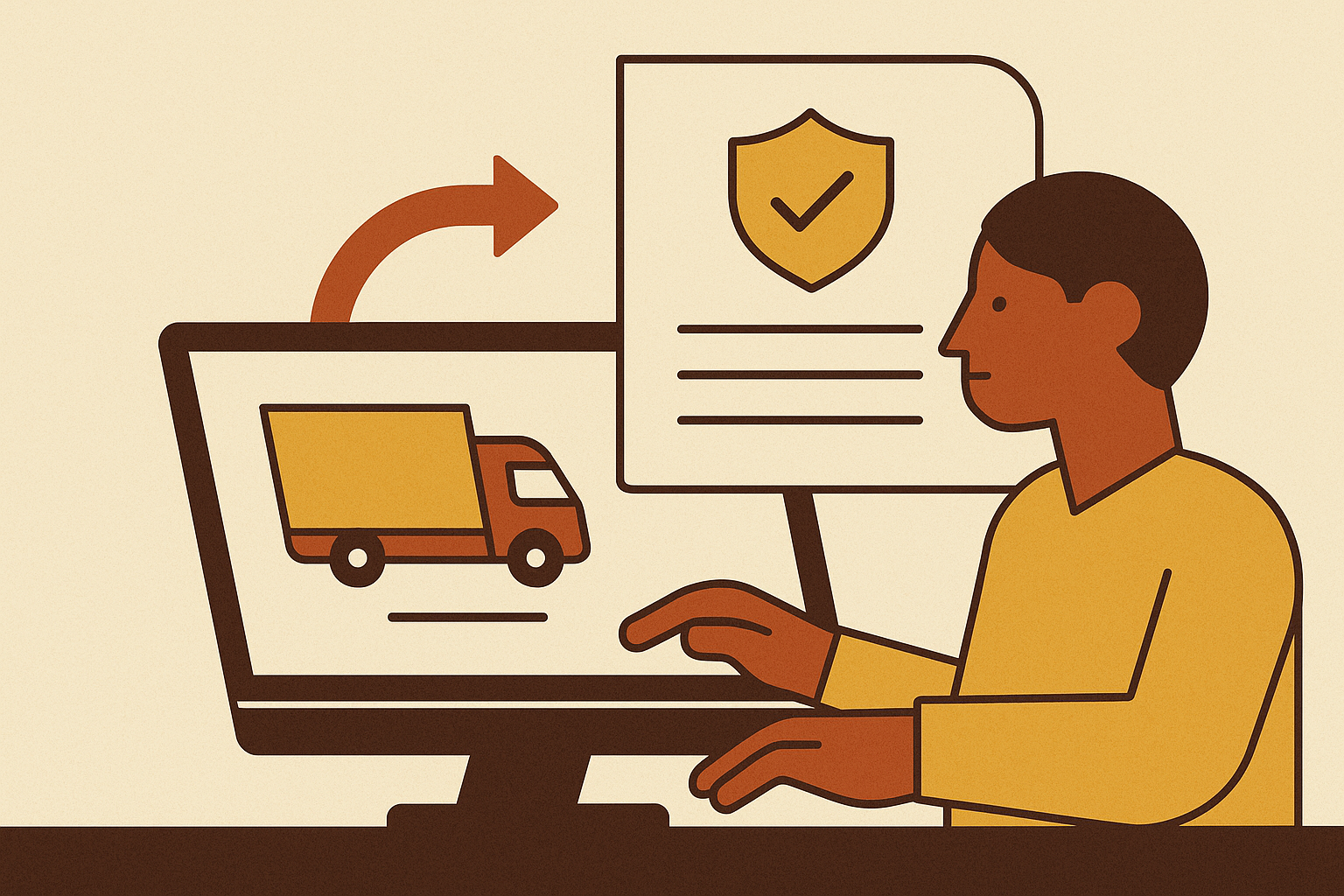
Customs brokerage automation now lives inside the shipment workflow itself, not bolted on after the fact as some add-on module. Digital freight platforms build document processing, tariff classification, and compliance checks straight into booking and tracking, and that's changing how fast, how accurate, and how expensive cross-border logistics actually is. I've spent enough time around this stuff to know the difference between a demo that looks slick and a system that survives contact with an actual customs audit. So this piece walks through why the shift is happening now, what the automation does at each step, and where a human broker still earns their paycheck, because someone has to.
Cross-border freight volume has grown, and its complexity has grown right alongside it, but customs has lagged behind booking and tracking the whole way. It's the one part of the process still stuck doing things by hand, like a factory that automated every station except the one where someone has to check the final product by eye. Traditional customs brokerage runs on people manually classifying goods, preparing paperwork, checking compliance, and filing entries one step after another. Each step is a place where a shipment can stall, or a mistake can slip through unnoticed until it costs real money. The EU's ICS2 rule can hit a company with fines up to €10,000 per violation for incomplete advance cargo data — a costly compliance failure that can stop a shipment in its tracks. Flexport has gone so far as to call 2026 "the Year of the Audit," pointing to customs filing errors at record highs right as government enforcement tightens its grip. None of this is really about replacing brokers outright. It's about cutting the lag and the error rate built into a workflow still run mostly by hand and a fair amount of institutional memory.
The scale of the market these platforms are now competing over
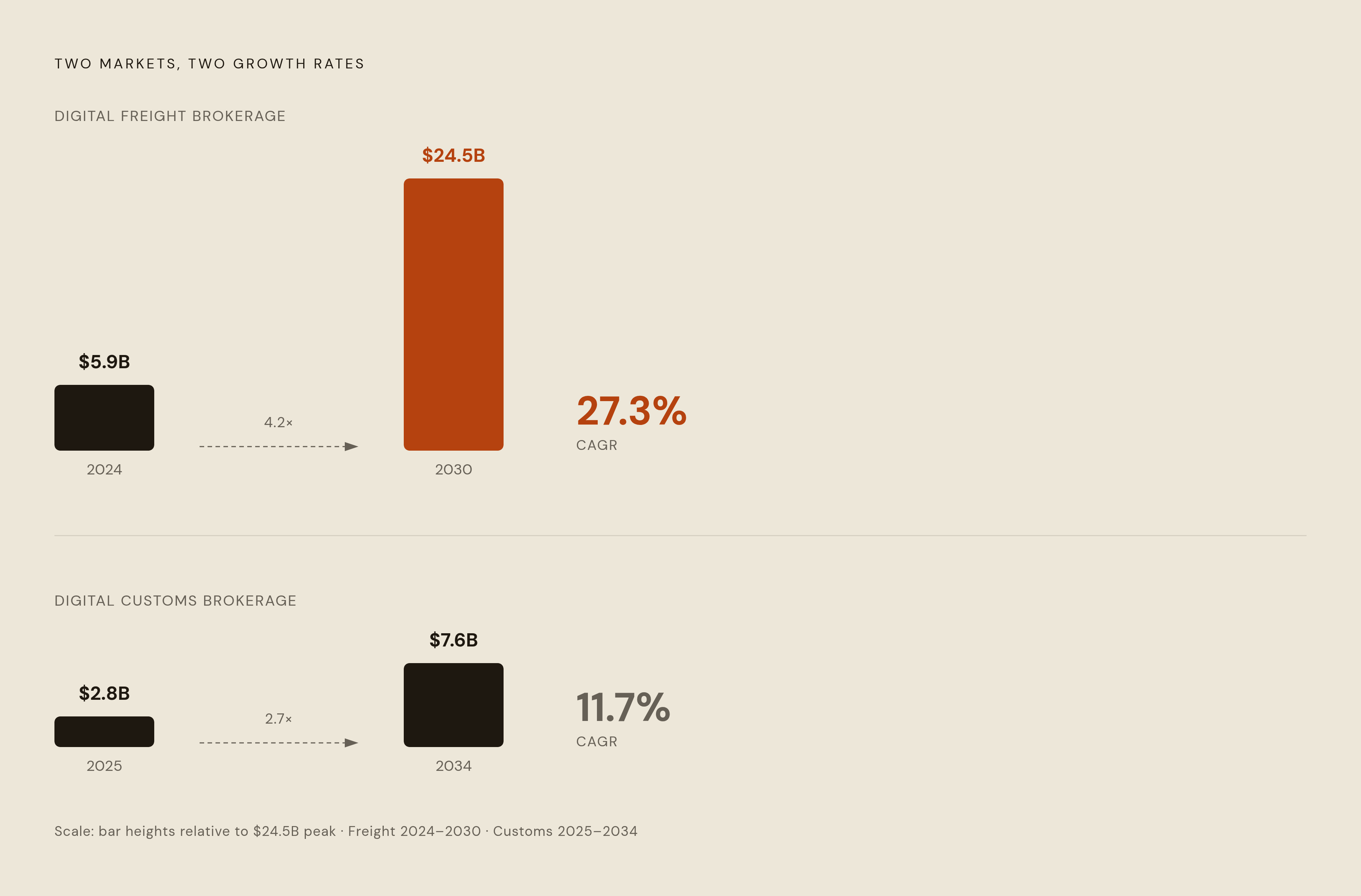
Two markets matter here, and one sits inside the other like a smaller box tucked into a bigger one. The wider digital freight brokerage market, covering booking, tracking, and payments broadly, was worth $5.9 billion in 2024 and is projected to hit $24.5 billion by 2030, a 27.3% annual growth rate according to Grand View Research. The narrower slice, digital customs brokerage platforms built specifically around compliance, sat at $2.8 billion in 2025 and is projected to reach $7.6 billion by 2034, growing at 11.7% a year.
That gap says something plain: customs is a specialized, regulation-heavy corner of the business, and it doesn't scale the way booking and tracking do. You can build a slicker tracking dashboard in six months. You cannot convince a customs authority in another country to change how it reads a bill of lading on the same timeline.
North America leads the customs platform segment, holding $974.4 million, or 34.8% of the market, in 2025. Credit USMCA cross-border complexity and the U.S. ACE mandate for pushing digital adoption along faster than it might have moved on its own. Asia Pacific is smaller at 24.1% of the market but growing faster, at a projected 13.6% annual rate through 2034, driven by China's Single Window integrations and India's ICEGATE system.
The real story sits in the difference between that 27.3% growth in broader freight and the 11.7% in customs specifically. Customs automation isn't stalling. The fight just isn't over standalone customs tools anymore; it's over which freight platform manages to fold customs into one workflow instead of treating it like a separate product bolted on the side. Market sizing numbers swing a fair amount across research firms depending on how they define scope, so treat these figures as directional rather than gospel.
What the core automation capabilities actually do inside a shipment workflow
Four capabilities make up the core stack, and they run in sequence as a shipment moves through the system.
Document processing comes first. AI built on optical character recognition and natural language processing pulls data out of invoices, packing lists, bills of lading, and import and export declarations in real time, grabbing documents from shared drives, cloud platforms, APIs, and email without a person retyping any of it. Automating that extraction step cuts manual data entry by as much as 80%, and fewer manual keystrokes means fewer transcription errors creeping into a filing at 2am because someone fat-fingered a customs value.
Tariff classification, assigning the right HS code to a product, is the most mature AI application in this stack. Machine-learning models train on datasets built from 50 million or more historical customs declarations and binding rulings, and by 2025, accuracy for general merchandise topped 96% according to research from MarketIntelo. That beats what expert human classifiers manage at high volume, plain and simple. The better systems also log their reasoning for every code they suggest, citing the actual legal notes behind the decision, which builds an audit trail that holds up far better in a post-clearance review than a broker's memory of why they classified something a certain way three years back. This matters more now because classification keeps getting more granular as regulatory changes in multiple jurisdictions expand the range of shipments that require precise HS code assignments.
Compliance checks come next, and this is more than checking whether a form got filled out correctly. The system checks data against jurisdiction-specific rules, customs codes, and documentation standards, flagging missing fields or anomalies before the filing goes out the door. FreightAmigo's industry analysis found digital platforms cutting compliance errors by 40%, a number that adds up fast across thousands of shipments a month.
Then there's risk assessment and pre-arrival processing. The AI looks at transaction history, trading partner relationships, and past compliance records to build a risk profile before the cargo even reaches the port or the container freight station. U.S. Customs and Border Protection runs its own Trade Entity Risk Model using supervised machine learning for exactly this purpose. Government adoption of that logic says something on its own: regulators aren't just tolerating AI-driven risk scoring, they're using it themselves. Forwarders running pre-arrival digital tools see clearance times run 25% faster than shops still stuck on paper.
Here's what actually determines whether any of this works: these four capabilities only pay off when they live inside the freight platform's own shipment record, not off in some separate compliance tool a broker has to log into on the side. Classification, document checks, and risk flags need to show up the moment a shipment gets created, not after it's already sitting at the border wondering what went wrong.
The efficiency gains that show up in operations — and the ones that don't yet
The headline numbers are genuinely striking. Companies report 50 to 70% reductions in customs clearance time and 60 to 80% reductions in documentation processing costs, with operational overhead dropping 15 to 30% for shippers running regular volume. But these numbers mostly come from vendor case studies and platform-affiliated research. That means they describe best-case scenarios for high-volume, standardized shipments rather than the messy middle of global trade most companies actually live in.
Where do the gains hold up? High-volume, repetitive commodity shipments with clean HS classifications. Trade lanes where both origin and destination have decent digital infrastructure. Shippers whose data flows in clean and structured from an ERP or WMS system instead of getting pieced together from five spreadsheets someone emails around on a Friday afternoon, hoping nobody notices the one with the wrong currency column.
Where things get murkier: novel or complex goods, where AI classification confidence drops and a human still has to step in and make the call. Trade lanes where one side runs modern digital customs infrastructure and the other side is still stapling paper together. Automation helps the filing side, but it can't fix a receiving customs authority stuck operating like it's 1998. Then there's tariff volatility itself. U.S. tariff policy shifted repeatedly through 2025, which means classification models need constant retraining just to keep pace with the ground shifting under them.
One gain that doesn't get talked about enough is the audit trail. A system that logs its HS code reasoning and cites the actual legal notes behind a classification gives a compliance team documentation most manual brokers never produce at that level of detail. Nobody has time to write it all down by hand while also racing a filing deadline.
How government mandates are forcing the pace of adoption
This wave isn't purely market-driven. Regulators in the U.S., EU, and Canada have set hard deadlines that functionally require digital compliance systems, whether a company feels ready or not, and readiness has never been a requirement for a government deadline.
In the U.S., the Automated Commercial Environment mandate has been the backbone driver, and the U.S. now accounts for roughly 79.3% of the North American digital customs platform market. CBP's planned ACE 2.0 update aims to expand supply chain visibility and push toward near-real-time data exchange with better international interoperability standards, with processing speed improvements among the stated goals, though the rollout timing stays a bit murky. CBP's own site says "no earlier than fiscal year 2026" for broad implementation, so check CBP.gov directly rather than take a secondhand date at face value. Meanwhile, de minimis threshold changes have expanded classification requirements across a wider range of shipments, increasing classification volume and, not coincidentally, demand for tools that handle that volume without hiring an army of classifiers.
In the EU, ICS2 has been rolling out across all member states and transport modes, requiring advance cargo information before departure. It requires advance cargo information before departure, and an incomplete filing triggers a Do Not Load order along with fines up to €10,000 per violation. Post-Brexit UK-EU trade corridors add another layer of regulatory complexity to manage. Looking further out, the EU's broader Customs Reform agenda points toward deeper platform integration requirements down the line.
Canada's CARM project, run by the CBSA, has been pushing Canadian trade participants toward compliant digital entry workflows whether they'd planned to move that fast or not.
Zoom out, and over 90 countries have implemented or are implementing WTO Trade Facilitation Agreement-compliant single-window systems as of 2025. That's the interoperability groundwork that makes platform-embedded customs automation workable across more trade lanes, rather than just the handful of corridors with mature infrastructure on both ends. Logistics teams that might have put off automation for another budget cycle are now facing hard go-live dates that turn a manual-only workflow into a real compliance liability.
How leading freight platforms are building customs automation into their core product
The real competitive line here is integration depth. Does customs live inside the shipment workflow, sit as a compliance module bolted on the side, or get handed off to a third-party broker who isn't even in the same system?
Flexport, used by more than 13,000 companies, launched a Customs Technology Suite in 2025 with over 25 new technology and AI products aimed squarely at tariff volatility and compliance. Its Customs Technology Suite includes tools aimed at tariff exposure and compliance risk, positioning automation as a core service offering rather than an afterthought. The broader roadmap points toward deeper AI-driven customs capabilities, with autonomous trade workflows as the stated long-term direction. Their Duty Drawback product reportedly generates 20 to 40% higher returns on average than traditional industry tools, a specific, named claim rather than a vague promise of "savings." The framing throughout is deliberate: this is a direct answer to tariff policy that shifted repeatedly through 2025, not generic automation dressed up for a pitch deck.
FreightAmigo combines customs brokerage and freight forwarding in one platform, leaning on automated HS classification and document processing built right into the booking flow, marketing automation as a response to specific regulatory changes rather than a general efficiency pitch.
Other players take an integration-layer approach, focused on document processing and classification that plugs into a company's existing freight management system rather than asking anyone to migrate off it — bringing automation to the platform a shipper already uses instead of asking them to switch tools mid-quarter.
AI-native tools built around HS code classification and real-time compliance checking have emerged for brokers and forwarders who want to automate the repetitive classification work that used to eat up a junior staffer's entire day, every day, week after week.
Across all of them, the pattern looks the same. Automation starts with classification and document processing, since that's the highest-volume and most standardized work, then expands into compliance checks and risk assessment, where the complexity and the value both go up. Full workflow integration is the long game, the thing that separates one platform from another over time. Whichever platforms build a deep audit trail, logging AI reasoning behind every classification call, are the ones better positioned as enforcement keeps tightening.
What still requires human judgment in an automated customs workflow
A 96% accuracy rate sounds great until you flip it around. At real scale, that remaining sliver of misclassified shipments can add up to serious duty exposure or enforcement risk, and a company running thousands of shipments a month can't wave that off as a rounding error. Four percent of a small number is nothing. Four percent of ten thousand monthly filings is four hundred problems waiting to happen.
Human broker expertise still earns its keep in a handful of specific spots. Novel goods that don't map cleanly onto existing HS categories, think new materials, composite products, or software-hardware hybrids that don't fit any tidy box. Binding ruling requests and formal challenges to a classification decision. Country-of-origin determinations in supply chains complicated enough to require a substantial transformation analysis. Trade remedy and sanctions screening, especially when the geopolitical ground shifts fast, which lately feels like every other Tuesday. And post-clearance audits and dispute resolution, where a company genuinely wants a licensed human standing behind the call, not a model that can't testify.
The broker's job is shifting, not vanishing; less time on data entry and volume classification, more time on exception handling, escalation calls, and duty optimization strategy. Tariff volatility adds its own wrinkle. When classifications shift because of a new trade measure, and U.S.-China trade policy has done this repeatedly, AI models trained on historical data need a broker's judgment to know what to retrain on and why. Put AI on volume and speed, put brokers on ambiguity and accountability: that's the split that actually holds up in practice. Platforms built around that division of labor, with clear escalation paths built right into the interface, will outperform the ones that quietly assume automation means full replacement.
What shippers and logistics teams should evaluate before committing to a platform
The market is expanding fast, but that doesn't mean the platforms in it are interchangeable. A few questions separate the real options from the sales pitches.
Integration depth matters most. Does customs automation live inside the actual shipment record, surfacing classification and compliance flags the moment a booking gets created, or does it sit off in a separate module someone has to remember to check? A bolt-on tool can look impressive in a sales demo and still add friction in daily use, because every handoff between systems is another place for something to fall through the cracks.
Audit trail quality is the next thing worth testing directly. Ask a vendor to show exactly what gets logged when their AI suggests an HS code. Does it cite the legal notes and binding rulings behind the call, or does it just spit out a number with no paper trail behind it? That distinction is the difference between a defensible position in a post-clearance audit and a shrug.
Then there's the honest question of where a platform's accuracy claims actually apply. A 96% classification accuracy rate on general merchandise doesn't say much about how the system handles the odd, complicated shipment that doesn't fit a standard category, and that's usually where the real cost sits anyway. Ask what happens when the model isn't confident, and how fast a human gets looped in when it isn't.
Finally, look at how the platform handles regulatory change itself. Tariff policy isn't holding still, and a system trained on last year's rules is only as good as its retraining cycle. The platforms treating retraining as an ongoing process, rather than a one-time model build, are the ones likely to hold up as ICS2, ACE 2.0, and whatever comes next keep reshaping the ground everyone's filing on.