Electric Vehicle Fleet Integration with Route Planning Systems
Charging decisions transform routing into an optimization problem vendors often oversimplify.
Swap the diesel trucks for electric ones, keep the same routes, the same dispatch board, the same driver habits, and the fleet should just work. That assumption is where most electrification projects quietly fall apart. Range, charging time, and energy use interact with each other and with the schedule in ways that break the old logic before the first EV even leaves the lot. This piece walks through what actually has to get rebuilt, layer by layer, to make an electric fleet run the way a diesel one used to.
What the Electric Vehicle Routing Problem actually involves, and why it's harder than conventional routing
The Electric Vehicle Routing Problem, EVRP for short, asks a fleet to serve a list of stops while also deciding when to charge, where to charge, and how much charge to take on, all at the same time. That last part is the whole difference from standard vehicle routing. In a diesel fleet, fuel stops are basically an afterthought; a truck runs low, it pulls into a station, it fills up in five minutes, and the route barely notices. Electric vehicles carry a heavier planning burden at every stop.
Every charging decision becomes a routing decision. Which station does the vehicle visit? Does it take a quick partial charge or wait for a full one? And how does the time spent charging line up against the delivery window the driver is already racing? None of these questions can be answered in isolation, because the answer to one changes the answer to the others.
Charging itself doesn't behave in a straight line, either. Lithium-ion batteries charge fast up to a point, usually somewhere in the 70 to 80 percent range, and then the rate slows down as the battery fills. That means "time to charge" isn't some fixed number a dispatcher can plug into a spreadsheet. It depends on the state of charge when the vehicle arrives, which itself depends on the route just driven, the load it carried, and the weather that day.
Put all that together and EVRP turns into a nonlinear integer program, which sounds like something out of a graduate seminar, and honestly, it kind of is. It's classified as NP-hard, meaning there's no shortcut to a perfect answer once the fleet gets past a handful of vehicles and stops; exact solutions don't scale, so real systems fall back on heuristics and approximations instead. Early academic models made this simpler by assuming fixed charge times, unlimited station capacity, and flat electricity prices. Those assumptions rarely survive contact with an actual depot at 6 a.m. when four trucks want the same charger and the utility rate just jumped.
Anyone shopping for routing software should know the vocabulary here, because vendors use it loosely. EVRPTW adds time windows to the mix. Partial charging models let vehicles top off instead of waiting for 100 percent. Mixed-fleet VRP handles a yard with both diesel and electric trucks. Multi-depot EVRP covers operations running out of more than one facility. If a platform doesn't mention which of these it actually handles, that's worth asking about directly.
How range variability actually behaves in the field, and what it means for route buffers
The number on the window sticker is a ceiling, not a promise. Actual range moves around based on temperature, how much weight is in the vehicle, the terrain it's crossing, and whatever the HVAC system is doing to keep the cabin comfortable. Treat the rated figure as a best-case scenario and the planning gets a lot more honest.
Temperature is the biggest offender, and it cuts both ways. Cold weather, especially sub-zero conditions, can cut available battery capacity by a wide margin, since the chemistry inside a lithium-ion pack just doesn't move electrons as efficiently when it's frozen. Heat carries its own cost: energy consumption climbs at 30°C and climbs even faster once temperatures drop well below freezing on the other end of the scale. These aren't rare edge cases reserved for a bad week in January. Any fleet running through a northern winter, or through a hot-climate logistics corridor in the summer, is living in these conditions on a regular basis.
Terrain and payload stack right on top of that. The same route, driven on two different days, can post wildly different energy consumption numbers depending on what's in the cargo bay and how many hills are involved. A flat suburban loop with a light load and a hilly route with a full pallet carry very different energy costs, even if the mileage on the map looks identical.
Then there's the slower variable: battery degradation over years of use. Geotab's analysis of a large fleet dataset found that modern EV batteries degrade at a modest average annual rate and stay operationally fit well past the point most fleets would have swapped out a comparable engine. That's the good news. The catch is that degradation compounds, so a route that was comfortably within range in year one might be running tighter margins by year three, even with no other change to the route itself.
So what does a fleet do with all that variability? The instinct is to build in a flat safety buffer, something like "always keep 20 percent in reserve," and call it done. Set the buffer too conservative and the vehicle can't cover routes it's actually capable of running; set it too thin and a cold morning with a full load turns into a stranded van three miles from the depot. A per-route energy model that actually ingests weather, load, elevation, and battery health as it stands today produces a far more reliable buffer than one someone picked because it sounded safe in a planning meeting.
Charging infrastructure gaps that break route assumptions before a vehicle even leaves the depot
Route plans can assume a public charger is available, working, and open when the vehicle rolls up. That assumption is doing a lot of heavy lifting it hasn't earned. Public charging infrastructure in the U.S. isn't keeping pace with the vehicles hitting the road; in 2025, the number of new public charging ports added was dwarfed by the number of new EVs registered, something on the order of one new port for roughly every 30 new EVs. That ratio alone should make any route planner nervous about depending on a public charger showing up as a waypoint.
Even when a public charger exists, it costs more, materially more, per kilowatt-hour than charging back at the depot. That price gap is exactly why fleets are leaning toward depot-first charging strategies rather than routing vehicles out to public stations mid-shift. Charge at home base overnight, and the whole cost structure looks different.
Depot charging brings its own headaches, though. Plug in a dozen high-capacity vehicles at the same time and the facility creates a peak power demand spike that the local utility notices immediately. Utility demand charges on those spikes can push operating costs up substantially, sometimes enough to erase a chunk of the fuel savings the fleet electrified to capture in the first place. And the electrical infrastructure needed to support that load, transformers, panel upgrades, new service capacity, often takes months to install, while the vehicles themselves can show up in weeks. That mismatch is where a lot of electrification timelines quietly go sideways: the trucks arrive on schedule, and the depot isn't ready to feed them.
Smart charge scheduling, spreading the load across off-peak hours instead of plugging everything in at once, can cut energy cost per mile substantially compared to unmanaged charging. That gap is the difference between a fleet electrification project that pencils out and one that doesn't. The strategic lesson here is straightforward: operators who order the vehicles before they've sorted out the charging infrastructure end up short on operational capacity despite having plenty of EVs. Charger availability, at the depot and out on the road, has to be treated as a hard constraint inside the routing software, not a hopeful assumption baked into the map.
How modern route planning systems rebuild their logic around charging windows and energy state
Modern EV route planning software works as an optimization engine, weighing energy, time, and charger availability against each other before it ever draws a line on the map, a step well beyond what a simple map overlay does.
A handful of capabilities separate a system built for this from one just bolted onto old logic. Real-time energy modeling factors in payload weight, road gradient, ambient temperature, and even driver behavior, rather than leaning on a static range number pulled from a spec sheet. Charging stop integration treats a charger visit as a full route node with its own time cost, accounting for that nonlinear charge curve mentioned earlier, instead of dropping it in as an afterthought waypoint. Live charger availability data keeps the route from being built on a charger that's actually broken or occupied by someone else's van. Time-window compatibility lines up charging stops with mandatory driver breaks and delivery windows so the two aren't fighting each other on the schedule. And dynamic rerouting lets the system respond mid-route to traffic, weather, or a charger going offline, without the whole day's schedule collapsing.
Some platforms go a step further and use data-driven traffic-flow forecasting, transformer-based models among them, to anticipate congestion before it happens and fold that into the energy estimate before the vehicle even leaves the depot. That's a meaningfully different approach than reacting to a traffic jam once the driver is already stuck in it.
None of this works without the routing system talking to everything else in the operation: the transport management system, the ERP, the depot's energy management platform. Route decisions and energy procurement decisions need to run off shared data, or the routing engine is optimizing against numbers that are already stale. One delivery fleet case cited in industry research found that an AI-optimized routing approach produced a meaningful cut in energy consumption, largely by avoiding congested routes and pre-conditioning batteries before departure. The exact percentage matters less than the mechanism: the system was making decisions before the problem showed up, not after. These features amount to a different architecture, one where energy state sits alongside time and distance as a core variable the system is solving for, not a constraint checked after the fact.
Where AI and machine learning are changing what's solvable in real-time fleet optimization
Three families of algorithms show up across the fleet optimization space right now: heuristic methods, optimization-based methods, and machine learning approaches. Each trades off differently between solution quality and how fast it can spit out an answer. A heuristic might get a good-enough route in seconds; a full optimization pass might take longer but get closer to the actual best answer. Machine learning sits somewhere in between, and it's the one changing fastest.
Reinforcement learning is one of the more interesting entries here. Instead of solving a single route in isolation, an RL agent learns charging and routing policies through simulated experience, which lets it account for consequences that only show up later. A route might look perfectly fine on paper and still leave a vehicle arriving back at the depot with too little charge to start the next shift. An agent trained on enough simulated runs starts to notice that pattern and route around it before it becomes a problem.
Forecasting demand is its own challenge, and a 2025 study published in PLOS ONE found that an LSTM-based model improved regional EV charging demand forecast accuracy in a meaningful way. That matters less for any single vehicle's route and more for depot-level load planning, since knowing how much charging demand is coming in the next few hours is exactly the information a facility needs to avoid tripping into a costly demand charge.
Emerging research from 2026 points toward battery-degradation-aware routing, frameworks that fold real-time battery state, core temperature, state of charge, mechanical stress, directly into the routing decision, so a route actively avoids conditions that wear the battery down faster. This relies on physics-informed modeling rather than just averaging historical data, and the practical implication is worth sitting with: a route that's perfectly feasible today might need to be shortened in year two if it consistently pushes the battery hard. A good system should be able to see that coming rather than waiting for the range to quietly shrink.
What's still missing from most commercial systems on the market is worth naming plainly. Multi-year battery degradation, variable electricity pricing across time-of-use tariffs, and charging station capacity limits under simultaneous demand from several vehicles remain active research problems, not solved ones. The gap between what shows up in an academic paper and what ships in production software is closing, but it hasn't closed. Anyone evaluating a vendor should ask directly which of these three simplifications that vendor is still making, because the answer changes what the software can actually be trusted to do.
Telematics platforms that currently support EV fleet and route integration
The money flowing into this space says something on its own. MarketsandMarkets puts the EV fleet management market at $9.10 billion in 2025, with a projection of $32.25 billion by 2030, a compound annual growth rate of 22.7 percent. That kind of growth means the platform landscape three years from now probably won't look much like it does today, so any evaluation done now should build in room to switch or expand later.
Geotab carries a large installed base across commercial fleets and an open architecture with a wide marketplace of third-party integrations. That openness matters for fleets that need routing to talk directly to energy management systems and whatever enterprise software already runs the business. Its EV-specific tools include battery health monitoring and range tracking, which line up directly with the degradation and range-variability problems covered earlier in this piece.
Samsara runs at enterprise scale, with a large customer base that points to production-grade deployment rather than early pilots. Its EV-specific features include automated suitability assessments, essentially a tool that flags which diesel vehicles in a mixed fleet should be replaced first, along with energy monitoring and emissions tracking. The modular setup suits fleets planning a gradual shift from mostly diesel to mostly electric rather than an all-at-once swap.
Verizon Connect also offers EV tracking and range monitoring tools, worth a look for any fleet that already runs on that platform and wants to avoid ripping out an existing system just to get EV support.
Whichever platform ends up on the table, a few questions cut through the marketing quickly. Is the energy model dynamic, or is it still leaning on a static range estimate dressed up to look sophisticated? Is charging stop logic built natively into the route optimization, or bolted on after the fact? How deep does the API integration go with depot energy management systems, and does the platform actually support a mixed ICE and EV fleet running side by side, since that's the reality for most operations during the transition. Fleet managers who run this evaluation themselves, rather than handing it off to a slow procurement process that takes months to produce a shortlist, tend to land on a better-calibrated answer faster.
How to sequence the operational rebuild when transitioning a working fleet
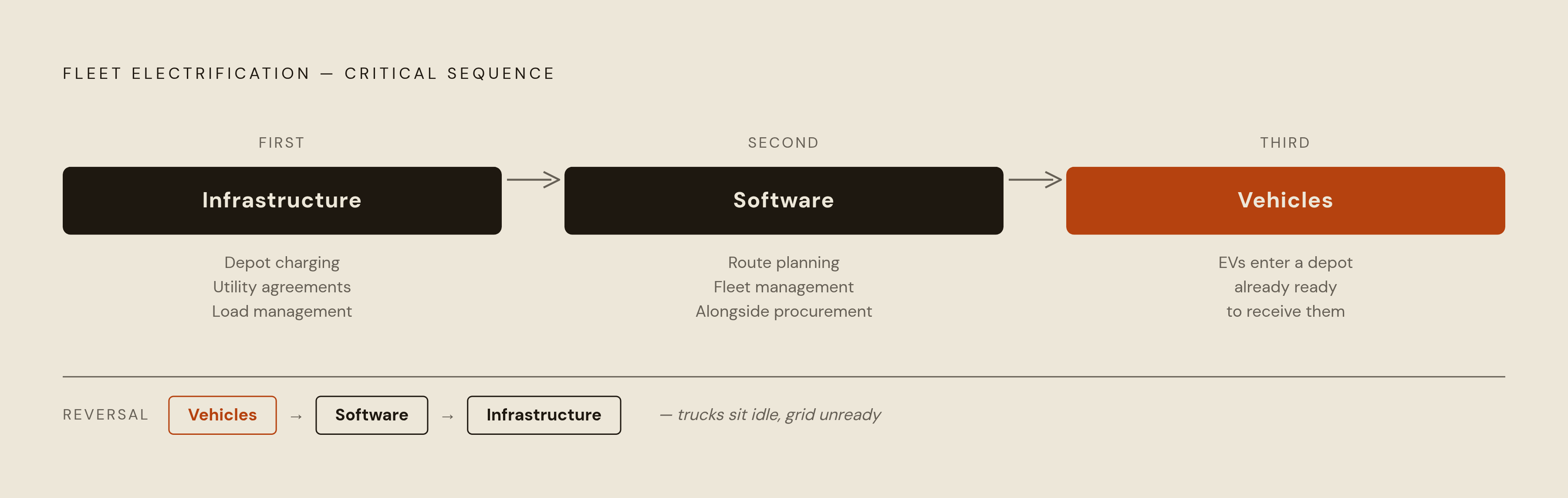
Order matters here more than almost anything else in this whole process. Infrastructure comes first, before the vehicles show up. Depot charging capacity, utility agreements, and load management systems all need lead time that a vehicle delivery schedule simply doesn't respect. Reverse that sequence, put trucks in the lot before the electrical work is done, and the fleet ends up with expensive vehicles sitting idle while someone waits on a utility crew.
Suitability analysis should happen before any route gets committed to electrification. Some routes have range profiles, stop patterns, and dwell times that fit current EV capability well; others don't, at least not yet. Forcing an EV's constraints onto a route that was designed around a diesel truck's habits is how a pilot program turns into a cautionary tale.
Pilot programs work better on forgiving routes: shorter urban loops with a guaranteed return to the depot each night, where range variability and charging access are the easiest to manage and the easiest to recover from if something goes wrong. That's where real operational data gets built, the kind that actually reflects local weather, local terrain, and local driver habits, before anyone extends the program to long-haul or high-variability routes where a miscalculation costs a lot more.
Route planning software needs to be upgraded alongside vehicle procurement, not after the trucks arrive. Static routing tools built for diesel logic will produce plans that are suboptimal at best and flatly infeasible at worst once EVs are added to the mix. And a new system needs real time calibrated against actual vehicle energy data, not vendor spec sheets, before anyone should trust it to plan a full day's routes.
The mixed-fleet period deserves to be treated as a permanent operating mode rather than some temporary phase to rush through. Most commercial fleets are going to run diesel and electric vehicles side by side for years, not months, so the planning system has to handle both without one dragging down the other. And charging cost management, off-peak scheduling, demand charge avoidance, balancing load across the depot, belongs in the route economics from the very first day, not as a fix applied after the first surprise utility bill arrives. Those numbers are what decide whether the total cost of ownership on an EV fleet actually delivers what it promised on paper.
The fleets that get this right went beyond simply swapping diesel trucks for electric ones. They rebuilt the planning logic underneath the whole operation, and they did the rebuilding in the right order: infrastructure, then software, then vehicles, with the mixed fleet running the whole time as the normal state of business rather than an inconvenience to get through.