Dynamic Routing vs Static Route Planning in Distribution Networks
Dynamic routing cuts costs and emissions.
Last mile now eats up more than half of total shipping cost, up from 41% in 2018 to 53% in 2023. Every distribution network is chewing on the same question: does the fix live in the route plan, or somewhere else. This piece walks through static and dynamic routing, the two answers everyone reaches for first, and lands on neither one being a clean winner. What fits depends on order volume, fleet size, geography, and how hard the last mile is squeezing your margins this quarter.
What static and dynamic routing actually mean in practice
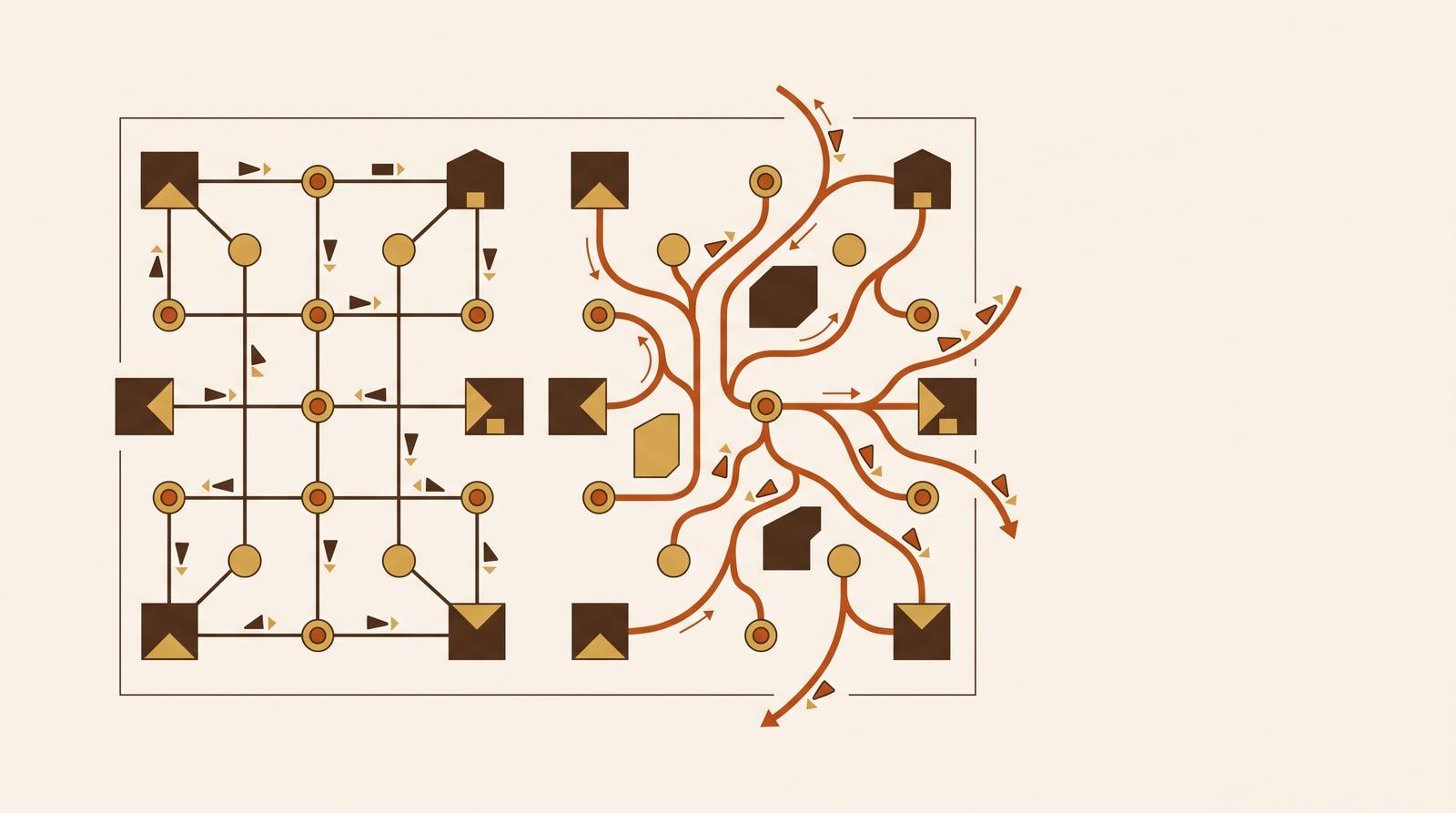
Static routing sets a fixed route at the start of a cycle, usually a day or a week, and holds to it no matter what happens on the road. Dynamic routing treats the route as a live decision, recalculated as traffic shifts, orders come in, or a driver falls behind.
The difference comes down to how often a decision gets made. Static makes one call per cycle and rides it out, while dynamic keeps making calls all day.
A common mistake is treating dynamic routing as a fancier, pricier static routing. That framing falls apart under any scrutiny. Static routing suits known, repeating demand: the same stops, the same order sizes, the same rhythm week over week. Dynamic suits demand that refuses to sit still long enough to plan around. Neither wins in the abstract. What matters is what the network needs to solve for, and that's a different answer for a pharmaceutical distributor than it is for a grocery chain running same-day orders through a dense metro.
Where static routing earns its place and where it breaks down
Static routing does its best work when volumes hold steady day to day, customer locations barely shift, and the territory is well known. Think retail replenishment runs, pharma distribution to the same pharmacies every week, institutional deliveries on a fixed schedule. Nothing exotic, nothing that needs a live traffic feed.
The payoff shows up in places that don't make headlines. Drivers know their routes cold, which cuts wasted mental effort and tends to keep turnover down, since nobody enjoys relearning their job every morning. Tech overhead stays low, too: no real-time data pipes, no optimization engine humming in the background eating server costs. And because the schedule is known ahead of time, dispatchers can plan around low-traffic windows, trimming fuel use on routes that barely change from one week to the next.
Then reality shows up, and static routing struggles to keep pace. An accident, a closed road, a snowstorm, and the plan just sits there, unresponsive. Drivers locked into their own zones can't grab a nearby stop even when it would save miles, so a truck runs half-empty while one two streets over is packed. A route built on historical averages falls apart the day actual orders don't match the average, which produces long warehouse waits, missed windows, and drops that never happen at all.
Industry estimates put the annual cost of inefficient routing at 25 to 30% of last-mile spend across fleets, with static planning named as a major driver of that number. Urban congestion piles on: traffic alone can eat up to half of total delivery cost in dense cities, and a fixed plan has no real way to dodge it, so it just absorbs the hit and moves on.
What dynamic routing delivers and what it costs to operate
Live deployments back up the sales pitch. Fleets running dynamic routing report distance cuts of 10 to 28% and route planning time cut by about half. On-time rates above 90% show up in company reports, against the 70 to 80% you'd expect from manual or static planning. McKinsey & Company research on real-time route optimization found gains of 15 to 25% in on-time delivery. Fuel savings run $2,000 to $5,000 per truck a year; run that across a 200-truck fleet and you're at $400,000 to $1,000,000 saved annually, before you even count reduced overtime or fewer failed drops.
Emissions drop too, usually in the 5 to 25% range, with some fleet studies claiming up to 40%. Given how much pressure distribution networks are under to show sustainability progress alongside cost savings, that number carries weight beyond the fuel bill.
None of it is free. Dynamic routing needs dependable real-time data: GPS feeds, live traffic, order management systems that talk to the routing engine without lag. Dispatchers and drivers need training, because a route that changes daily asks more of a driver's attention than one they've had memorized for three years. Customer commitments get harder to hold, too. Specific delivery windows, the same driver showing up at the same dock every Tuesday, those relationships get shaky when the route underneath them won't stop moving. A two-truck operation almost certainly won't generate enough day-to-day variability to justify any of this overhead. Some vendors cite on-time rates above 98%, which sounds great until you realize that's a mature deployment three years in, not a number you get in month one.
How AI and machine learning turned dynamic routing from theory into scalable practice
Early dynamic routing leaned on human dispatchers re-planning by hand in real time, and that worked, until it didn't. Past a certain fleet size the math gets too heavy and mistakes pile up fast. Modern systems hand that job to machines. Reinforcement learning adjusts routing strategy on the fly based on live traffic, congestion, and road closures. Deep learning digs through historical and current traffic data to guess where congestion will build before it happens, so the system routes around it in advance instead of reacting after the fact. Advanced machine learning models now feed arrival-time predictions straight into dispatching and sequencing decisions.
Major carriers have deployed AI-driven software that sequences routes in real time while weighing traffic and delivery constraints at once, and that matters less as a trivia fact than as proof the approach works at industrial scale, well beyond a pilot program with three vans. A 2025 study in Scientific Reports made a similar point in academic language, noting that urban last-mile systems face volatile traffic, tight delivery windows, and frequent disruption, conditions that "limit the effectiveness of static and single-strategy vehicle routing approaches." The real world won't hold still long enough for a fixed plan to keep up with it.
AI has limits, too. It doesn't fix bad data, doesn't patch integration gaps between systems that were never built to talk to each other, and doesn't make a driver comfortable with a route that's different every single day. The technology enables better routing. The operational groundwork underneath it still has to get built by hand, by people, on a timeline that has nothing to do with how fast the model trains.
UPS ORION as a case study in the limits of static optimization and the transition to dynamic
ORION launched as a static system, generating an optimized sequence each morning across more than 66,000 routes in the US, Canada, and Europe. Once the day started, the plan held, no matter what happened on the road. The original engine evaluated an enormous number of alternative sequences per route before landing on the day's optimum, so calling it simple would undersell it. The sophistication was real; it just stopped the moment trucks pulled out of the lot.
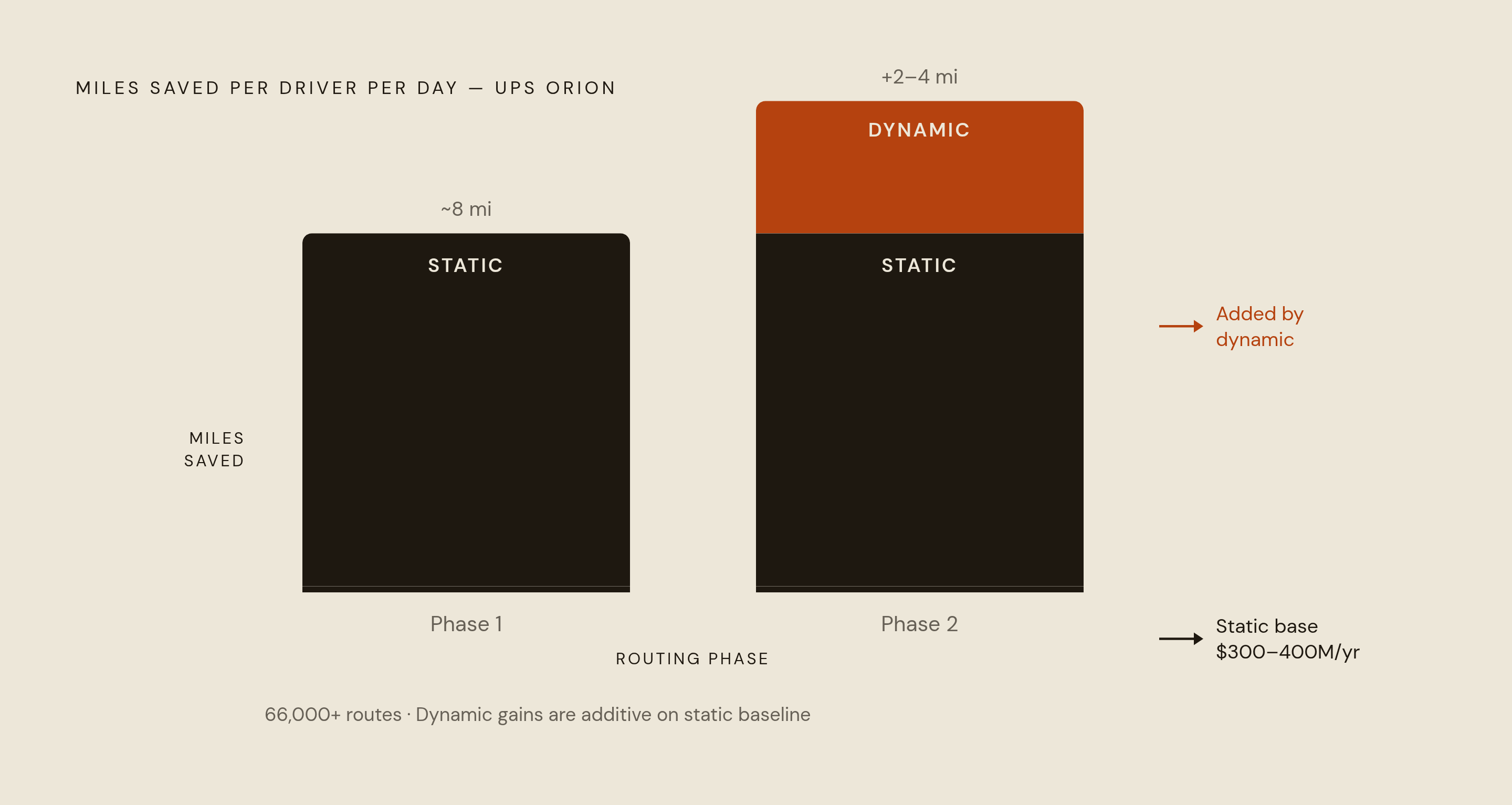
The payoff was real. ORION cut roughly eight miles per driver per day, which sounds small until you multiply it across tens of thousands of routes, every day, for years on end.
UPS later rolled out dynamic ORION, recalculating routes in real time through the day instead of locking them in at sunrise. That added another two to four miles per driver on top of the original gains. Combined, both versions saved UPS an estimated $300 to $400 million a year alongside meaningful reductions in carbon emissions.
What most case studies skip is the human side of getting there. Rolling out dynamic ORION meant retraining drivers across a large national fleet, running structured A/B tests, and building feedback loops into the transition rather than flipping a switch one Monday morning. By documented accounts, driver resistance fell substantially over the course of the rollout, and it got there through deliberate change management, not because drivers woke up one day thrilled about routing software. ORION is about as clean a proof point as exists that static routing can be genuinely well built, and that its ceiling still sits below what dynamic achieves once an operation has the scale and volatility to justify the jump.
The operational variables that determine which approach fits a given distribution network
Order volume predictability comes first. Regular retail replenishment or institutional supply, where next week looks like this week, favors static or a hybrid built around a static core. E-commerce, on-demand delivery, seasonal spikes: all of that favors dynamic, since the value of rerouting in real time climbs right alongside how unpredictable demand gets.
Fleet size sets a rough line, too. Savings from dynamic routing compound as the fleet grows. A ten-truck operation clears real value, while a two-truck outfit might never recoup the setup cost. That $2,000 to $5,000 per-truck annual fuel figure gives a rough yardstick for weighing payoff against what implementation actually costs.
Geography and congestion density matter just as much as fleet size. Dense urban routes with unpredictable traffic gain the most from dynamic rerouting, since static plans degrade fastest exactly where congestion is worst. Fixed suburban or rural routes with light, steady traffic hold onto more of static routing's efficiency edge, mostly because there's less chaos to react to in the first place.
Customer relationships shift the math further. B2B accounts with scheduled windows, food and beverage wholesale or pharma distribution among them, don't respond well to routes that shift daily; the relationship runs on consistency as much as speed. B2C parcel customers tend to care less about which route the truck took and more about whether the box showed up in the window they were promised.
Data infrastructure is the last piece, and probably the one that actually gates everything else. Dynamic routing needs dependable GPS, live traffic feeds, and order management systems sharing data in real time. Without that foundation, the modeled savings simply don't show up on the P&L. Static gets by with far simpler systems, which makes it the sensible starting point for operations that haven't made that infrastructure bet yet.
Why most distribution networks at mid-scale land on a hybrid model, and how to structure one
Pure dynamic routing has a blind spot: B2B accounts with long-standing relationships and specific delivery windows get disrupted when the route around them won't stop shifting. That's the gap the anchor-and-fill model closes, and it's already common practice among food and beverage distributors.
The idea is simple enough to fit on a napkin. Key accounts become fixed anchors, locked delivery windows that never move. Everything else fills in dynamically around those anchors, based on the day's order volume and current road conditions. The result holds high-value relationships steady while still capturing dynamic routing's efficiency gains on everything else.
Some food distributors run documented versions of this in production: static planning tools capture dispatchers' local knowledge, built up over decades on the job, and turn it into skeleton routes, which then get adjusted and filled in dynamically each day. Beverage distributors often follow a similar path in three stages. Crawl means recutting master routes so they reflect current demand and seasonality instead of running on assumptions from two years back. Walk means layering in dynamic hybrid routing, fixed anchors with dynamic fill built around them. Run means shifting toward primarily dynamic, blending on-premise and off-premise customers onto shared trucks.
Running a hybrid model this way asks something specific of the software underneath it: the ability to hold two constraint types at once, a skeleton route that doesn't move and live stops that do. That requirement narrows the field fast. Platforms built around strategy-first workflows, ones that let dispatchers encode what they already know before the dynamic engine starts adjusting, tend to fit hybrid operations better than pure real-time engines that toss out historical structure and start from a blank slate every single morning.
How to evaluate routing software when the right model is a hybrid
Here's the mistake worth naming directly: buying "dynamic routing software" on the assumption it'll handle hybrid constraints right out of the box. Most pure-dynamic engines are built to optimize for real-time efficiency, full stop, and they don't hold fixed-anchor commitments particularly well, since that was never the problem they were built to solve.
A few questions cut through vendor pitches fast. Can the platform mark certain stops as fixed, off-limits to the optimizer no matter how much it wants to resequence them? When a mid-route disruption hits, does the system reroute on its own, flag a dispatcher, or just sit there until a human notices? What data integrations does it actually require, and what's the realistic timeline before live routing works, not the one in the sales deck? And how does it keep drivers in the loop when the route changes mid-shift, since a driver who doesn't know the plan changed is worse off than one running a stale static route?
Change management is not a footnote here. UPS's own rollout makes the case on its own: driver resistance to dynamic ORION fell substantially, and that only happened because training was built into the rollout from day one, addressed before drivers started complaining rather than after. Any implementation plan that skips this step is skipping the part that decides whether the software actually gets used.
Worth testing across a few vendor categories rather than settling on the first flashy demo. Purpose-built last-mile platforms with hybrid support, names like Locus, DispatchTrack, and Descartes among them, bring different strengths depending on fleet size, integration depth, and industry focus. The real decision was never static versus dynamic to begin with. It's figuring out which constraints in your network are genuinely fixed, which ones can flex, and which platform handles that exact mix at the fleet size and geographic density you actually run, not the one from someone else's case study.