Fleet Route Optimization for Cold Chain Deliveries
Smart routing and real-time tracking prevent costly spoilage in temperature-sensitive deliveries.
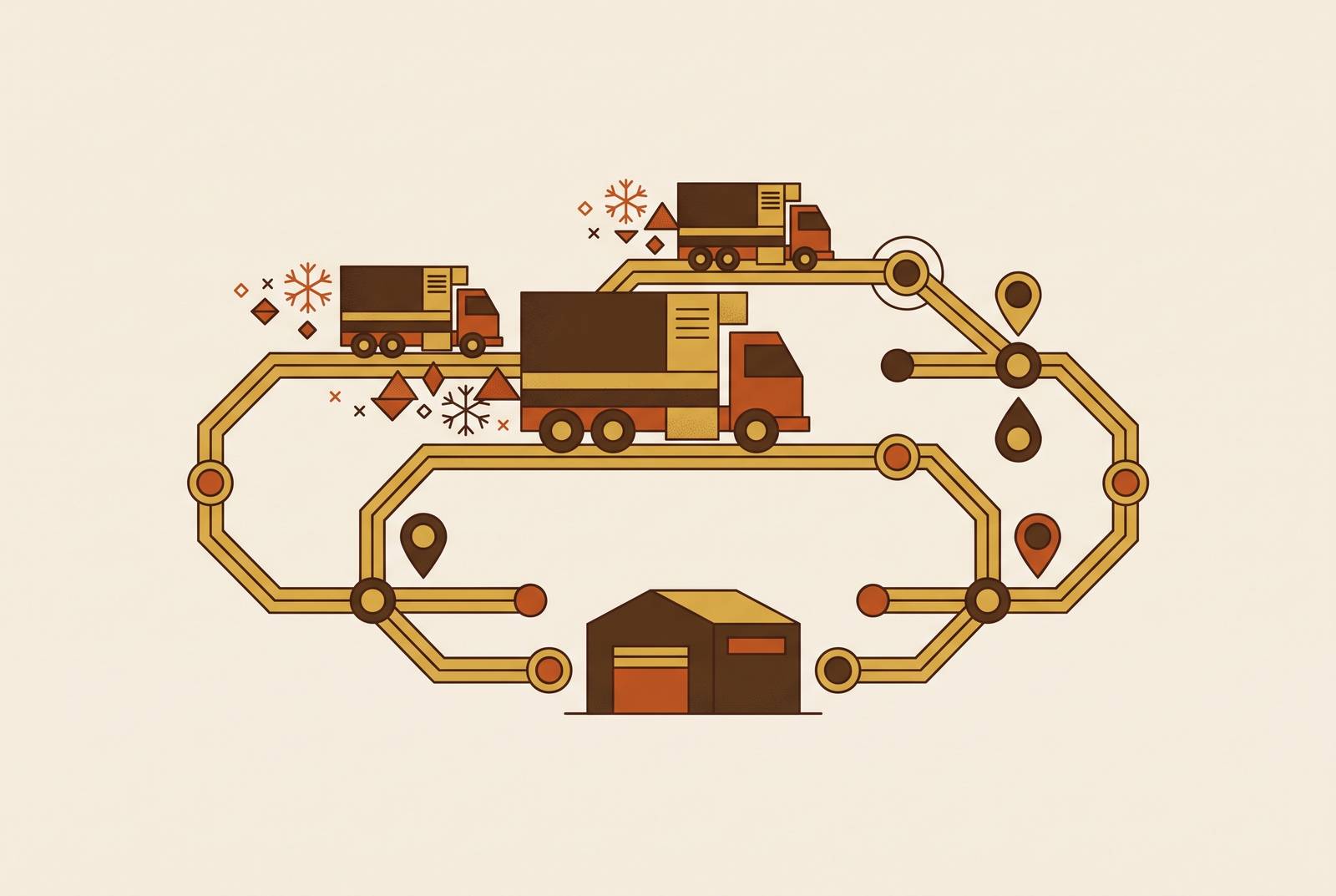
Cold chain route optimization is planning delivery of temperature-sensitive goods like food and pharmaceuticals so they hold the right temperature from pickup to drop-off. Shortest-path routing doesn't work here, period: it ignores delivery time windows, compartment logic, plus current live traffic conditions, and how slight drift ruins any shipment. The gap explains why a lot of cold chain freight gets there compromised, even when a driver took the best route.
Global Market Insights puts the cold chain logistics market at $382.3 billion in 2025, climbing to $1.37 trillion by 2035 at a 13.8% compound annual growth rate. Food plus beverages make up 74.25% in the market; biologics and pharmaceuticals rise 7.56% annually, groups facing wildly different temperature tolerances, with different regulators checking them. In such a market, one poor route turns into recurring costs for thousands of vehicles daily.
The compounding challenges that make cold chain routing fail in practice
Cold chain delivery issues aren't exotic by themselves. Stacked on one route, in one shift, they make manageable work unrecoverable quickly.
Paperwork first. For every cold chain step, you need documentation showing temperatures held within limits per FSMA and HACCP, plus Good Distribution Practices covering pharma shipments, along with what FDA plus USDA require for that cargo. Mess up the paperwork and the risk is real, bringing recalls and fines along with it. Mordor Intelligence says FSMA Rule 204 is making real-time temperature tracing a way for trucking firms to win business.
Climate brings one more layer. Any route plan relying on yesterday's assumptions gets undone by extreme cold or scorching days. Traffic causes the same problem at a different angle: one blocked route or stalled interchange pushes each delivery beyond its set time or safe temperature window, bringing spoilage, broken service agreements, and budget overruns next.
The biggest expense is this visibility gap since no one expects it. Lacking live tracking, the dispatcher can't tell the truck's cold chain has already failed on a road with no service. Cellular no-signal zones often hit the corridors that cold chain freight uses, and this data gap shows up right where danger is greatest. No routing software fixes a broken compressor in your reefer or any outage hitting the cross-dock.
Each problem on its own can be handled. When a few land on the same truck at once, and the route has no slack for them, it often fails. Before anyone notices what went wrong, that product's frequently compromised. Running cold chain logistics reactively is a losing bet, and the gap is wide.
Time-window constraints as the structural spine of a cold chain route
A set time for arrival with cold chain delivery is about food-safety and drug-safety, not customer scheduling. When the truck shows up late, that shipment on a hot loading dock starts going bad, even if nobody logs the problem.
Time-window routing covers loading, unloading, and service time at every stop plus a limit on overall route length, instead of only what a mapping app hands you between pins. NextBillion.ai notes that embedding service constraints into the plan, durations for loading and unloading alongside firm delivery windows, ensures each route meets on-time targets and compliance rules so that each route satisfies on-time targets and compliance with temperature rules.
With sequencing, many dispatchers think in exactly the wrong way. Most spoilage mid-route happens because people mix up the geographic shortest distance with the cargo safest route. Most temperature-sensitive or shortest-shelf-life cargo should lead the way on any multi-stop route. If multiple stops cluster near one time, drivers sit idling outside while ambient air keeps creeping past the closed compartment, stretching dwell and pushing temperature up.
When one time slot is blown, the harm grows. One delayed stop shrinks or kills the time slot for every other stop after it on that route. The routing engine needs Time-window logic built in during planning. By the time the day starts falling apart, any fix a dispatcher patches on over the phone comes too late.
Multi-compartment vehicle logic and why load configuration changes the route
Many cold chain fleets carry frozen goods with chilled goods plus ambient goods together in one vehicle. Inside, that truck carries several temperature zones, each with a different tolerance plus a door of its own.
The fix is Multi-dimensional capacity planning, putting shipments into each compartment so no part of a vehicle drives half-empty. NextBillion frames it as placing chilled, frozen, and ambient goods in different zones within one vehicle, avoiding unnecessary fleet use.
The sharper danger hiding here is Cross-contamination, which stays invisible until an official checks for it. Cold cuts, just-picked crops, plus packaged shelf goods must be kept apart; when a routing engine skips the compartment linked to a stop's shipment, it brings a food-safety issue no route savings can hide. How a truck gets packed, putting frozen product toward the back while chilled product rides near front, dictates stop arrangement beyond what geography alone allows: for unloading, a driver must follow each compartment layout, so service at those stops won't happen the way a map shows.
The savings are genuine, and no extra truck purchase is needed. One regional food distributor used optimization tools to set up bi-directional routing logic, scheduling outbound trips and scanning for return-leg pickup chances. The approach reduced empty mileage and improved warehouse scheduling. Since a fleet won't always have multi-compartment vehicles to start with, the software routing engine must check what each truck holds against what's being shipped, not just if it's open.
How real-time traffic adaptation prevents temperature excursions mid-route
By mid-morning, that 6 a.m. finalized route plan seldom survives untouched. Traffic builds, a street shuts down, a driver phones out, the forecast turns. Fixed routing falls apart fast, occasionally in just a few moments.
For cold chain work, a delay goes past mere inconvenience, counting as exposure time stacked onto a shipment with finite tolerance. Every extra minute a reefer waits in traffic or is diverted down a slower route eats into that tolerance before the truck pulls up to its first stop.
NextBillion.ai notes that route optimization taps into live traffic data, re-optimizing nonstop so ETAs stay on track and trim delay and spoilage along with lost product. The computational work is more important than you'd think: AI routing systems can process complex vehicle and route constraints, delivering re-optimized multi-stop routes quickly for large fleets That pace quickly turns any mid-route issue into one the dispatcher can fix before it causes waste.
Trained on over 400 million deliveries, Onfleet's routing engine re-optimizes continuously while traffic shifts, drivers cancel, or fresh work arrives, not only at the first dispatch run-through. If it only points to a delay without acting, it's just a notification. Software that instantly recalculates its route, clawing out that time, is what truly protects a shipment, and that gap lands in spoilage numbers, not on the dashboard.
IoT monitoring and edge connectivity as the ground truth layer
Route optimization gives the truck its destination. Alone, it can't reveal the conditions happening inside that box as the truck's rolling. IoT monitoring handles it, making the route plan verified, not assumed.
We already know the basic setup: RFID tags, sensors, and data loggers track temperature plus humidity as it happens, sending a warning whenever a value drifts past safe limits. The real issue is reach. Delivery corridors, usually the same areas with the thinnest cold chain, get cellular service that is patchy, leaving holes where monitoring counts most.
AI on the device closes part of the gap. Fleet Rabbit's approach keeps temperature data on the device when no signal is available, writes it to an ongoing record, and sends out alerts once the network is restored. Where trips go off-grid for good, they offer Iridium modem integration to cover spots without phone service.
A real deployment puts numbers on the value: once it adopted Fleet Rabbit's IoT monitoring, a grocery distributor in Washington state with 16 reefer vans brought the excursion rate down to 1.1%, against 8.4% per delivery before. That result means inventory saved, with legal exposure cut, big enough for the books, beyond any compliance binder. After trips wrap up, collected monitoring data never stays idle: logs of dwell-time plus historical excursion spots alongside temperature profiles at lane-level all shape upcoming route planning, making this layer a teaching tool alongside compliance paperwork. And for compliance, continuous sensor logs form an audit trail that FSMA and Good Distribution Practices require. After the system's set up right, compliance and monitoring stop serving as split tasks.
Predictive disruption handling: moving from reactive to anticipatory routing
Real-time fixes issues once they're already happening. Predictive systems aim to lower the frequency of those issues by adding avoidance to the plan ahead of the truck pulling out.
So the AI gets historical traffic data, prior delivery results, seasonal shifts, plus forecasts for conditions, then flags high-risk time slots and lanes ahead of dispatch. This also extends across vehicles: predictive checks spot bad refrigeration gear before it breaks, so a packed reefer isn’t left stranded mid-route carrying a broken compressor with no quick fix.
Algorithmic forecasting improves prediction accuracy by 20 to 42% relative to conventional statistical baselines, and continuous IoT-based temperature monitoring cuts cold-chain spoilage rates 15 to 30%. Those figures matter a lot in a business where waste shows up straight on the profit-and-loss sheet.
Part of the loss across cold chain traces to a call made with poor facts, not a temperature issue: a fixed shelf-life label, or holes in incomplete visibility causing premature discard, late pulls, or goods moved elsewhere. This is as much about decision quality as about temperature control, so predictive systems justify themselves through better choices, not merely the thermal data they produce.
When Fleets anticipate trouble early, they keep service agreements on track, lower waste from spoilage plus liability costs, and pass every compliance audit without issues. Still, it’s not a complete fix. Predictive tools work only with deep historical data, and any new route, a vehicle never used before, or a grocery-order spike tied to quick-commerce can push past what it has learned. A dispatcher still has to back up the model with real decisions, not just go through the steps.
Selecting and integrating a route optimization platform for cold chain operations
Picking the right platform begins with a frank assessment of the fleet. Are there only in-house drivers, or do other delivery workers handle some of the load too? Many tools work for one setup but not the second, while vendors don't share what they support.
Constraint handling comes next as a filter. Can your routing engine natively manage multi-compartment logic, overlapping time windows, per-stop durations for service, plus a strict limit on each route, or do workarounds cut into the software’s promised value? Does this platform re-optimize just each morning, or keep working continuously while things shift? You're looking at distinct solutions sold under one name, and mixing them up brings regret a quarter into the agreement.
Integration is often what matters most. Certain businesses require a routing engine which plugs straight into their current ERP or TMS. Some want everything: an app for drivers, a dispatcher screen, and customer notifications, set to go. Whatever gets picked needs to scale, handling more stops, more vehicles, and new geography without forcing a rip-and-replace two years down the line.
Onfleet's 2026 overview of AI route optimization keeps naming the same three options, and even though vendors tend to hide that point in their marketing, those options aren't interchangeable. Onfleet works best for delivery setups with high stop volumes, several delivery windows, and in-house plus third-party fleets managed on one platform; its routing engine, trained on over 400 million deliveries, does continuous re-optimization all shift long and bundles in auto-dispatch, live tracking, customer messaging, and delivery confirmation, with no extra software layer bolted on top of it. You'll see it regularly used for food box and ready-to-eat delivery, plus pharmacy and healthcare equipment logistics.
DispatchTrack fits teams with structured delivery work, good at planning routes, scheduling delivery, plus coordinating customer updates within set windows. Food, beverage, grocery, plus appliance delivery teams and logistics companies that are third-party often pick it when customer coordination matters more than replanning at mid-day.
NextBillion suits developers using its routing API for existing ERP, TMS, or logistics software, not a packaged platform. It easily handles tough constraints plus multi-compartment logic alongside multi-depot work at a high stop count, yet you won't find any dispatcher screen, an app for the driver, or messaging tools for customers included; you have to code or source them yourself. You’ll find it in enterprise logistics, field services, and custom logistics.
Whichever platform you pick, integration alone determines its worth, not the tools. However smart the routing engine may be, without wiring it up to temperature monitoring data, telematics from the fleet, plus warehouse scheduling, it only sees part of what's happening. For 3PLs and logistics agencies juggling multiple client brands, there's a further requirement: the platform needs to report temperature compliance and route performance per client, not as one aggregated fleet number, since that per-client data often doubles as a retention tool and a billing justification.
What integrated cold chain route optimization actually delivers at scale
Combine the parts and the gains build on each other. Following Time-window schedules cuts those dwell-time excursions. Multi-compartment logic raises the share of truck's capacity that's really in use and cuts down on empty return trips. Delays get caught by Real-time re-optimization before goods end up spoiled. IoT monitoring gives regulators the audit trail they need. Predictive handling cuts down on how many crisis dispatches are needed from the start.
The data proves it. With Continuous IoT-based monitoring, cold-chain spoilage rates can be reduced by 15 to 30%, according to the ResearchGate review, while a Washington state grocery distributor's fall, from 8.4% excursion rate to 1.1%, puts the best-case result on a 16-van fleet.
Seen from a different angle, one bi-directional routing effort NextBillion.ai's team ran for that regional food distributor shows the same thing: thousands of kilometers cut each week, less running empty on return trips, more common and more predictable slots for delivery, all without adding one new vehicle. They solved the routing issue by running their existing fleet more intelligently, getting extra from that capacity rather than buying new trucks.