Telematics Data in Predictive Fleet Maintenance Programs
Most fleets have telematics data but lack systems to act on it before breakdowns happen.
Fleet maintenance runs on two default modes: fix the schedule, or fix what just broke. Telematics data, the stream of engine and sensor readings already flowing out of most commercial vehicles, can replace both with something more precise, but only if fleets know which signals to trust and what to do once an alert fires. The actual subject here isn't whether the technology exists, but why so few fleets have turned it into a working system.
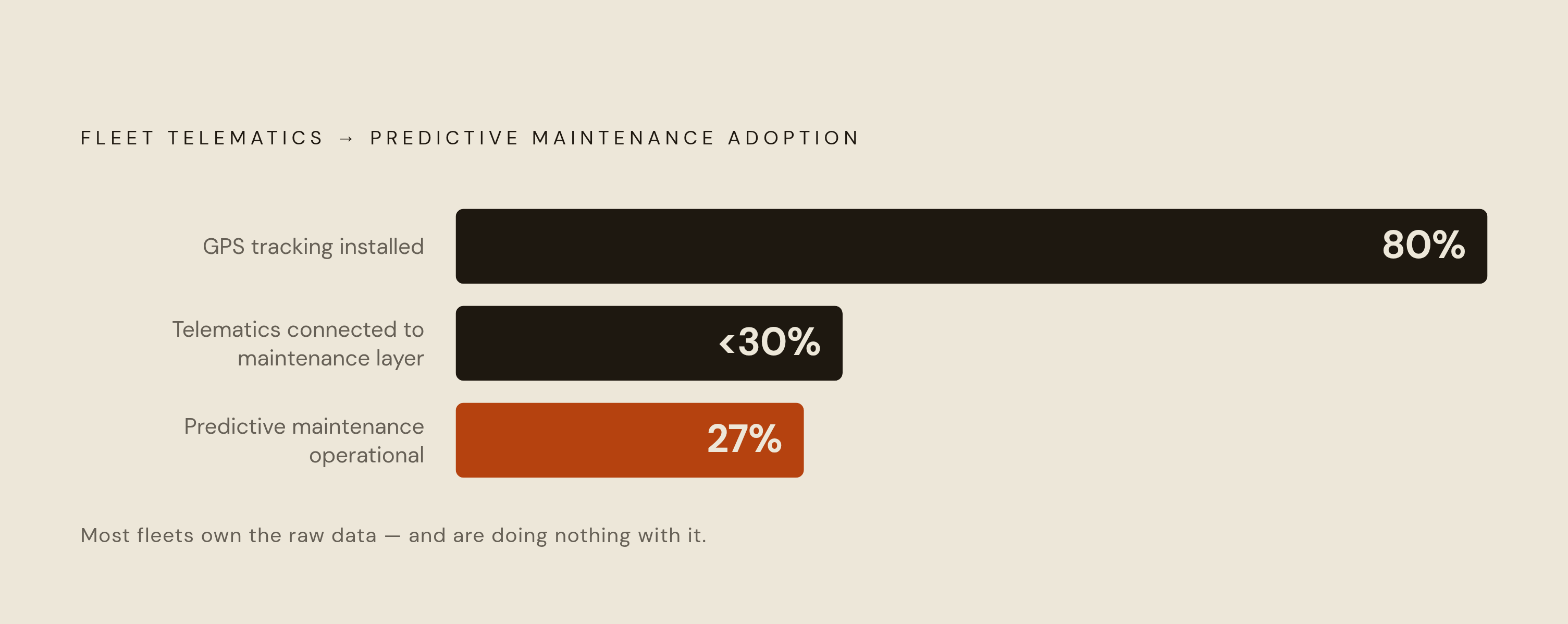
Start with the cost of doing nothing differently. A roadside breakdown runs $450 to $760 in direct repair costs; add towing, lost productivity, and driver downtime, and the total climbs substantially higher. Reactive maintenance (the kind that happens after a part fails rather than before) costs significantly more than planned repairs, and yet 80% of fleets already have GPS tracking installed. Only 27% have turned that data pipeline into an operating predictive maintenance program. Most fleets are sitting on the raw material and doing nothing with it, which is a bit like buying an espresso machine and drinking instant coffee next to it every morning.
What telematics systems actually capture and where that data comes from
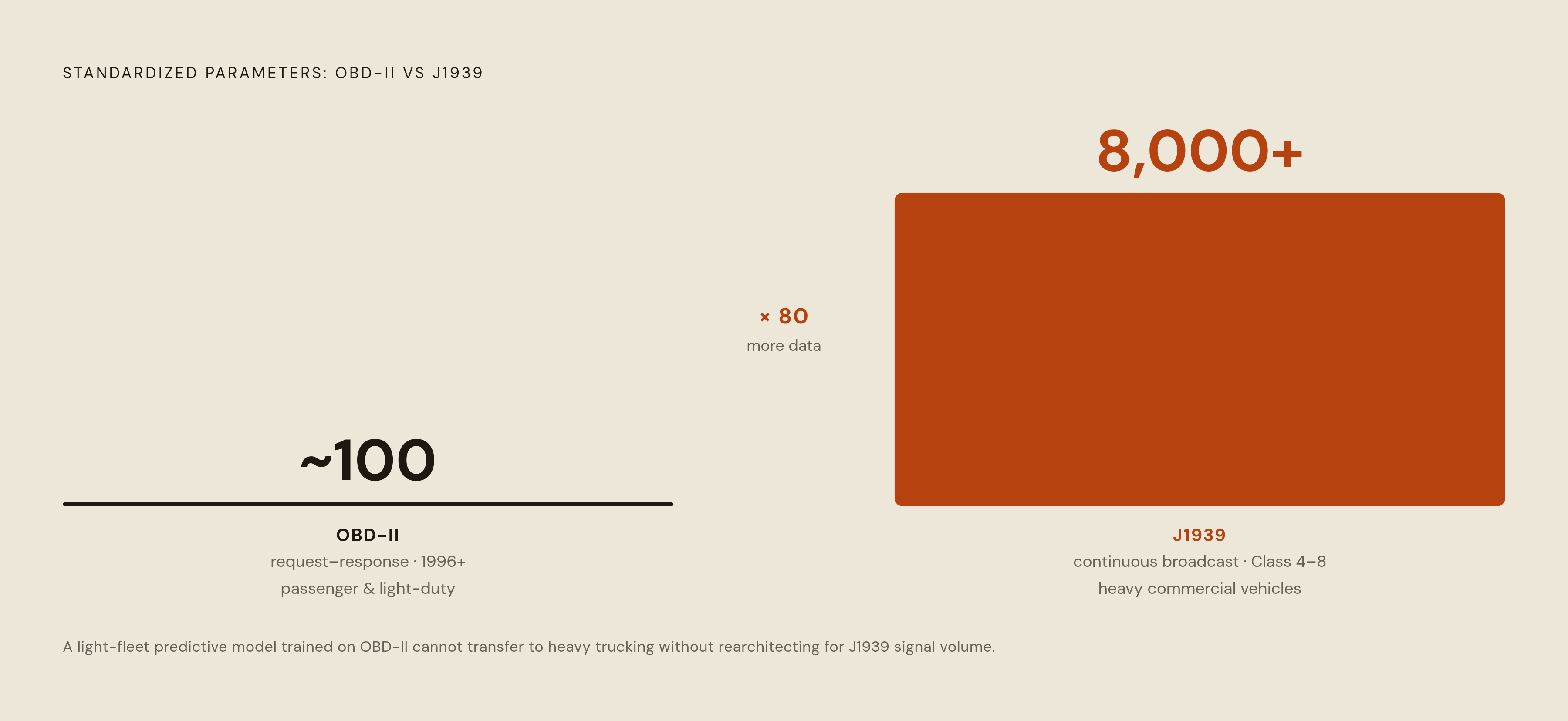
Two standards govern what a vehicle is willing to tell you, and they're not remotely equivalent.
OBD-II has been mandatory on every US passenger car and light-duty truck since 1996. It was built for emissions compliance, not predictive maintenance, and it works on a request-response basis: something asks, the vehicle answers. It exposes roughly 100 standardized parameters. J1939, the SAE standard governing every Class 4-8 commercial vehicle, works differently. It broadcasts continuously across the vehicle's network, and it exposes over 8,000 standardized parameters, about 80 times the data volume of OBD-II. That gap isn't a rounding error, and a cargo van and a Class 8 semi-truck are not equivalent data sources. A predictive maintenance approach built around a light-duty fleet doesn't transfer cleanly to heavy commercial trucking, since the vocabulary, data rate, and everything else differ.
What actually gets captured across these protocols: RPM, coolant temperature, oil pressure, transmission performance, Diagnostic Trouble Codes, vibration patterns, exhaust temperature, fuel trim corrections, diesel particulate filter (DPF) soot levels, and battery voltage. By 2026, over 90% of newly manufactured vehicles are expected to ship with embedded telematics hardware, meaning diagnostic data increasingly comes standard rather than requiring an aftermarket dongle plugged into the OBD port.
A protocol shift is coming that platform buyers should have on their radar. Starting in 2027, new engine-powered vehicles must comply with OBDonUDS (formally SAE J1979-2), the successor to conventional OBD-II. Telematics platforms will need to adapt to read it, and that's worth asking about now rather than after the transition hits.
None of this data does anything on its own. A raw sensor stream is not a maintenance signal; it's an input sitting there waiting for someone, or something, to interpret it.
How predictive models turn sensor streams into failure forecasts
The core move predictive models make is comparing behavior across time rather than reading a single snapshot. One elevated coolant temperature reading, on its own, is just noise. It could be a hot day, or it could be traffic. But a slow, steady rise in coolant temperature paired with declining fuel efficiency on the same routes over several weeks: that's a pattern, and patterns are what these models are built to catch. Rising exhaust temperature combined with a fuel efficiency drop on consistent routes can point to injector or turbocharger stress weeks before any Diagnostic Trouble Code would ever fire.
Machine learning models built for this compare a vehicle's current behavior against its own historical baseline, and separately against fleet-wide norms for similar vehicles running similar duty cycles. No single reading triggers an alert on its own; it's the correlation of several parameters drifting in the same direction at the same time that generates a prediction.
The accuracy numbers, drawn from vendor and industry benchmarks, land in a fairly consistent range: 85% to 95% accuracy predicting major component failures, with risk surfacing 20 to 45 days ahead of when a traditional diagnostic would raise the alarm. Some sources put the figure above 90% accuracy, 2 to 4 weeks out. Industry analysts, including coverage in the Gartner Market Guide for Vehicle Fleet Telematics, have named predictive maintenance as the primary value driver behind telematics platform investment now, which says something on its own: GPS tracking used to be the headline feature, and it no longer is.
How much of this transfers out of the box? Not as much as vendors would like to admit. Duty cycles, load variation, and road conditions differ enough between fleets that a model trained on generic data underperforms a model calibrated to a specific fleet's actual operating profile. Off-the-shelf accuracy claims deserve a follow-up question: accurate for whom, running what routes, hauling what loads?
The signals that actually predict failures (and the ones that mislead)
Some signals are worth building a program around, while others will burn trust in the system before it has a chance to prove itself.
Battery voltage drift sits near the top of the reliable list. It's one of the most consistent leading indicators of an oncoming roadside electrical failure, and fleets that build predictive alerts around battery voltage, coolant temperature, and DPF soot levels together can meaningfully cut roadside breakdowns. DPF soot accumulation builds gradually and shows up in sensor data long before a regeneration failure strands a truck, giving a scheduling window measured in days to weeks rather than hours. Fuel trim deviations catch injector wear as the fuel system quietly compensates, before combustion efficiency visibly drops. And transmission fluid temperature spikes on routes a vehicle runs regularly point to clutch pack wear or a cooling system starting to fail.
Diagnostic Trouble Codes matter, but mostly as confirmation rather than early warning. By the time a DTC fires, the analog sensor drift that preceded it has usually already been visible for a while. The actual advantage sits in watching that pre-DTC drift, not in waiting for the code.
Where operators get burned: treating a single-parameter threshold as gospel without checking the trend behind it. A high coolant reading on a 95-degree day in July is not the same finding as a coolant baseline that's crept up steadily over 30 days, and a system that can't tell the difference will flood a maintenance team with alerts that don't mean anything. This is alert fatigue, and it kills programs fast; once a maintenance team stops trusting the flags, they revert to the schedule-based approach the whole program was supposed to replace. GPS location data and driver behavior scoring are useful for other things (routing, safety coaching, insurance), but they are not maintenance data, and fewer than 30% of fleets have actually connected their telematics stream to a maintenance intelligence layer at all. When the signal combinations are read correctly, systems can predict failures 3 to 8 weeks out and prevent as much as 85% of what would otherwise become an emergency repair.
The action layer: what it takes to convert an alert into a prevented breakdown
Here's where most predictive maintenance programs actually die, not in the modeling, but in what happens after the model is right.
A fault code sitting in a dashboard nobody checks has the exact same practical value as no fault code at all. An elevated parameter trend routed to a team with no authority to pull a vehicle from service accomplishes nothing except generating a paper trail for an incident that already happened. The real discipline, the thing that separates a program that works from a pilot that quietly dies, is an automated trigger: when a threshold gets crossed, a work order fires directly into the CMMS (computerized maintenance management system) without a person having to notice, interpret, and manually forward anything.
That requires the telematics platform and the CMMS or FMIS (fleet maintenance information system) to actually talk to each other, automatically, not through someone exporting a spreadsheet every Friday. It also requires clear ownership: who receives the alert, who has the authority to pull a vehicle off a route, and what happens when a driver pushes back on a restriction they think is unnecessary. Condition-based triggers layered on top of the standard time-based PM schedule matter too, so an elevated transmission fluid temperature restricts a vehicle from heavy-load routes regardless of where it sits on the mileage calendar. And the layer benefits from real-time fault transmission while the vehicle is still out on its route, which lets a mechanic start diagnosing before the truck even pulls back into the yard, a workflow change that compresses diagnostic time meaningfully.
Over-the-air updates round out the action layer. Not every fix needs a bay and a wrench; some calibration and component-level issues can be pushed remotely, which trims the number of software-addressable problems that ever require a shop visit at all.
Worth sitting with for a second: fleets that already have GPS tracking but haven't wired it into a maintenance workflow are one integration project away from this whole capability. The barrier isn't hardware. It's process, ownership, and systems architecture, which is a less exciting problem to solve but a solvable one.
What predictive maintenance programs actually cost and what they return
Start with the honest number, not the flattering one. Platform licensing costs vary by provider and fleet size, but the fees alone — before integration work, staff training, or the process redesign that has to happen alongside the software — represent a real line item. The platform fee is the floor, not the ceiling.
Against that: industry data points to meaningful maintenance cost reductions from predictive programs, with unplanned downtime falling substantially as well. Top-performing fleets report meaningful per-vehicle annual maintenance savings, with heavy trucks generating larger returns than medium-duty units. Fleet managers who have deployed these programs report direct downtime reductions in their own operations, a reasonably strong showing given how many technology rollouts produce shrugs instead of results.
The case-level numbers give the abstractions some shape. Larger fleet deployments have demonstrated that percentage-point reductions in maintenance costs and downtime can translate into seven-figure annual savings at scale. Smaller fleets have also reported significant first-year maintenance spend reductions after operationalizing predictive programs. Government fleet deployments have reported meaningful annual maintenance cost reductions as well, a benchmark worth noting precisely because public-sector results are not vendor-handpicked customer stories.
The ROI math depends on duty cycle intensity, what the fleet's baseline maintenance costs looked like before the program started, and, circling back to the section before this one, how completely the action layer actually got built. A fleet that buys the platform, watches the dashboard light up, and never closes the loop between alert and work order will land well below every benchmark listed here. The software doesn't do the work. It tells you where the work is.
How the predictive maintenance market is maturing and what that means for platform selection
The market numbers suggest this stopped being an experiment a while ago. Predictive maintenance for vehicles was valued at $4.66 billion in 2024, and Global Market Insights projects that reaching $23.39 billion by 2034, a 17.5% compound annual growth rate. The AI-specific slice within fleet telematics sat around $3.8 billion in 2024, projected to climb to roughly $14.2 billion by 2032 at an 18.4% CAGR. North America alone was around $2.1 billion in 2024, growing at 16.8% through 2033, which points to a market where the competition for platform dominance is heating up rather than settling down.
Here's what that competition looks like in practice: telematics vendors, CMMS providers, and OEM data feeds are converging into single platforms, and point solutions that only handle one piece of the chain (data capture, say, without work order generation) are getting squeezed out by end-to-end offerings.
For a fleet manager actually shopping, the evaluation checklist comes down to a few concrete questions. Does the platform handle J1939 for heavy commercial vehicles, or only OBD-II? How deep is the CMMS integration, native or bolted on through an API, and how much of the alert-to-work-order flow is actually automated versus manual? Can a maintenance manager see why the model generated a particular prediction, or is it a black box that says "trust us"? Is the platform ready for the OBDonUDS transition landing in 2027, or will that require a hardware retrofit down the line? And does the platform's pricing and design actually fit a mid-market fleet running 20 to 100 vehicles, or was it built for enterprise scale and merely priced down for smaller buyers?
One more number worth sitting with: 65% of fleets plan to adopt AI-driven maintenance tools by 2026, but only 27% are operational today. That gap is closing, and whatever competitive edge exists in being early to this is not going to last indefinitely.
Building a predictive maintenance program that actually operates in practice
Most programs stall for the same reason: someone bought the technology and skipped the process change. The hardware gets installed, the dashboard goes live, and then nobody actually owns the alert queue. No CMMS integration exists, and the system dutifully collects data that nobody acts on.
A sequence that avoids the common failure modes looks something like this. Start narrow: DPF, battery voltage, and coolant system, the components with both high predictability and high cost-of-failure, where an alert has an obvious, immediate action attached to it. Build a baseline health profile for each vehicle before tuning alert thresholds; the default settings a vendor ships are calibrated for nobody's specific fleet and will generate more noise than most operations can tolerate. Wire the alert-to-work-order path before the system goes live, not after; if a mechanic still has to manually check a dashboard to find out a truck needs attention, the program has already failed, it just hasn't announced it yet. Decide, in writing, who has the authority to pull a vehicle from service and under what specific conditions, because that organizational question turns out to be harder to resolve than any of the technical ones. Review the false-positive rate every month too, adjusting thresholds as needed; calibration isn't a launch-day task, it's ongoing maintenance for the maintenance system.
Measurement matters more than most rollouts treat it. Track unplanned downtime events, emergency repair costs, and mean time between failures, before the program starts and after. Without that baseline, there's no way to make the ROI case to anyone holding the budget, and "trust me, it's working" convinces nobody who controls a checkbook.
The compounding effect is the part worth remembering after everything else in this piece fades. These models improve as they accumulate fleet-specific failure history, meaning a program's second year outperforms its first, and its third outperforms its second. The earlier a fleet starts feeding the model real data, the sooner that curve starts bending in its favor. Which raises the obvious question for any fleet still running on oil-change stickers and gut instinct: what exactly is the argument for waiting?