Fleet Electrification Route Planning Constraints
Real-world range, winter cold, and payload limits force fleets to rebuild routes entirely.
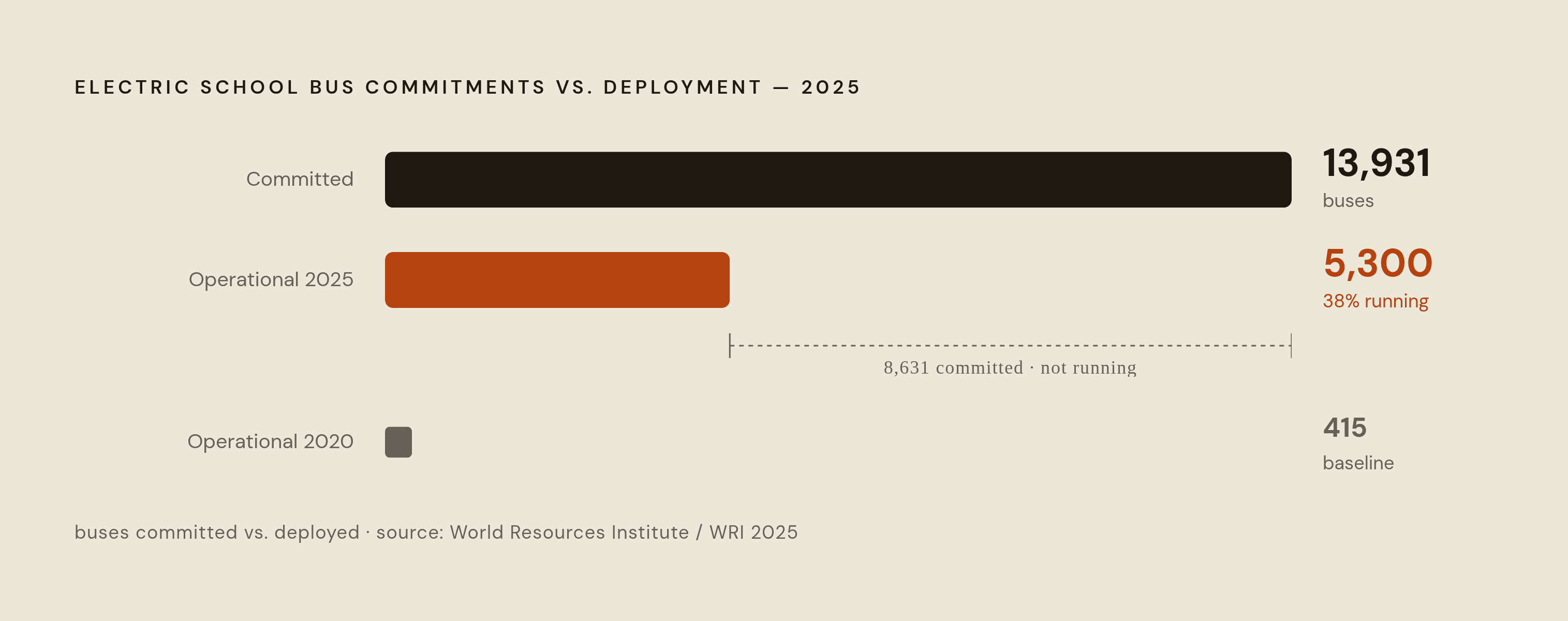
Fleet electrification presents six distinct problems at once: range shrinks under real conditions, cold hits range and charging speed at the same time, payload limits fight battery weight, and grid infrastructure takes longer to build than trucks take to arrive. As of 2025, only 5,300 electric school buses are operational out of 13,931 committed, according to Driivz data, up from 415 operational units in 2020. That gap between commitment and deployment (roughly 38% of committed buses actually running) is the whole subject of this piece.
A different scale shows the same pattern: FedEx running 8,000 EVs toward a stated 100% electric goal means a large operator with real capital and dedicated staff is still mid-transition years in. The constraint problem is arriving next quarter for most fleets, whether the spreadsheet says so or not.
How range actually behaves in commercial duty cycles, versus what specs promise
Rated range is a ceiling, and most planners overestimate how close to it they'll actually get. Terrain, payload, speed, and cold all eat into that number before a single mile gets driven, and the biggest thief is one engineers argue about in design reviews and planners ignore in dispatch: air resistance eats up to 65% of a heavy truck's energy at highway speed, which makes aerodynamics a routing variable, not a spec sheet footnote.
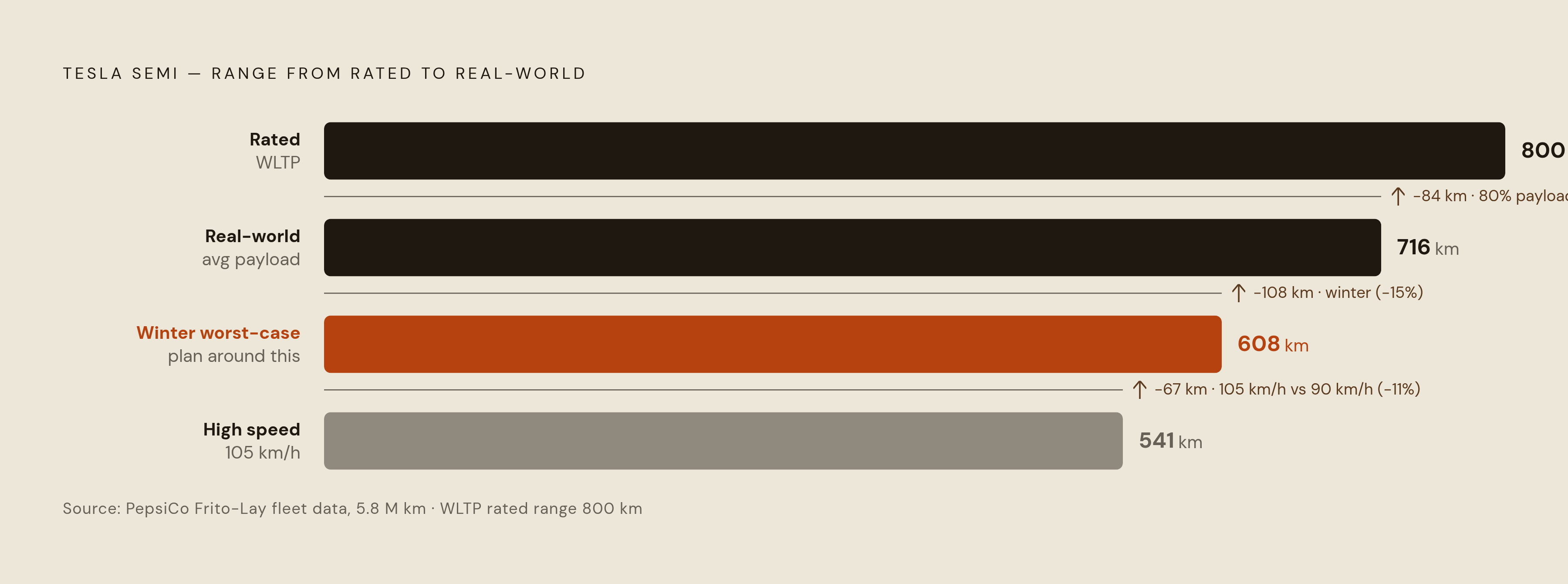
PepsiCo's Frito-Lay operation is the clearest real-world dataset around: 36 Tesla Semi trucks across two California facilities, over 5.8 million kilometers logged, payloads between 31,000 and 36,000 kg. Rated range (WLTP) is 800 km. Real-world average came in at 716 km at 80% payload. Winter dropped it further, to 608 km, a 15% seasonal cut stacked on top of the already-reduced baseline. Speed matters too: researchers documented an 11% efficiency penalty at 105 km/h versus 90 km/h, so a planner's choice of highway over back road affects the energy budget as much as the schedule.
Zoom out and the trend line looks encouraging: advertised range for zero-emission heavy trucks climbed from 180 miles in 2019 to 250 in 2021 to 300 by 2023. U.S. DOT data shows 80% of truck routes run under 100 miles a day, which sounds like most routes should already be safe territory. Here's the catch: that figure only holds if charging and temperature don't compound, and they routinely do, as the next section makes clear. Add battery degradation of roughly 2 to 3% range loss per year, and a truck well-matched to a route today may need reassignment in three or four years. Planners who build schedules off sticker range are building on sand. The only honest starting point is worst-case real-world range, sorted by payload class, speed profile, and season, not the number on the window sticker.
What cold weather does to range, charging time, and route feasibility simultaneously
Lithium-ion batteries like to live between 20°C and 25°C. Push outside that window in either direction and efficiency drops, but cold is the one that actually wrecks route plans. Range falls roughly 20% in mild cold and 40% or more below negative 20°C sustained, so cold-climate fleets need to plan around the worst winter week, not the annual average. That worst week is the day a truck gets stuck three miles short of the depot.
Cold doesn't just cost range on its own; it costs range, energy draw, and charging speed all at once, and the three compound fast. Picture a truck using 15% more energy while charging runs 30% slower: total time to charge for the same trip rises by roughly 50%. At 32°F, state of charge after 60 minutes of charging comes in around 36% lower than it would at 77°F. A depot schedule built around July numbers simply breaks in January.
Where does the extra energy go? Mostly cabin heating, which draws 3,000 to 5,000 watts against heated seats at around 75 watts (a gap that matters because it's an actual lever fleet buyers can pull at the procurement stage, long before the first cold snap). Trucks with heat pumps handle winter meaningfully better than ones stuck with resistive heating, which turns "does this have a heat pump" into a routing question and not just a comfort one. The main fix is battery preconditioning: warm the pack before departure while it's still plugged in, and the energy cost lands on the grid instead of draining the battery to do the job itself. A single seasonal plan filed away and forgotten won't hold up here. Cold-climate fleets often need seasonal shift restructuring, added mid-day charging stops, or route reassignment come winter, and the map needs updating as conditions shift.
How payload weight interacts with battery mass to constrain what a route can carry
Battery packs are heavy, and every pound of battery competes with freight for the same gross vehicle weight limit. On short-haul routes this rarely bites; the payload gap between electric and diesel stays small enough for most jobs. The constraint sharpens on long routes running full loads, where every kilogram of battery is a kilogram of cargo left sitting at the dock.
Regulators have tried to close that gap. U.S. federal law lets electric power units exceed standard weight limits by 2,000 pounds, up to a max gross vehicle weight of 82,000 pounds on federal highways. The EU goes further, granting electric trucks an extra 4 tonnes, which nudges European fleets toward a different vehicle mix than what shows up stateside. A statutory allowance means nothing, though, to a bridge rated below it, or a tunnel with its own limit written into local code. Route planning needs a weight audit by corridor, not a payload number pulled off a spec sheet, because the binding constraint might be a specific bridge three miles from the depot rather than anything in federal law. The upshot: an electric truck in the "same class" as its diesel predecessor doesn't necessarily carry the same cargo on every route that predecessor used to run.
The formalized structure of the electric vehicle routing problem and why it is computationally hard
Everything above (range variability, cold weather, weight limits) gets formalized in what researchers call the Electric Vehicle Routing Problem, or EVRP. It extends the classical Vehicle Routing Problem to include charging constraints, energy uncertainty, and time windows. The EVRP is NP-hard in the strong sense: no algorithm solves it exactly at fleet scale in reasonable time, full stop. Real deployments lean on heuristics and hybrid methods, because exact solutions for anything past a toy problem don't finish computing before the trucks need to leave the yard.
So what does the EVRP actually have to hold in its head at once? Depot constraints first: the count of vehicles leaving has to match the count coming back. Time windows second: each delivery has to land before the customer's deadline, and that math has to survive a charging stop getting inserted mid-route. Energy uncertainty is the trickiest piece, since real consumption shifts with load, speed, and weather; robust optimization builds around the worst plausible draw, because a plan built around the expected case fails exactly when conditions turn against it. Charging station capacity adds another layer: some research has handled networks with up to 320 customers by treating routing and charging capacity as linked but separable sub-problems. More recent research extends the EVRP further, incorporating soft time windows, partial recharging, and per-vehicle charging stop limits, reflecting how fleets actually run rather than some idealized always-full-battery world.
The formal version most software vendors build against, the EVRPTW, incorporates time windows and cargo capacity as linked constraints that researchers and toolmakers continue to refine. The takeaway for anyone running a fleet: a spreadsheet and a rule of thumb get you through the first ten routes and fall apart on the eleventh. The interactions are dense enough that real optimization needs purpose-built software treating energy uncertainty, time windows, and charging availability as one linked problem.
Why depot charging is the economic center of gravity for most fleets (and where it breaks)
Per NREL's fleet charging research, roughly 80% of a commercial fleet's total energy demand gets covered by depot charging during scheduled overnight or dwell periods. That number alone should settle where the infrastructure dollars go: the depot is the investment, by a wide margin, and everything else is a rounding error by comparison. The remaining 20% or so comes from en-route or public charging, functioning as backup capacity rather than a primary supply for most duty cycles.
Cost scales sharply by charging level. Commercial Level 2 chargers carry a substantially lower installed cost per port, which most fleets with long overnight dwell times absorb without much drama. DC fast charging is a different cost category entirely, running significantly higher per installed unit, which makes it a capital-committee decision, not a facilities line item. That expense earns its keep for fleets with tight duty cycles or vehicles that can't sit idle overnight, but it's a deliberate architectural choice worth weighing against its price, not an automatic upgrade.
Then there's the timeline nobody puts in the procurement schedule: interconnection, permitting, and transformer upgrades with the local utility routinely take well over a year, often longer than it takes the trucks to actually show up. Order the vehicles before locking down that utility timeline, and a fleet ends up with electric trucks parked next to a depot that can't charge them at scale. The Megawatt Charging System, positioned as long-haul trucking's answer to the range problem, on paper. In practice, MCS needs depot electrical infrastructure most existing facilities don't have yet. Depot charging is where the infrastructure constraint and the route constraint meet head-on: the charging window comes from the duty cycle, and the duty cycle comes from the routes. Plan one without the other, and the plan is only half-finished.
Demand charges as the infrastructure cost most fleet operators don't anticipate
Here's the mechanism that catches operators off guard almost every time: commercial utilities bill for two separate things, energy consumed in kWh and peak demand in kW, usually measured as the highest 15-minute average draw across the billing period. Several DC fast chargers all firing up at once during a shift change is exactly the kind of spike that drives that peak-demand number sharply upward, and it's the number nobody budgets for at procurement.
The effect isn't small. Demand charges can constitute a substantial share of the total electricity bill for fleets doing heavy fast-charging, and at that share, demand charges alone can wipe out the entire per-mile cost advantage that got the electrification project approved in the first place. The financial model stops holding up the moment the first utility bill actually arrives. Heavy vehicle batteries draw far more power while charging than light-duty EVs do, which makes load management a much bigger deal at depot scale than it ever is for a fleet of electric sedans.
Scheduling fixes more of this than added hardware does. Managed charging can meaningfully cut depot peak loads and reduce overall grid upgrade needs. Fleets running smart charging management report meaningful electricity cost reductions, plus better charger utilization, mostly by timing the same hardware better rather than buying more of it. Which loops straight back to route planning: the order vehicles return to the depot, how long they sit, how shifts get structured, all of it decides exactly when charging demand peaks. Route design and charging schedule are two halves of one decision. Treat demand charges as a facilities footnote instead of a design question, and the total cost of ownership on the spreadsheet will be wrong, consistently, in the same direction, every single time.
How all these constraints interact when planning an actual route network (and what systematic analysis requires)
None of these constraints sit in their own lane. A route that clears the range threshold at rated capacity in June can fail it outright in January, and a depot handling today's charging load without trouble can generate punishing demand charges once EV penetration climbs from the current low single digits toward a third or more of the fleet. So how does a planner hold all six of these in their head at once? Mostly, they don't, which is exactly why this keeps getting treated as six separate problems instead of one system with six moving parts.
Trace the chain. Real-world range, already knocked down from the spec sheet, sets the max distance before a charging stop becomes mandatory. Cold weather shrinks that max further, by 20 to 40% depending on severity, while stretching charging time by as much as 50% in the worst weeks. Payload and gross weight decide which vehicle class can run the route at all, independent of range entirely. Charging location and capacity decide whether a mid-route stop even fits inside the delivery window. Demand charges decide whether the charging plan survives contact with the actual utility bill. And the EVRP's computational complexity means none of this gets solved by a planner with a whiteboard and good intentions; it needs optimization tooling built for exactly this job, because the whiteboard runs out of room around constraint four.
What does responsible analysis actually look like before the first electric vehicle turns a wheel? Start with a telematics-based audit of existing routes (actual mileage, stop patterns, payload profiles, dwell times) instead of trusting the scheduled estimates sitting in a dispatch system from five years back. Segment the network by electrification readiness: routes viable today, routes that need infrastructure first, routes that need the duty cycle redesigned, routes not worth touching yet. Model the worst winter week, not the annual average, for any fleet running a climate where "sustained cold" is a real phrase and not a hypothetical. Co-design the charging schedule with the route plan itself, treating vehicle return sequencing and shift structure as inputs to the infrastructure spec, worked out before the chargers go in the ground. Finally, build a phased deployment plan that actually matches vehicle acquisition to infrastructure readiness, because the gap in school bus electrification (5,300 running out of 13,931 committed) is exactly what happens when acquisition and infrastructure get decoupled and left to catch up with each other on their own separate schedules.
The constraint map here isn't a checklist to clear once and file away. Vehicle mix keeps shifting, battery chemistry keeps improving, charging infrastructure keeps maturing, and the constraint binding six months from now won't be the one binding today. Bolting range onto an otherwise unchanged diesel routing model rarely survives contact with a real winter or a real utility bill. Planning tools that treat energy uncertainty, time windows, and charging availability as one linked system are what separate fleets closing the deployment gap from fleets watching it widen. This work has no finish line; it's an operating discipline a fleet either builds or doesn't.