Cold Chain Risk Assessment for Emerging Market Lanes
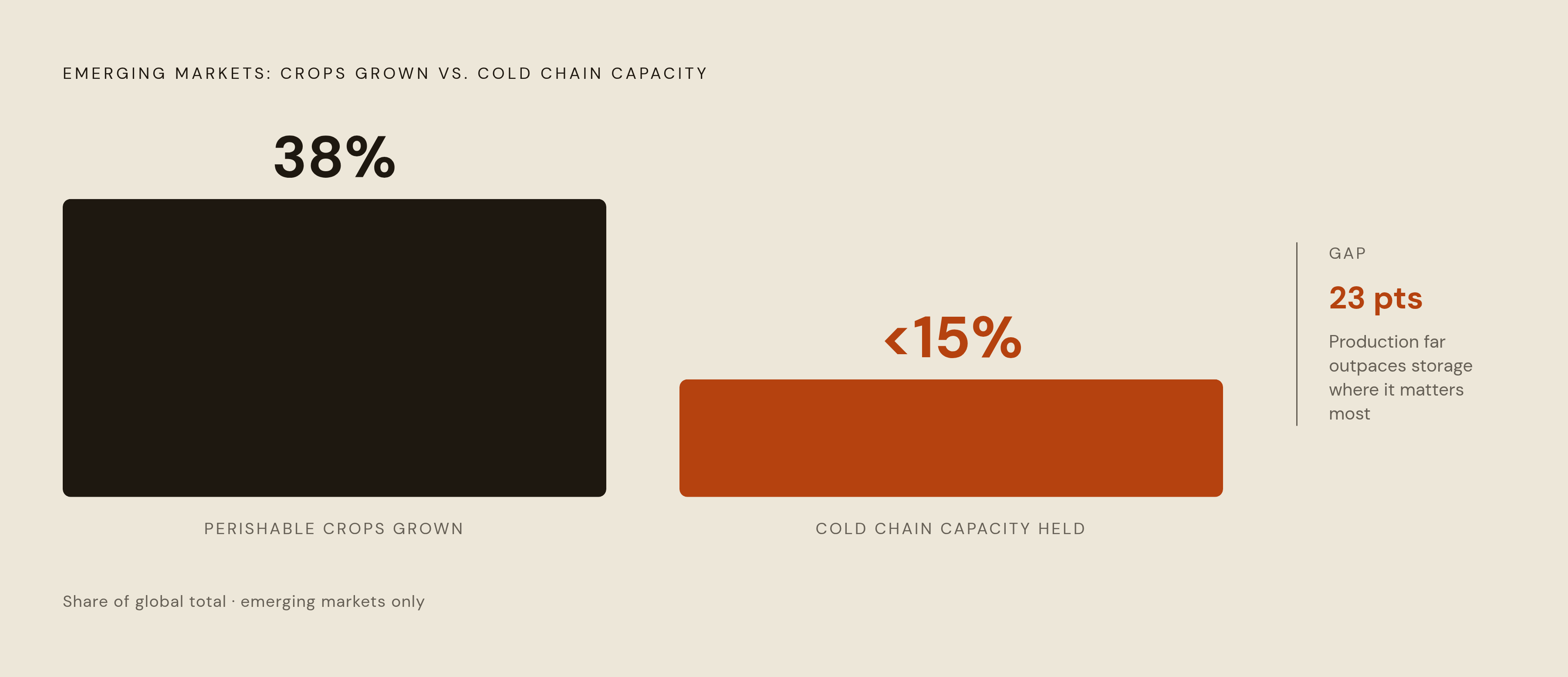
Emerging markets grow 38 percent of perishables but hold just 15 percent of cold storage capacity.
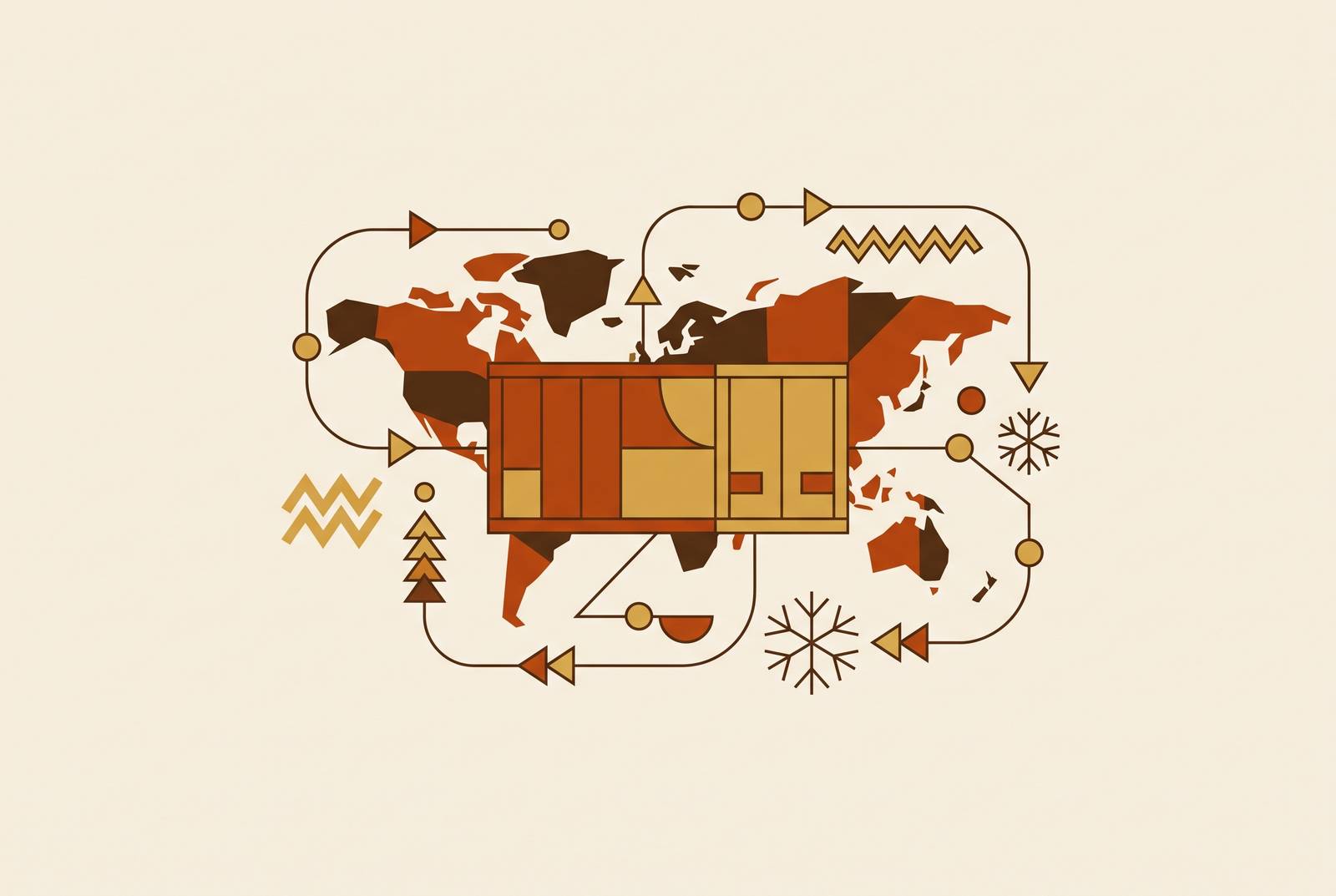
Multiple separate issues make up Cold chain risk across emerging markets. A handful of failure modes, weighted by route: cargo in ports, along border crossings, or within inland hubs. Treat them as one generic risk and shipments go missing. These economies hold under 15 percent of cold chain capacity worldwide, while growing roughly 38 percent of perishable crops. This gap, from where goods are made to where capacity for cold storage actually sits, affects each lane below.
Naming the error shippers keep making: using a single mitigation strategy for every country. A shipment routed via Singapore faces different risk than one sent through inland Vietnam, even with the same product, temperature band, and shipping company. After crops are picked, storage fails to hold nearly 40% of what India grows. That generic playbook won't prevent the damage. It simply absorbs that loss as overhead, one shipment at a time. Next up: a region-by-region rundown of where the risk really sits, plus a scorecard approach to pricing cargo before it leaves the dock.
The four risk categories that apply across every emerging market lane
Each lane, regardless of area, is measured against identical criteria, and the initial one shapes most of what comes next: infrastructure reliability. Is the power running? Is there enough cold storage for this route? When goods ship out, do refrigerated trucks actually wait nearby, or are they only on paper somewhere? Ignore this step and all other precautions are just decoration.
Regulatory complexity comes next. Import licensing, in-country distribution, plus documentation remain unharmonized in Latin America and Asia-Pacific, as well as Africa. Crossing a trio of markets in one lane, a shipper satisfies each of their rulebooks with no common thread.
Even items that look forgiving face environmental variables, a risk people often underestimated. Products held at 15 to 25°C, where temperature excursions may span 15°C to 30°C per USP (Ph. Eur. sets 15 to 25°C. Ph. Eur. and WHO guidance), can still degrade on the road unless packaging validated for that corridor is paired with monitoring that catches drift before goods spoil.
The last category: modal exposure at handoff, already seen as the weakest link. Temperature regulation stops working without warning when Cargo stays too long between transport methods at any port, rail ramp, air hub, or distribution dock. At those handoff points, dwell time is frequently that single variable deciding if the shipment survives.
Another category, cybersecurity, is now emerging rapidly. Inside every cold chain are IoT sensors plus monitoring gear, much as utility kit sits within power grids, and such connectivity opens one more route to disruption. A strike on monitoring could spoil product through a full lane, rather than a single shipment. For 2025 to 2026, the National Threat Assessment put out by Canadian Centre for Cyber Security's team covers ransomware hitting critical infrastructure, state-sponsored espionage, AI-amplified attacks, plus digital supply chain intrusions in a broad way, but never mentions temperature-sensitive routes specifically. Below, each regional lane is scored on these axes.
Sub-Saharan Africa: infrastructure deficit as the primary risk variable
A 2025 World Bank study finds that Sub-Saharan Africa's food storage capacity covers under 30% of annual production. This gap runs deep, and it shapes how any cold chain lane across the area must be planned.
Roughly 600 million people across the continent still lack grid access. Here, keeping goods cold without a backup power setup can't be assumed; a shipper must build that refrigeration safeguard in on purpose. Most sites use generators to cover that gap, and they do fine, but cold storage overhead rises meaningfully, an expense stacking at each multi-leg lane point.
Poor routes and light transport links delay all movement, while cross-border checks create more friction. Product spends extra time on the road, stretching dwell time and feeding into modal handoff risk noted above. Before picking a route, you must get infrastructure reliability scored for every lane crossing this area. Lanes without reliable power require redundancy from the start, rather than being bolted on once failure happens: backup supply, with passive packaging designed to extend thermal protection.
The 2026 Africa-Asia Intercontinental Cold Chain Summit will try to boost cross-regional funding and partnership until 2030. If these commitments become certified infrastructure in practice, capacity alongside standardization could improve meaningfully. For five-year lane work, Operators should treat it as one variable, not a fixed certainty.
India and Southeast Asia: uneven development within a single regional label
For pharmaceuticals, India's cold chain gaps appear starkly: temperature excursions destroy as many as 25% of all vaccines. This single point shows how India is the fastest-growing country in the pharmaceutical cold chain packaging segment. If you can't rely on that lane, packaging must compensate, so validated shippers shift from backup to your main protection.
Southeast Asia resists any single tag, since treating it that way is how many lane assessments fail. Few places on earth match Singapore for top-tier cold logistics. Other nearby ASEAN states lack capacity in cold storage and for last-mile distribution. Calling "Southeast Asia" one lane with one risk profile is an analytical mistake, plain and simple.
Don't group Monitoring failure with infrastructure. A Southeast Asian cold store saw roughly SGD 18,000 of frozen product spoil in a single night, since power held but the tracking setup did not. It's a failure of the whole system, and one generator on its own couldn't cure it.
Capacity spending across the area shows where things have actually gotten better. In April 2025, DHL Group dedicated EUR 500 million (roughly USD 520 million) to growing Asia-Pacific cold-chain infrastructure, taking over CRYOPDP and rolling out a string of Pharma Hubs that are GDP-certified throughout the area, fitting into a wider EUR 2 billion Health Logistics initiative under DHL going to 2030. LOTTE Global Logistics began building a cold-chain site worth USD 34 million during February 2025 at Dong Nai in Vietnam, adding GDP-certified rooms plus blast-freezing to handle seafood, hoping it starts by May of 2026. Lineage Logistics wrapped up its USD 4.4 billion IPO during 2024, then bought ColdPoint at USD 223 million, expanding the frozen-storage footprint throughout Southeast Asia plus adjacent markets.
Public budgets confirm where those gaps sit. In June 2025, the Philippines spent PHP 3 billion on 99 sites to address regional gaps across fisheries and produce. Indonesia's 2025 spending plan sets aside USD 7.1 billion to keep supplies safe, focusing on storage upgrades and logistics digitalization. On each APAC lane, separate the hub-adjacent routes with certified infrastructure in place or being built from routes that go beyond these hubs, where things are much more like that Africa case above.
Latin America: regulatory complexity layered over infrastructure variability
Cold chain logistics in Latin America hit USD 12.3 billion in 2025, a size that settled entry questions for most players before now. They've already arrived. Risk assessment has become a day-to-day necessity, not a choice about being there.
Each nation here sets its own licensing and import plus distribution requirements, so any lane crossing multiple boundaries must satisfy non-harmonized frameworks together, offering no shortcuts linking them. Customs is where regulatory friction hits most. When refrigerated cargo sits idle near a border crossing beyond what its packaging can take, a mere scheduling problem turns into a full temperature excursion. Here, modal handoff and regulatory risk collide.
Emergent Cold Latin America moved across Uruguay and Paraguay with cold storage and logistics facilities in each, a sign that maturity is developing in certain corridors. But such maturity doesn’t reach every place evenly, so each lane assessment must show where corridors actually include certified infrastructure while others still need work.
Climate brings something else to consider. Tropical humidity and high temperatures dominate Central America and upper South America. Altitude shifts and big temperature swings hit Andean routes. The ocean-side corridors cross dry, sandy land. Rather than one regional average, every route requires a separate environmental rating inside the lane assessment. In LATAM, regulatory know-how and strong in-country partnerships need to weigh for scoring as much as refrigeration gear. A lane scoring full marks for cold storage yet unable to pass customs predictably is still high-risk, period.
How rising ambient temperatures and climate variability add a cost multiplier to every lane score
Because of Rising ambient temperatures, operators now spend 12 to 15% more on machines in every tropical market just to build extra capacity. That expense recurs each time machinery is swapped out or a site expands, and never just once.
The market is already charging for it. Premiums for cold chain facilities in climate-vulnerable regions rose 35% over the past three years, and that tells risk assessors something worth acting on: the market has already started pricing the trajectory forward, so lane scoring should do the same instead of treating today's ambient temperature as a fixed number.
A lane that clears today's risk threshold by a comfortable margin might not clear it in three to five years without upgrades. We face a real planning-horizon challenge, far from hypothetical. Across Africa, plus some APAC markets alongside Latin America, it's already the day-to-day fact behind today's 12 to 15% gear cost.
As ambient temperatures go up, Passive packaging matters more since dwell times shrink while it gets hotter outside. Insulated shippers already make up roughly half the cold chain packaging market by product type, and that segment is under direct pressure to hold thermal protection across longer stretches of exposure than it was originally built for.
Where technology strengthens the risk assessment and where it introduces new exposure
Cold chain monitoring spending hit USD 8.31 billion in 2025, with the market expected to climb to USD 15.04 billion by 2030, working out to a 12.6% each-year increase, MarketsandMarkets reports. Spending that much confirms real-time monitoring is increasingly adopted, not limited to high-value cargo.
An analysis of 97 peer-reviewed studies from 2010 to 2025 saw quick rises in the use of IoT plus AI in cold chain work, pushed by rules from regulatory bodies and buyers wanting transparency. The change under way is a shift from recording breakdown after it occurs to seeing it ahead of time. A business could only prove each shipment kept the temperature band after arrival. When a pharmaceutical shipment stalls in warm weather, predictive monitoring calculates the thermal protection remaining inside passive packaging before being spent, and can trigger action while time remains.
Let's be blunt here: tech has yet to fix that handoff problem. Rail ramps, air cargo hubs, and distribution docks remain the sector's weakest links, and tracking numbers at these sites only helps if action kicks in before the goods are compromised. Information with no trigger for responding amounts to one better-documented failure.
Digitalization works both ways. More linked tools create more weak points for break-ins, and a cyber event disrupting monitoring may spoil product as much as equipment failure. A lane risk assessment must weigh cybersecurity posture against infrastructure every time, not something tacked on as an afterthought. Another quieter issue sits below this: several companies on one single lane use varied IoT tools, GPS services, storage sites, and ERP apps, and they may not connect. Silos form right where you need visibility most. A real lane assessment asks if that monitoring stack actually connects all the way. Checking that sensors are sitting in place somewhere falls short.
Building a lane-by-lane risk scorecard: the variables and their sequencing
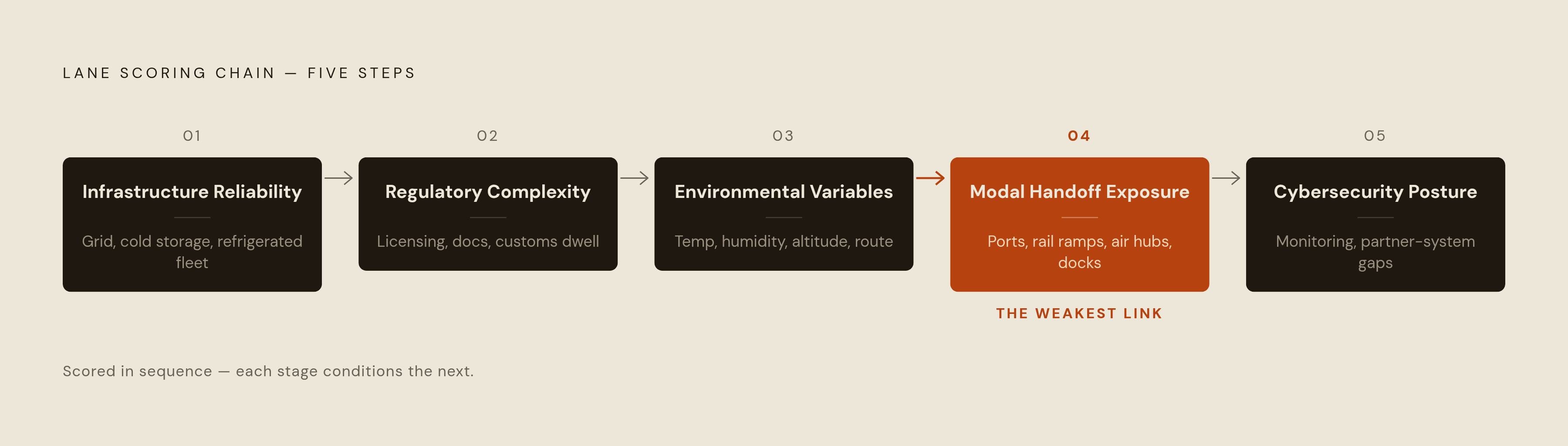
Keep your scorecard active, continually revisited, not shelved after one single review. It works as an ordered chain, each part setting up the one after: infrastructure reliability, regulatory complexity, environmental variables, exposure from modal handoff, and at the end, the stack with its cybersecurity posture.
To judge Infrastructure reliability, check power grid strength and whether backup is ready along the route, not only at both endpoints. This also covers cold storage depth and local certified sites at each point, and if refrigerated trucks or railcars can actually be found along that corridor when required, not merely theoretically running somewhere nationwide.
To score Regulatory complexity, add up the import licensing plus documentation required in each place the lane crosses, see how much area laws diverge from what regulatory standards expect the shipper to follow, and watch predictability of customs clearance. Use Average border crossing dwell time as the main temperature exposure metric, ahead of the transit-time metric.
Environmental scoring covers seasonal ambient temperature swings over the lane's full length, plus micro-climates tucked inside it: humidity in beach-adjacent corridors, hot air over sand crossings, Andean routes with high-altitude stretches. You must also factor in trajectory: is the lane's temperature profile staying flat, or instead trending closer to the price limit already seen across tropical markets?
Modal handoff mapping means scoring every place cargo switches transport modes (port, rail ramp, air hub, dock distribution) against average dwell time, temperature-controlled staging, and past excursion records. At these points, monitoring must trigger action instead of only logging the past.
The closing step is the cybersecurity review: confirming monitoring operates end to end along the full lane instead of at scattered checkpoints, testing the monitoring stack to see if it actually integrates every partner's systems or shows holes at handoffs, and scoring the cybersecurity posture of every monitoring and control system the lane's partner chain touches.
The result: a lane risk profile, giving a rating per category and a plain view of where the biggest-priority exposure sits. No generic checklist here. A lane-tailored record that drives contingency planning and packaging choices for that route.
Contingency planning as a product of the risk scorecard, not a separate exercise
Each scored risk category points to its own contingency plan, and making them outside a scorecard defeats using that scorecard altogether.
Poor infrastructure raises risk, demanding passive packaging tested to keep thermal protection during outages the assessment marked as realistic, with backup cold storage set up at every node on the path. Regulatory risk means documentation pre-cleared before shipment, in-country teams who can run customs brokerage on their own, plus contingency routing set to skip those highest-dwell border crossings if delays seem likely.
Serious environmental risk means scheduling shipments by season when you can, while validating packaging for each corridor's worst recorded temperature rather than the average. When handoff risk is severe, it means arranging early staging at spots flagged as trouble points, setting calibrated real-time alerts to trigger right there, and getting protocols settled with all parties before instead of leaving them improvised. Serious cybersecurity risk calls on redundant monitoring, with offline logging so the temperature trail stays intact when connectivity fails, plus a plan for how any spoilage is noted and shared.
It all falls apart without those executing the plan locally. Experienced on-site staff actually hold cargo to cGMP plus GDP standards each shift, and contingency setup must hand them clear escalation routes they can trigger on the spot, not hold for sign-off from central hubs an ocean apart. When a scorecard identifies risk accurately yet leaves the next step in a guide nobody's read, it changes nothing. That only records the trouble more exactly.