Vehicle Load Optimization and Route Planning Integration
Doing load and route planning together, not separately, cuts fuel waste and fills trucks better.
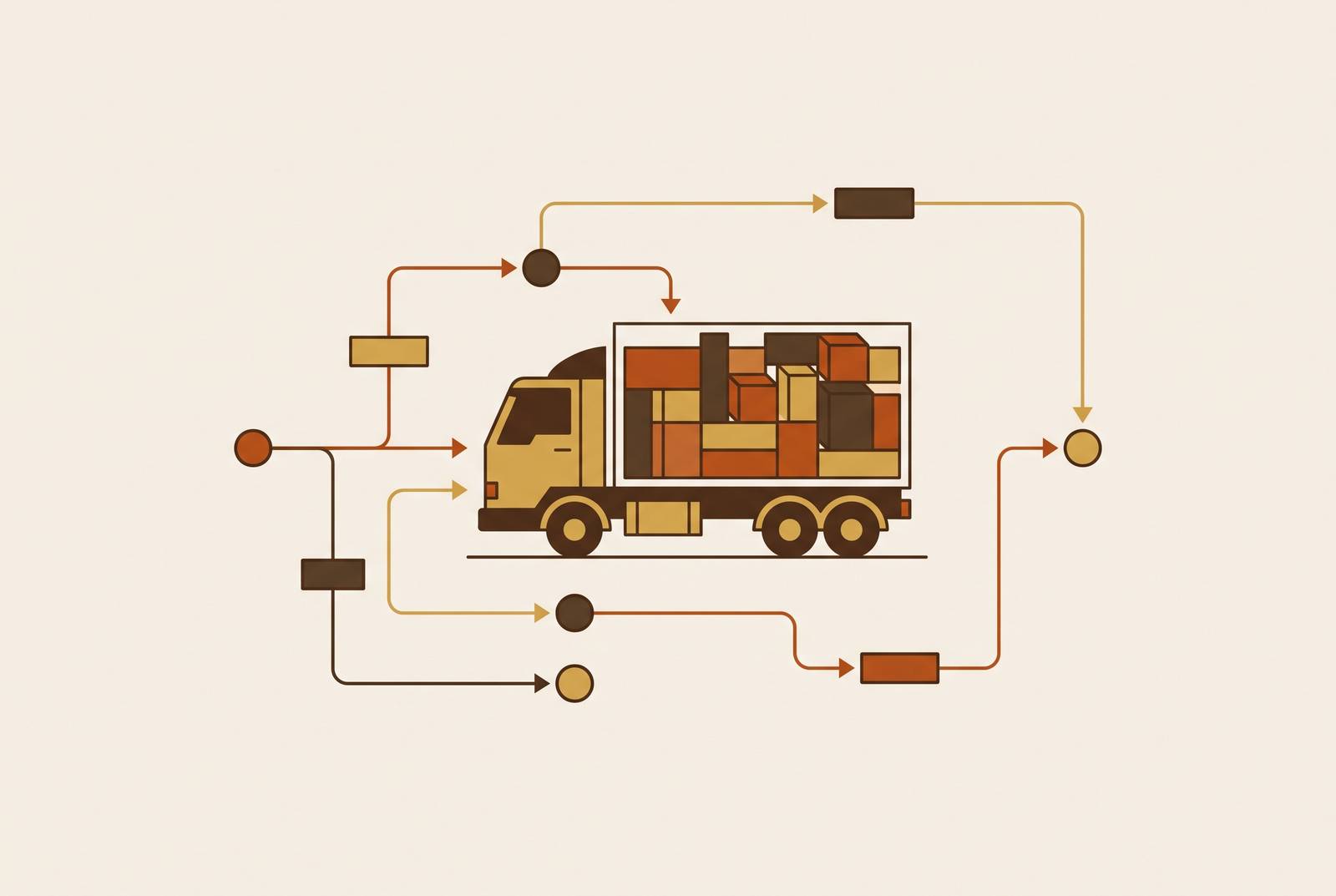
For years, fleets split load optimization and route planning into two tasks, assigned to two different workers, passed along one after the other. The problem lies in that handoff, because a truck's route affects its ideal load, and its load affects the roads it can use. Most fleets do it the wrong way. Fleets prioritize load optimization before route planning, ignoring the fact that the truck still needs to travel after being loaded.
Normally, planners load a truck with whatever fits and send it to a routing system that assumes capacity can't change. But capacity changes. Its capacity changes with its destination, permitted routes, and the number of deliveries before refilling. Axle weight reveals the problem. The trailer’s load placement sets braking distance and road-load compliance, so it controls which bridges and restricted zones the truck can enter. That's a routing constraint caused by a loading decision, and clever routing can't fix it once the truck's been packed wrong.
Locus research showed truckload underutilization went up from 43% to 58% in one year. A single weak link breaking wouldn't cause such a sharp rise. The structure broke down, and doing the load before the route might be the reason. The job done first sets a limit the other must follow, even if that limit no longer fits once the truck is on the road.
What each discipline demands from the other
Before a wheel turns, loading strictly limits routing. Weight limits set which roads, bridges, and low overpasses a truck can use. Axle-weight distribution is another constraint: a truck's total weight can be legal, yet still exceed axle limits if the cargo is poorly placed, so route planners must know the weight and its distribution. The order of deliveries and the order of loading must match, too. If the first pallet loaded is the last to be delivered, someone will either have to rearrange the cargo mid-route or face an unnecessary delay. Stop order involves more than just measuring the distance between map points. It's a loading constraint, disguised as a GPS coordinate.
Cargo stability complicates things further. When cargo isn't stable during transit, it damages goods, pallets, and sometimes the people unloading them; the route's sharp turns or steep grades are directly linked to the initial weight stacking. Skip the terrain, and a load plan that seemed safe on paper becomes dangerous by the second exit ramp.
Routing resists just as strongly. Delivery time windows limit the number of stops a vehicle can make, affecting which load combinations are feasible. Driver hours-of-service rules put a ceiling on how long a route can run, which sets a ceiling on how many consolidated loads make sense before a second truck has to get involved. Road restrictions, low-emission zones, weight-restricted streets, and urban access rules entirely remove certain vehicle types from some areas, so vehicle selection and load assignment must be tied to route selection, even if a planner prefers otherwise. A sudden traffic snarl or blocked road can reshuffle stops on the fly, wrecking a load plan tied to an order that’s already gone.
Priority cargo is in every part of it. Its accessibility, without unloading what's on top, determines both its spot in the truck and its place in the stop sequence. A plan that arranges the load without the route, or plans the route without the load layout, is undone by real-world limits once the truck leaves the yard.
The mathematics of solving load and route as one problem
Integrated planning is officially called the capacitated vehicle routing problem with three-dimensional loading constraints, or 3L-CVRP. It's NP-hard, which means the possible ways to order stops and place cargo increase faster than any brute-force computer can handle at real fleet scale. It's no criticism of the math. This occurs when discrete choices, like the next stop, mix with continuous ones, such as a box’s exact 3D position, all within one optimization goal.
The field relies on heuristics, metaheuristics, and machine-learning approximations instead of exact solvers, because an exact solver would take too long, finishing after next quarter's freight has shipped. A precise solution might come too late for the delivery window, so "good enough, fast enough" isn't settling for less here. It's the only kind of correct that counts when a truck's due at a dock at 6 a.m.
The toolkit contains several familiar categories. Classical VRP solvers and Dijkstra's algorithm manage the basic task of navigating route maps. Genetic algorithms, including improved IGA versions, explore the joint routing-and-packing space by repeating steps, not brute force, like natural selection, to find a good answer. A residual space optimized (RSO) strategy tackles 3D packing by using the remaining empty space in a trailer to inform each new placement decision, much like a game of cargo Tetris where each piece alters the board's shape. A 2025 study from May combined RSO and IGA to cut miles driven and fill trailers better in one go, not two.
Reinforcement learning tweaks routes in real time based on current traffic, learning from actual road conditions instead of relying on engineers to update the rules. Some newer models avoid the optimization step entirely: after training on sample problems, they produce a solution straight away, giving up some theoretical accuracy for faster results. Neural column generation, shown at IJCAI 2024, applied this method to VRP issues with two-dimensional loading and last-in-first-out rules, meaning the last box in must be the first out.
A 2025 study in Transportation Science addressed routing and loading together for preowned car shipping, viewing them as a single goal instead of separate steps. The math has long been unified. Most fleets still use tools based on the old sequential approach and haven't kept pace.
Where integration breaks down in practice, and what it costs
Awareness isn't the issue. Locus research showed that 39% of logistics groups see route and load optimization as a key challenge, but 96% of multi-stop truckload shipping users are still unhappy with their routing software. Recognizing an issue isn't the same as having a solution, and the industry mostly accepts this reality.
The balance sheet reveals inefficiency in fuel costs. In 2024, fuel made up $0.481 of the $2.260 average trucking cost per mile, says the 2025 American Transportation Research Institute report. Use a truck too big for a light load and the fuel cost adds up, because each unused kilogram still takes energy to move, even if it’s not carrying anything.
Load-route misalignment hits hardest in last-mile delivery: stops are tightly spaced, delivery windows are narrow, and vehicle size must fit access limits cities impose on their streets. Across the EU, things look even grimmer. In the EU, road freight vehicles traveled 21.6% of their total distance empty, according to Eurostat's 2024 data. Empty running isn't just wasted diesel. It's a cost problem and a regulatory exposure riding in the same truck.
Fleets’ tools for tackling this issue are outdated too. Surveys in 2025 showed that a large share of transportation firms still depended heavily on manual work. Lots of spreadsheets stand between the load dock and highway, but none of them ever rerouted a truck around a closed bridge.
How modern platforms bring load and route planning into a single workflow
Route optimization pays off only if it connects to the full system, TMS, WMS, order tools, telematics, driver apps, via open APIs, so both load and route data come from the same place instead of being fixed later by hand. For example, Locus's routing engine applies over 250 constraints simultaneously, factoring in vehicle and load, driver availability, service commitments, time windows, road restrictions, and updates active routes instantly when conditions change.
It’s real-time data that gives that recalibration its value. Real-time traffic updates allow systems to reorder stops during a route, but this only works if the load was initially packed to accommodate such changes. Otherwise resequencing just creates a new problem at the next stop. Telematics, weight sensors, and GPS pings flow directly into the planning system, linking the planned load to what’s actually on the road. IoT devices enable rapid recalculation, a pace a once-a-day static planning cycle cannot match.
Dispatch systems that auto-allocate work by where trucks are, how much they can still carry, and who’s free skip the human swap between load and route teams, the exact swap where most link-ups fail. Cloud-native deployment has also boosted adoption: NextBillion.ai found that in 2025, cloud-based platforms are expected to account for 72.4% of route optimization revenue, because with SaaS, updates to constraints, map refreshes, and algorithm tweaks reach all users automatically.
Telling a truly integrated platform from one that’s just well-promoted comes down to a few key questions. Can the routing engine process 3D load data as a constraint, or does it only show it visually? Do the API links to the WMS work both ways, letting the load manifest and route plan update together? When stops move, does re-optimization hold the load sequence? Systems that let dispatchers define the rules and then apply them to every new route are the ones bridging theory and day-to-day operations.
What integration produces, measured outcomes from fleets that have closed the gap
Businesses using integrated route optimization have reported reductions in mileage and fuel costs, along with improved fleet utilization. Companies using AI route optimization have reported reductions in transportation costs and fuel savings. The ranges overlap enough that they appear to be measuring the same effect, not unrelated phenomena.
Everyone in logistics talks about UPS's ORION system, and it's easy to see why. UPS's ORION system avoids heavy traffic and high-emission areas, and UPS's ORION system has reported savings of hundreds of millions of miles, tens of millions of gallons of fuel, and hundreds of millions of dollars annually. ORION's worth isn't in the number's size. Those savings weren’t just from better routes or better packing. They resulted from combining vehicle configuration, stop sequencing, and real road constraints into a single optimization target rather than handling them separately in three departments.
DHL's use of predictive maintenance shows a similar point from another perspective. DHL's use of machine learning in fleet monitoring has led to reductions in unscheduled downtime and maintenance costs. If maintenance data isn't connected to routing and loading systems, fleets risk losing efficiency gains.
The same pattern appears in every example: ORION, DHL, the 3L-CVRP research. You don’t get gains by improving just one part on its own. They are achieved by preventing the pieces from staying apart initially.
How to assess whether a fleet's planning process is truly integrated
The diagnostic question isn't "do we own route optimization software?" It's whether the routing system actually knows what's loaded, and whether the load plan actually knows where the truck is going. Just exporting data to a common spreadsheet doesn't make two tools an integrated system. They're just two tools sharing a folder, and sharing a folder has never kept a truck from going over an axle-weight limit on a bridge it shouldn’t cross.
A few signs point to the real thing. Load manifests and route plans are created together in one planning cycle, not passed between different systems. The routing engine accesses axle-weight and cargo-stability limits directly, not from the loading team's private notes. If a route changes suddenly, the system verifies the original load order still works instead of just assuming it does. Empty miles and utilization rates are measured together, not as separate stats kept by teams that don’t talk. A dispatcher's screen displays route progress and remaining vehicle capacity together, in a single view, not split between two tabs.
The warning signs point the other way. Load and route planners use separate systems, then manually reconcile discrepancies via email or, worse, spreadsheets. They choose the vehicle before confirming if it can handle the route. Stop-sequence changes mean either a manual reload or being ignored completely, since reloading mid-shift is a hassle. They look at fuel use and truck loads only after the run, not when they’re sending the trucks out, like reading the forecast once the rain’s already ruined the picnic.
Many fleets operate between fixed loads with fixed routes and dynamic routing with set load limits, and some confuse that middle ground with true integration. That's not it. That's the wrong place to stop, and it’s important to be clear: a fleet that stops there just has a quicker version of the same flawed handoff, not a solution. The real thing is fully joint load-route optimization with live recalibration that closes the loop in both directions, not routing that's gotten faster while the load plan sits frozen in the truck bed like it's still 1995.
Also, remember that fancy software alone won't make this work. Integrated outcomes from a platform with 250 configurable constraints require someone to actually define the fleet's real vehicle types, axle limits, time-window priorities, and service-level tiers before the algorithm ever runs. The algorithm doesn’t create the rules. It follows the rules it's given, so the real integration work begins with people using a whiteboard to map how the fleet really works, not a procurement contract line item.